The Vision turns Marvel Super Heroes spoiler into colorless Commander build
The Vision is already a Commander blueprint, not just a spoiler. A Workshop-style colorless shell may be the fastest way to turn the Marvel headliner into a real threat.
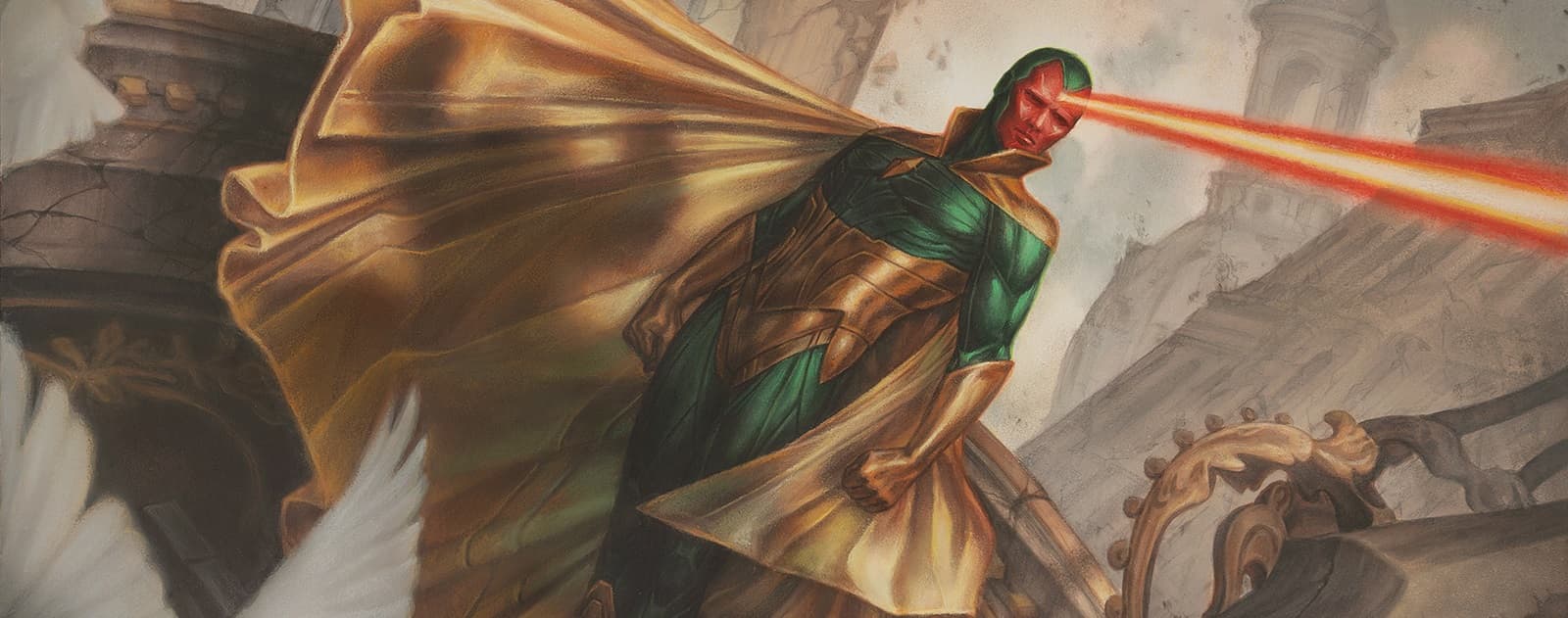
The Vision is the kind of spoiler that turns preview hype into a deckbuilding plan almost immediately. Wizards of the Coast has placed Magic: The Gathering | Marvel Super Heroes as a major Universes Beyond release in its 2026 lineup, with prerelease running June 19 to 25, 2026, and the full set releasing June 26, 2026. The preview prologue says the set includes multiple Commander decks, and Wizards singled out The Vision as the headliner for one of them, which is why this card already feels less like flavor and more like a real construction challenge.
A colorless commander that actually does something
The Vision is a legendary artifact creature, Robot Hero, with flying and vigilance, but the real draw is the triggered ability. Every time you cast a noncreature spell, you choose one mode that has not been chosen yet that turn, and the options are double strike, indestructible, and draw a card. That is a clean design for Commander because it gives you pressure, protection, and card flow from the same commander, and it scales naturally as you keep casting spells across a turn cycle.
In multiplayer, that matters more than it would in a one-on-one preview. A commander that can become lethal with double strike, survive the crackback with indestructible, and then reload with a card draw trigger gives you multiple lines every turn. It also means The Vision is not just a novelty colorless legend, it is a genuine build-around that rewards sequencing, resource management, and the ability to string together several noncreature spells in a turn.
Why the deck wants a Workshop-style mana base
EDHREC’s deck tech frames the list as a Mishra’s Workshop-style artifact shell, which is the right way to read the spoiler if you want it on the table early. The core idea is simple: if The Vision is the payoff, then the deck needs fast colorless mana and lands that behave like acceleration pieces instead of passive sources. EDHREC specifically points to Mishra’s Workshop, Planar Nexus, and the Urza lands as the backbone of that plan.
That approach makes the commander feel much closer to an explosive artifact strategy than to a typical “play good colorless stuff” pile. Mishra’s Workshop is the obvious dream card for powering out artifacts, Planar Nexus adds another powerful mana angle, and the Urza lands give the list the kind of burst that lets a deck jump ahead of schedule. The goal is to make The Vision matter before the table has settled, not after everyone else has already built a board.
What to prioritize first
If you are turning this spoiler into a playable Commander list, the first cards to chase are the ones that make the mana work. EDHREC makes that point bluntly, noting, “Notably, this can be used to cast The Vision way ahead of schedule!” That is the right lens for the build: get the commander down early, then let every noncreature spell turn on another mode.
- Start with the big mana lands first, especially Mishra’s Workshop, Planar Nexus, and the Urza lands.
- Add land tutors so you can assemble the right mana pieces instead of hoping to draw them naturally.
- Fill the rest of the ramp package with artifact acceleration so your deck can keep pace even when the perfect land draw does not show up.
- Keep enough cheap noncreature spells in the list to trigger The Vision consistently, because the ability only rewards you if you keep casting through the turn.
This is also where the price tag becomes part of the story. EDHREC’s own deck tech warns, “I wouldn’t advise looking at the price tag on this deck.” That line fits the build perfectly, because the version of The Vision that actually plays like the preview suggests is not a casual pickup pile. It is a power-mana project, and power-mana projects tend to cost real money.
The biggest build constraint is sequencing, not flavor
The Vision looks straightforward, but the deckbuilding puzzle is tighter than it first appears. The commander only checks noncreature spells, and each mode can be chosen only once per turn, so the list has to keep casting spells over time rather than trying to solve everything with one giant turn. That pushes the deck toward a disciplined artifact shell, where ramp, interaction, and card draw all have to coexist with the mana plan.
That is also why the Marvel Super Heroes preview matters beyond one card. Wizards used the MagicCon: Las Vegas panel to reveal The Vision as the commander main card for one of the new decks, and it also showed The Mind Stone, which reinforces that the set is seeding functional, buildable cards rather than only splashy references. The message is clear: this is a product line with actual Commander infrastructure, and The Vision is the clearest early sign of how serious that infrastructure can get.
For Commander players, that makes the next step obvious. The Vision is not waiting to become a deck after release, because the shell is already visible: load up on fast colorless mana, lean hard into artifact acceleration, and use the commander’s three modes to turn a Marvel spoiler into a real multiplayer threat. Once the prerelease window opens, the fastest path to a finished build is already on the table.
This article was produced by Prism’s automated news system from verified source data, official records, and press releases, then run through automated quality and moderation checks before publishing. The system is built and supervised by the people who set the standards it runs under. Read our full AI policy.
Did this article answer your question?