Ulasht, the Hate Seed turns token swarms into Commander threats
Ulasht still plays like a hidden Gruul bomb: token makers, counter doublers, and a documented combo turn a 2006 legend into a real Commander threat.
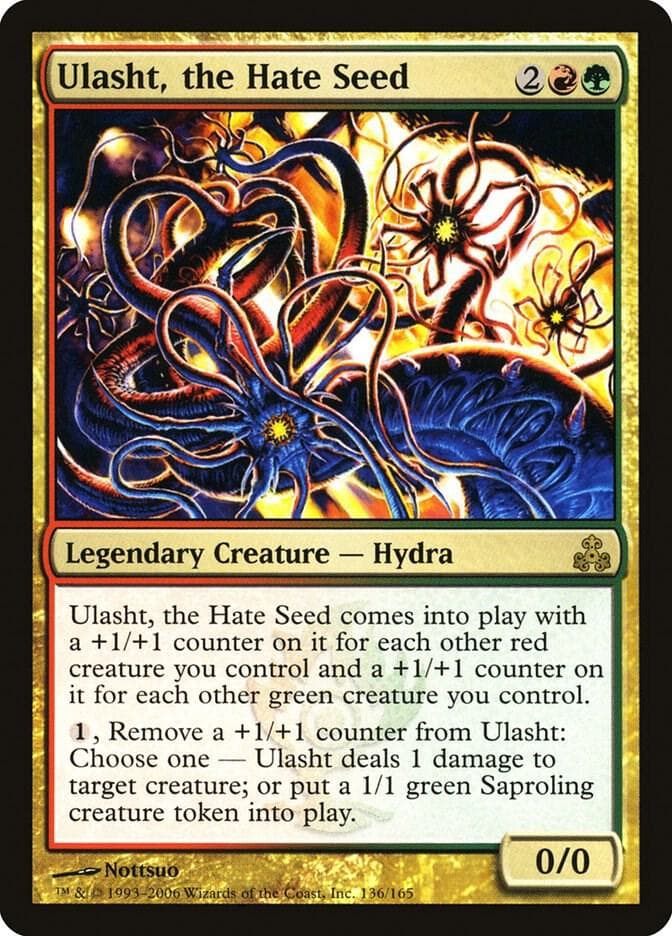
Ulasht, the Hate Seed still hits like a truck
Ulasht is the kind of Gruul commander that rewards you the moment the board gets crowded. Every red and green creature you deploy can turn it into a larger threat, and the right shell lets that power snowball from simple combat pressure into a real game-ending engine. What looks like an old Ravnica oddity becomes a modern Commander problem as soon as you start making tokens and cashing counters in.

A forgotten legend with real pedigree
Ulasht first appeared in Guildpact, which released on February 5, 2006, as the second set in the original Ravnica block. That matters because this is not a niche build-around invented for current design trends, it is a legend from an era when Commander was not yet an official Wizards product. The first preconstructed Commander decks did not release until June 17, 2011, which means Ulasht spent years as a regular rare before the format even existed in its current supported form.
The card’s Oracle text is deceptively straightforward. Ulasht enters with a +1/+1 counter for each other red creature you control and each other green creature you control, and its activated ability costs {1} and removes a +1/+1 counter to either deal 1 damage to target creature or create a 1/1 green Saproling token. That combination of scaling size, repeatable removal, and token production is exactly why the card still deserves a second look.
Why the board math gets out of hand so fast
Ulasht is at its best when the deck is built to flood the battlefield with red and green bodies. Token makers such as Dragon Broodmother and Avenger of Zendikar give the commander a fast and reliable way to enter with a pile of counters, which can turn it into a huge threat almost immediately. The important detail is that creatures that are both red and green give Ulasht two counters, not one, so multicolor token boards can inflate it faster than many players expect.
That makes Ulasht feel less like a fair value commander and more like a board-state tax. If you are presenting multiple creatures each turn, Ulasht does not just scale, it starts to dominate combat math. Once it is large enough, a single attack can represent lethal damage, and if combat is stalled, a payoff such as Chandra’s Ignition turns that size into a direct route to closing the game.
The activated ability is what gives the deck texture
A lot of commanders that care about counters stop at being giant threats. Ulasht goes further because each counter can be converted into a choice between removal and board development. Paying {1} to remove a counter and deal 1 damage to a creature gives the deck a way to pick off small utility creatures, while the Saproling mode keeps the token engine moving and feeds future counters.
That flexibility is what lets the deck play like more than just a stompy shell. You are not only trying to make Ulasht big, you are turning every spare counter into pressure, either by controlling the board or by adding another body to the table. In practice, that means the commander keeps contributing even after the first wave of token production has already happened.
Counter doublers push the deck from strong to absurd
Once the shell is established, cards like Hardened Scales and Doubling Season push the commander beyond ordinary combat math. These effects make each counter count for more, which means every token swarm and every activation becomes more dangerous than the last. Ulasht already rewards a board full of creatures, but with counter support in place, it starts to grow at a pace that demands an answer immediately.
This is also where the deck earns its reputation as a hidden build-around instead of a novelty pick. EDHREC’s 2017 Underdog’s Corner coverage and a 2022 Classic Commander piece both framed Ulasht as overlooked but viable, and that reads as more than nostalgia now. EDHREC currently tracks 765 Commander decks for Ulasht, tagged around +1/+1 counters, tokens, burn, and combo, which shows that the commander's appeal is still very real.
The combo line gives Ulasht a second way to win
The most compelling part of the deck is that it does not have to rely only on combat. EDH combo listings and Commander Spellbook verify a loop with Ulasht, Death’s Presence, and Utopia Mycon that becomes infinite once Ulasht has at least two +1/+1 counters on it. The result is infinite enters-the-battlefield, leaves-the-battlefield, death, and sacrifice triggers, which is exactly the kind of engine that can end a game even when combat is locked up.
That matters because it changes how the deck is built and how it plays. Ulasht stops being just a big threat and becomes a pseudo-aristocrats commander, one that can convert creature deaths and sacrifice loops into a win without ever needing to turn sideways. The loop also makes the deck resilient, because the combo line is not dependent on drawing one giant payoff spell and hoping the table is unprepared.
Backup pressure keeps the deck honest
The strongest Ulasht lists do not lean on one route to victory. Sacrifice outlets and damage payoffs give the deck additional angles, and combo databases list related Ulasht loops with Phyrexian Altar and Ashnod’s Altar. Add cards like Impact Tremors and Purphoros, God of the Forge, and suddenly every token creation step becomes damage even if the board never opens up for a clean attack.
That backup pressure is what makes the commander feel current rather than outdated. If the table can answer a giant attacker, you can still bury it under token triggers and sacrifice value. If the table can shut off combat, the deck can pivot into trigger-based kills. Ulasht works because it gives you a clean front door for damage and several back doors for closing the game.
Why this old Gruul legend still deserves attention
Ulasht fits the simplest Gruul philosophy: go big, go fast, and make the board impossible to ignore. The card rewards token production, scales with multicolor creature counts, and turns every counter into more than just power and toughness. That is a strong baseline on its own, and the documented combo with Death’s Presence and Utopia Mycon pushes it well past fair value.
For players who want a forgotten legend that still plays like a real Commander weapon, Ulasht offers the full package: combat threat, token engine, removal, and a documented infinite line. It is the rare old-school Ravnica commander that does not need nostalgia to justify its slot, because the shell around it still does exactly what modern Commander asks for.
This article was produced by Prism’s automated news system from verified source data, official records, and press releases, then run through automated quality and moderation checks before publishing. The system is built and supervised by the people who set the standards it runs under. Read our full AI policy.
Did this article answer your question?