Where optimized Commander ends and cEDH begins in Wizards’ new brackets
The line between Bracket 4 and cEDH is not a card-pile argument. It comes down to speed, tutors, mulligans, and whether your deck is built for a known meta.
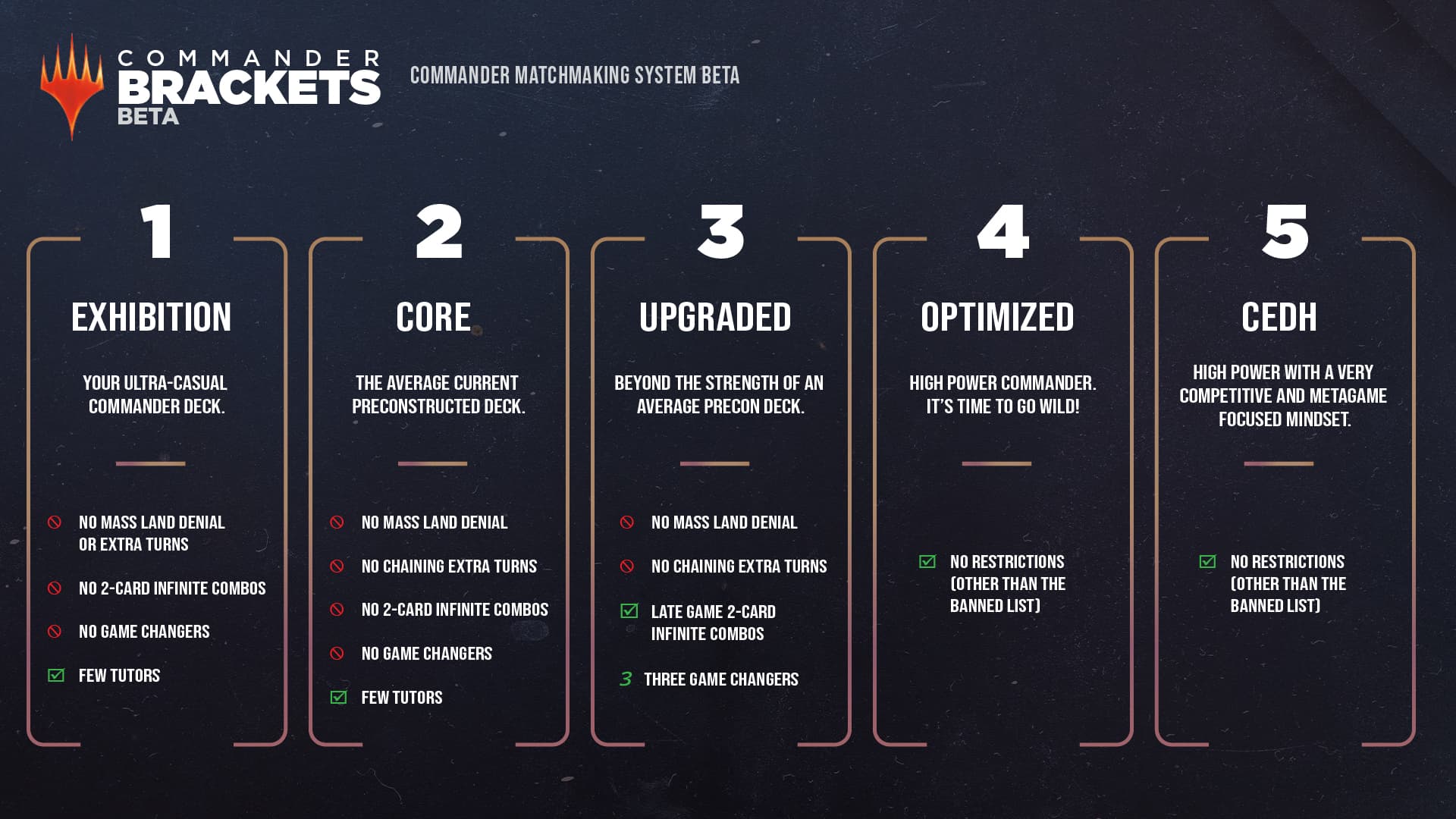
Wizards launched Commander Brackets beta on February 11, 2025 as a matchmaking system for Commander, not as a replacement for the social contract that already runs the format.
Why Wizards built the bracket language
The brackets are optional and meant to support pregame conversations. Wizards describes Bracket 5, or cEDH, as a “high power with a very competitive and metagame-focused mindset.” The system was updated on April 22, 2025, October 21, 2025, and February 9, 2026 as Wizards folded in feedback, event data, and input from the Commander Format Panel.
Wizards moved stewardship of the format away from the Commander Rules Committee in 2024 and formed the Commander Format Panel, a structure it said was inspired in part by the Pauper Format Panel. Before the brackets, players tried to compress “what kind of game is this?” into a rough 1-to-10 power scale that never really worked.
A practical checklist for calling Bracket 4 or cEDH
Bracket 4 is the optimized but still non-cEDH space, where the expectation is generally that games last several turns before someone wins or loses. cEDH is built to operate in a known metagame, and games can end on any turn.
Use this checklist at the table:
- Fast mana density: Ask how much of the deck’s early game is built around explosive acceleration. A Bracket 4 deck can be strong and efficient, but when the opening hand repeatedly produces cEDH-style acceleration, the game stops feeling like “optimized Commander” and starts looking like a race.
- Tutor volume: One tutor is a tool. A dense package of tutors turns the deck into a search engine. The more often the deck can turn one card into the exact next piece, the more it is acting like a metagame deck.
- Deterministic combo lines: Bracket 4 can contain strong synergies, but cEDH deck construction is usually centered on compact lines that end the game the same way every time once the pieces are assembled. If the deck is trying to assemble a deterministic win rather than just leverage value, you are moving toward cEDH.
- Mulligan behavior: In Bracket 4, players usually keep hands that set up a good game. In cEDH, you are often checking whether a hand can execute a plan, interact early, or threaten a win quickly. If your mulligans are shaped by combo assembly and turn-one or turn-two pressure, that is a competitive tell.
- Win-speed expectations: Moxfield labels Bracket 4 Optimized and generally expects it to play about four turns before someone wins or loses. cEDH does not promise that kind of runway. If your list is built assuming that the game can end immediately and you are fine with that, you are no longer in ordinary high-power territory.
What the meta really means here
Cas Hinds discusses meta as more than another word for powerful cards. In this context, it means a field of decks that are tuned to win quickly, generate overwhelming resources, and survive while every table is trying to do the same thing. That is why the same shell can feel casual in one pod and fully competitive in another, depending on whether it is built to fight the dominant metagame or simply packed with strong cards.
EDHREC’s five-bracket framing, Exhibition, Core, Upgraded, Optimized, and cEDH, gives players a useful map, but it does not solve the hardest question on its own. Moxfield’s bracket estimates are only an approximation, and the site says they cannot perfectly classify every deck. A deck can look off-meta or unconventional and still be built on cEDH principles, which means the label has to come from intent and play pattern, not just card choice.
Why the argument keeps happening at tables
Wizards says the system’s weak spot is that a deck can technically fit a lower bracket’s restrictions while still playing at a much higher power level. The October 21, 2025 update emphasized intent, not just deck composition. By that point, Wizards said that after three MagicCons and nine months of use, the brackets had been a success, with survey data showing that they helped players find games more easily and encouraged more pregame conversations than before.
How to use the system before shuffling up
The cleanest Rule 0 conversation now sounds less like a power-level argument and more like a calibration check. If someone says Bracket 4, you can ask whether the deck is tuned for explosive starts, heavy tutoring, or a deterministic finish. If someone says cEDH, you already know the expectations are faster, tighter, and built around a competitive field where any turn can be the last turn.
This article was produced by Prism’s automated news system from verified source data, official records, and press releases, then run through automated quality and moderation checks before publishing. The system is built and supervised by the people who set the standards it runs under. Read our full AI policy.
Know something we missed? Have a correction or additional information?
Submit a Tip%2Fcontent%2Fopengraph%2FMTG-Wakanda-Forever-Marvel-Super-Heroes-Commander-Upgrade-Guide-MSC.jpg&w=1920&q=75)