Words of Wind turns card draw into brutal Commander bounce value
Words of Wind looks fair until repeatable draw turns every cantrip into a table-wide bounce. In Commander, the right shell makes it a blunt tempo engine, not a cute old enchantment.
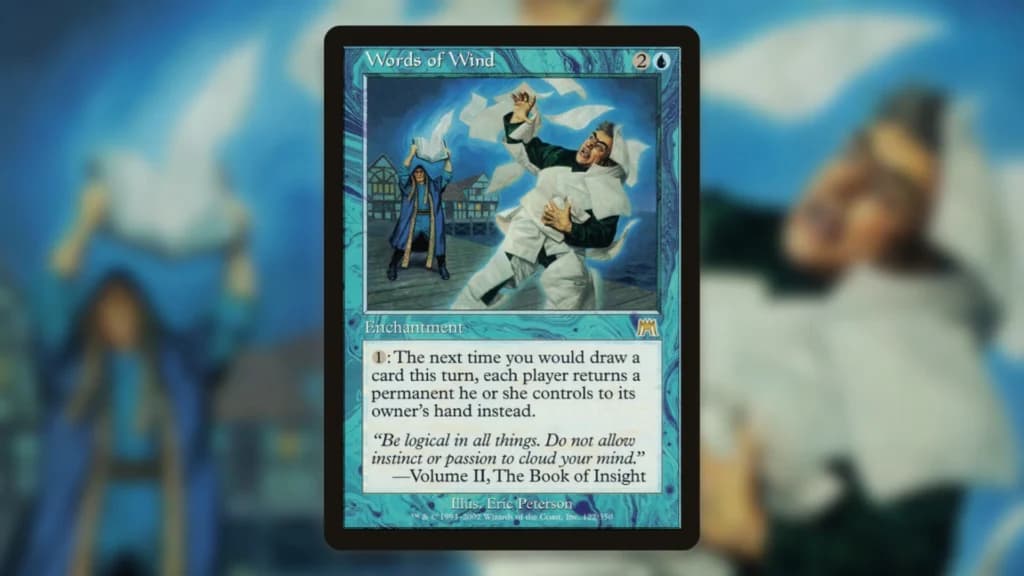
Words of Wind is the kind of old enchantment that slips past players until someone builds around it properly. Printed in Onslaught on October 4, 2004, it asks only for one mana to replace your next draw with a mass bounce trigger: “{1}: The next time you would draw a card this turn, each player returns a permanent they control to its owner’s hand instead.” That sounds symmetrical on paper, but Commander is exactly the format where symmetry gets cracked open.
Commander decks are 100-card singleton lists, players start at 40 life, and the official deckbuilding rule means no two cards can share the same English name except basic lands. That creates a format built around redundancy through roles, not exact duplicates, which is why a card like Words of Wind gets stronger when your deck can produce draw triggers, disposable permanents, and replay value over and over. Wizards of the Coast’s Commander Brackets beta, introduced in 2025 and updated again in 2026, adds another layer to that conversation by pushing deck builders to think more carefully about power level and how quickly a “value” card can become a game-warping engine.
How the card stops being symmetrical
The cleanest way to use Words of Wind is to make sure you are never paying one card to merely reset the table. Cheap draw spells are the starting point because they let you turn excess mana into immediate bounce pressure. Night’s Whisper and Demand Answers fit that job well, since they trigger Words of Wind without forcing you to give up your normal draw step for the turn.
From there, the card becomes much nastier when you stack in repeatable draw sources. Heartwood Storyteller and The One Ring can keep the machine running across turns, and in the case of The One Ring, the draw pressure can extend into opponents’ turns as well. That matters because Words of Wind does not care where the draw comes from, only that a draw is being replaced, so every extra trigger is another chance to ask each player to pick up a permanent.
The key is breaking parity. If you are bouncing your own board, the bounce has to help you more than it hurts you. That is where value artifacts and creatures come in. Ichor Wellspring and Hopeless Nightmare are ideal because they reward being recycled, while token makers give you permanents that are easier to spare than your real engines. Solemn Simulacrum and Wood Elves fit the same plan from a creature angle, because replaying them turns each bounce into extra land drops, extra mana, or extra cards instead of a setback.

The shells that abuse it best
Words of Wind gets especially ugly in decks that already want to replay permanents. Landfall shells are the clearest example. Extra land-drop effects like Exploration let you return your own lands, then redeploy them for more landfall triggers, turning what looks like a symmetrical bounce effect into a value loop that keeps feeding your board.
That same logic applies to token-heavy lists. If your board is full of tokens, or your nonland permanents are built to replace themselves, then the “each player returns a permanent” clause stops being a fair reset and starts being a filter. Your opponents lose mana development, blockers, or engines; you convert the same trigger into another landfall burst, another enters-the-battlefield trigger, or another artifact death payoff. In a 40-life format where games often hinge on incremental engines, that kind of tempo swing can decide a pod fast.
This is also why the card is showing up in real Commander numbers instead of just theory. EDHREC currently lists 4,492 Words of Wind decks, which is exactly what you would expect from a card that is not everywhere, but is clearly known to players who like squeeze-the-table engines. It is a niche piece, not an obscurity, and that middle ground is usually where Commander’s most dangerous tech lives.
Where the line gets crossed
The jump from clever value to oppressive lock is much shorter than it first appears. Once your deck can keep drawing, Words of Wind turns every extra card into another tempo hit, and enough repeatable triggers can leave the table unable to keep up with your bounce cycle. At that point, you are not just drawing cards and smoothing your hand. You are converting card flow into permanent denial.
The most explosive proof of that ceiling is the Wormfang Manta, Scroll of Fate, and Words of Wind line. Commander Spellbook and EDHREC both document it as an infinite-turns combo, and the setup is as mean as it sounds: Wormfang Manta in hand, Scroll of Fate and Words of Wind on the battlefield. That is the exact kind of package that shows why an enchantment like this deserves respect. It is not a nostalgic throwback. It is a combo enabler with enough built-in flexibility to serve as removal, tempo denial, and, in the right shell, a path to ending the game on the spot.
What to watch for at the table
Words of Wind asks one big question before it asks anything else: are you trying to create value, or are you trying to keep everyone else from playing Magic? In a casual pod, that distinction matters more than the card type suggests, especially under Commander’s Rule Zero expectations. The Commander Rules Committee updates the format roughly every three months if needed, and that ongoing maintenance reflects how often table experience matters as much as deck legality.
Once you start chaining repeatable draw, token production, and land replay together, Words of Wind stops being a forgotten enchantment and starts being a pressure valve that never lets the table stabilize. That is the real story here: the card does not need nostalgia to be relevant, because in the right Commander shell, it turns every draw into a bounce spell and every bounce spell into a problem.
This article was produced by Prism’s automated news system from verified source data, official records, and press releases, then run through automated quality and moderation checks before publishing. The system is built and supervised by the people who set the standards it runs under. Read our full AI policy.
Did this article answer your question?