Does magnet fishing require a license? It depends on local rules
A fishing license is not the whole story. Magnet fishing can hinge on park rules, salvage controls, and how your state defines the catch.

In Georgia, a 2020 magnet-fishing outing in the North Oconee River produced 30 guns over a few days. The first fear for beginners is simpler: getting stopped, cited, or ordered off the bank before the first throw. Magnet fishing often falls outside the ordinary fishing-license lane when you are only pulling metal from the water, but the rules change fast once a state, park, or property manager treats the activity as fishing, salvage, or archaeological recovery instead. Start with the place, then read the exact words the local authority uses.
Start with the law that controls the water
Magnet fishing is not governed by one universal rulebook. In some places, a fishing license is tied to catching or attempting to catch fish, while magnet fishing may sit outside that definition because the goal is metal recovery, not angling. Terms such as angling, fishing, salvage, retrieval, and extraction can carry different consequences.
Virginia makes the basic point clear. Its fishing-license rules require people who are required to have a license to carry it and show it immediately upon request. The same page frames licensing around fishing, trapping, and hunting.
If you are on Indiana Department of Natural Resources property
Indiana gives magnet fishers a concrete example of how local rules override assumptions. The Indiana Department of Natural Resources requires a permit to magnet fish on its properties, but the permits are free. The department also limits the activity to hand-carried magnets and does not allow motorized equipment.
Indiana DNR directs people who are not on DNR water to check with the relevant property manager or owner.
If the water is federal land or an archaeological site
Federal land is where the risk rises fastest. The U.S. National Park Service lists looting and vandalism of archaeological resources on federal lands as conduct that can be prosecuted as a felony under the Archaeological Resources Protection Act. Metal detecting and removing archaeological materials without a permit are also prohibited activities.
A magnet does not make a submerged object harmless. If the water is inside the National Park System, or if the bank feeds into an area with archaeological protections, your throw can shift from hobby outing to protected-resource issue in seconds. In those places, a park rule or federal permit matters far more than any ordinary fishing-license question.
If your state is still defining the hobby
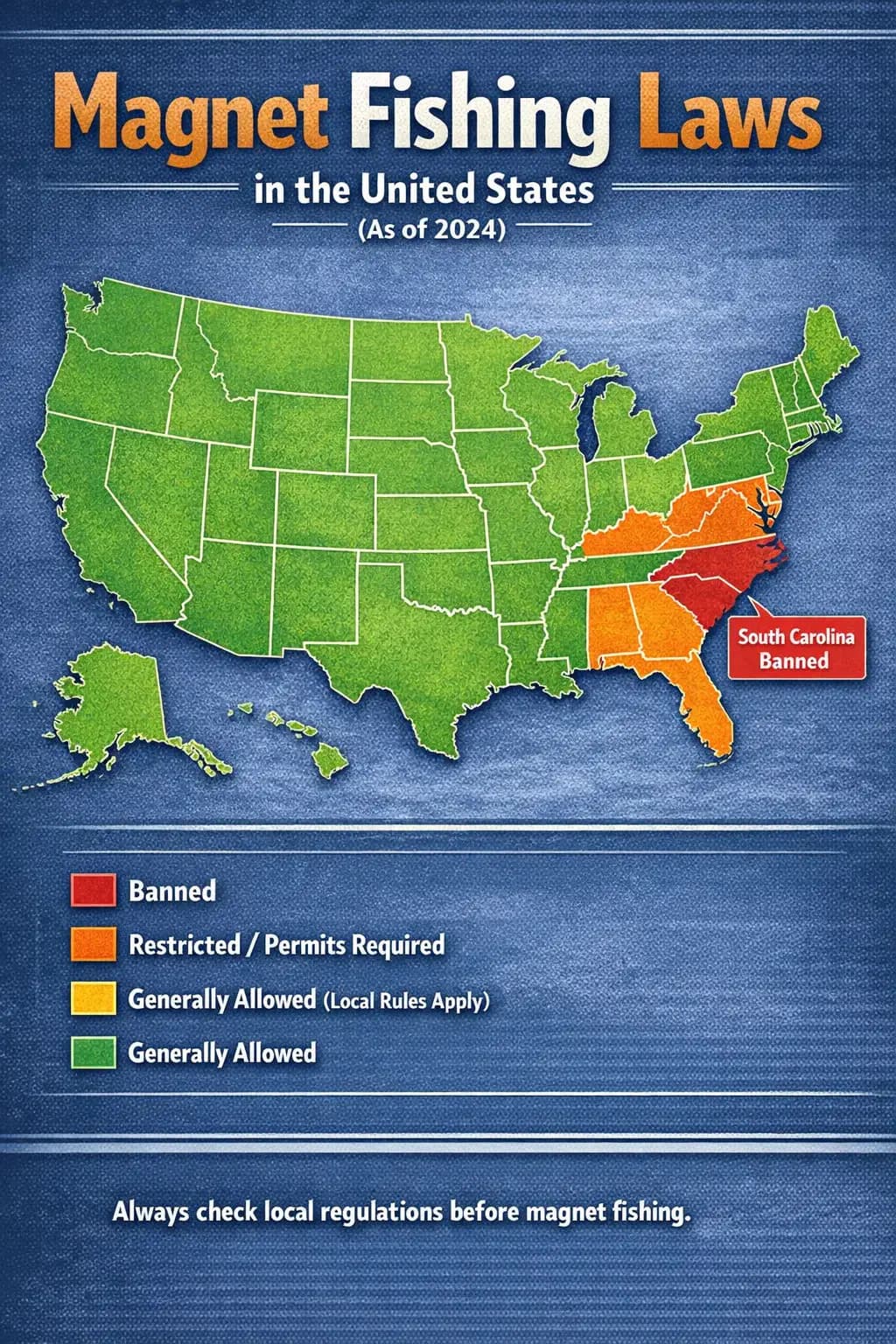
South Carolina shows how unsettled the classification can be. House Bill 4398 was introduced in the South Carolina General Assembly on April 23, 2025, and it would amend the state hobby-license law to permit the recovery of objects by magnet. Under the bill’s text, submerged artifacts and fossils could be recovered under a hobby license if obtained by hand or by magnet.
If you actually catch or disturb fish
The absence of a hook does not guarantee the absence of regulation. If a magnet fishing session actually hooks, disturbs, or retrieves fish, a fishing license may become relevant even if the original goal was metal recovery.
When the find changes the risk
Some finds are not just junk. In that Georgia case, the recovered guns were to be processed by Athens-Clarke County Police and Bureau of Alcohol, Tobacco, Firearms and Explosives agents to see whether they were tied to crimes.
A firearm, a cache of artifacts, or anything that looks linked to a crime scene is a different category entirely, and it can draw a response that has nothing to do with a fishing license.
A practical checklist before your first throw
Before you walk to the water, run through this checklist:
- Identify who controls the water, bank, or park.
- Read the exact rule words: fishing, angling, salvage, retrieval, extraction, or archaeology.
- Check whether a permit is required, as it is on Indiana DNR property.
- If a permit is required, confirm whether it is free and whether only hand-carried magnets are allowed.
- If you are on federal land, look for archaeological restrictions and permit rules before you cast.
- If the state license rules require licensed users to carry the license, keep it with you and ready to show.
- If you pull up a firearm, artifact, fossil, or anything that looks tied to a crime, stop and call the relevant authority.
This article was produced by Prism’s automated news system from verified source data, official records, and press releases, then run through automated quality and moderation checks before publishing. The system is built and supervised by the people who set the standards it runs under. Read our full AI policy.
Did this article answer your question?