Epomaker Glyph Blends Typewriter Aesthetics With Dual Displays and Wireless Features
Epomaker's $139 Glyph brings a physical carriage-return lever and dual displays to a 75% wireless board, but its round uniform-height keycaps block most aftermarket sets.
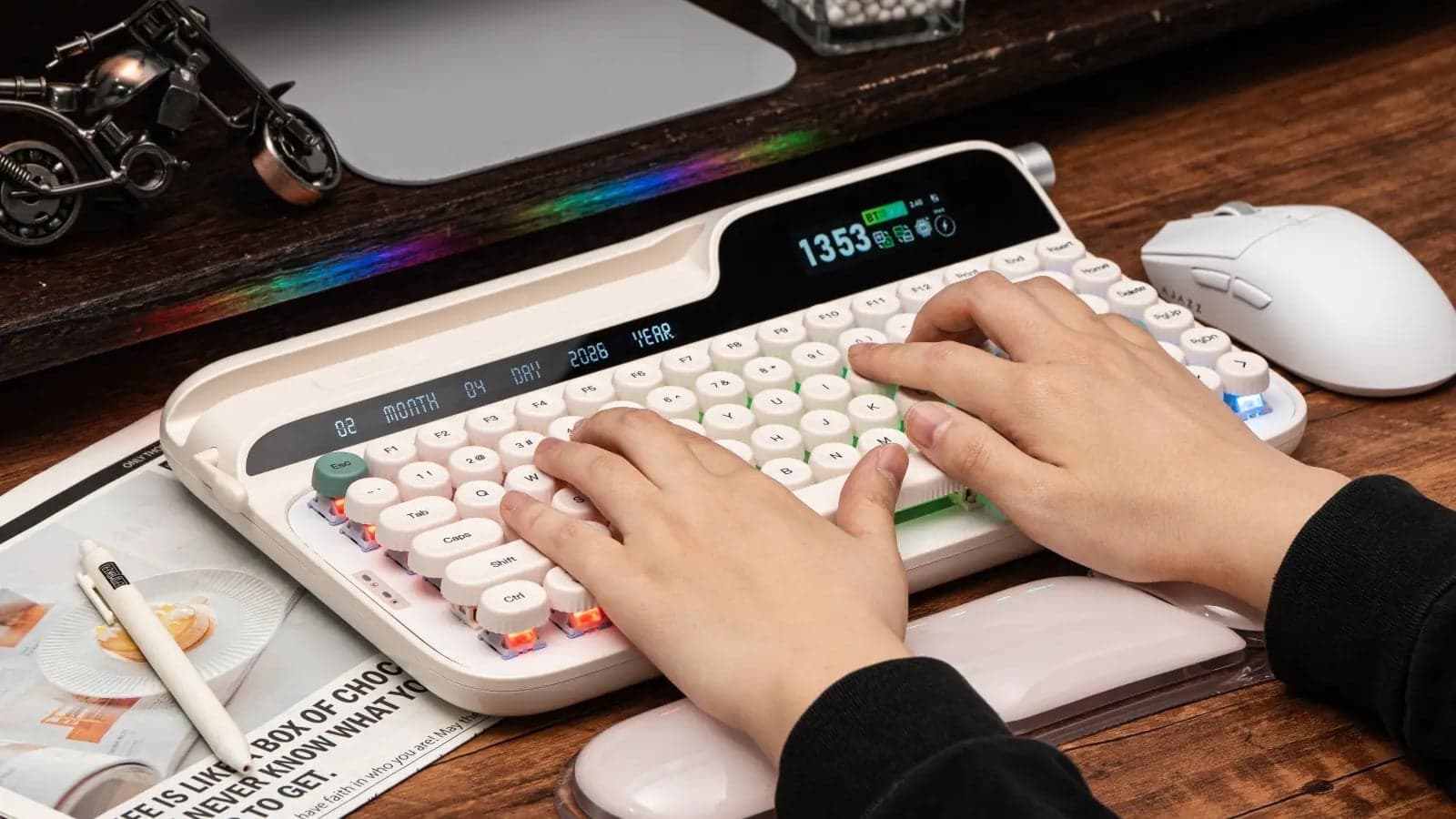
The Epomaker Glyph shipped at $139 with a mechanical side lever that pushes up to fire Enter and pulls down for Backspace, making it one of the few 75% keyboards on the market where a piece of moving hardware physically mimics a 1950s typewriter carriage return. That lever is the Glyph's most shared-screenshot feature, and the honest question is how much of its appeal survives the first week of actual use.
The short answer is: more than you'd expect, but with real caveats. The lever's inputs are fixed, Enter up and Backspace down, and the press release makes no mention of remapping it to, say, a macro trigger or layer switch. For writers who pound Enter and Backspace constantly, the ergonomics are plausible. For coders who barely touch those keys, it's décor. Anyone expecting the lever to function as a two-input macro pad will need to verify that capability hands-on rather than assuming it from the hardware's programmable appearance.
The dual displays, positioned at the upper left corner, show date, time, battery status, and connection mode in real time. That's a clean readout for navigating between Bluetooth, 2.4 GHz, and USB-C modes, but it's worth confirming whether Epomaker's custom software exposes layer state or macro indicators on those screens; the announcement doesn't specify. The rotary knob at the same corner handles volume, brightness, and system switching, and Epomaker confirmed that custom animations can be uploaded to the displays, which opens a genuine path for thematic desk builds beyond the factory defaults.
Internally, the top-mount structure locks the plate directly to the case with no gasket absorption, producing what Epomaker describes as a focused, bright acoustic profile. That's accurate language for a board that will clack rather than thud, which pairs honestly with the retro aesthetic but will disappoint anyone drawn to typewriter-styled keyboards for soft, dampened sound. The full hot-swap PCB is the practical answer: drop in tactile switches for a satisfying clatter or silent linears for late-night use without pulling the board apart.
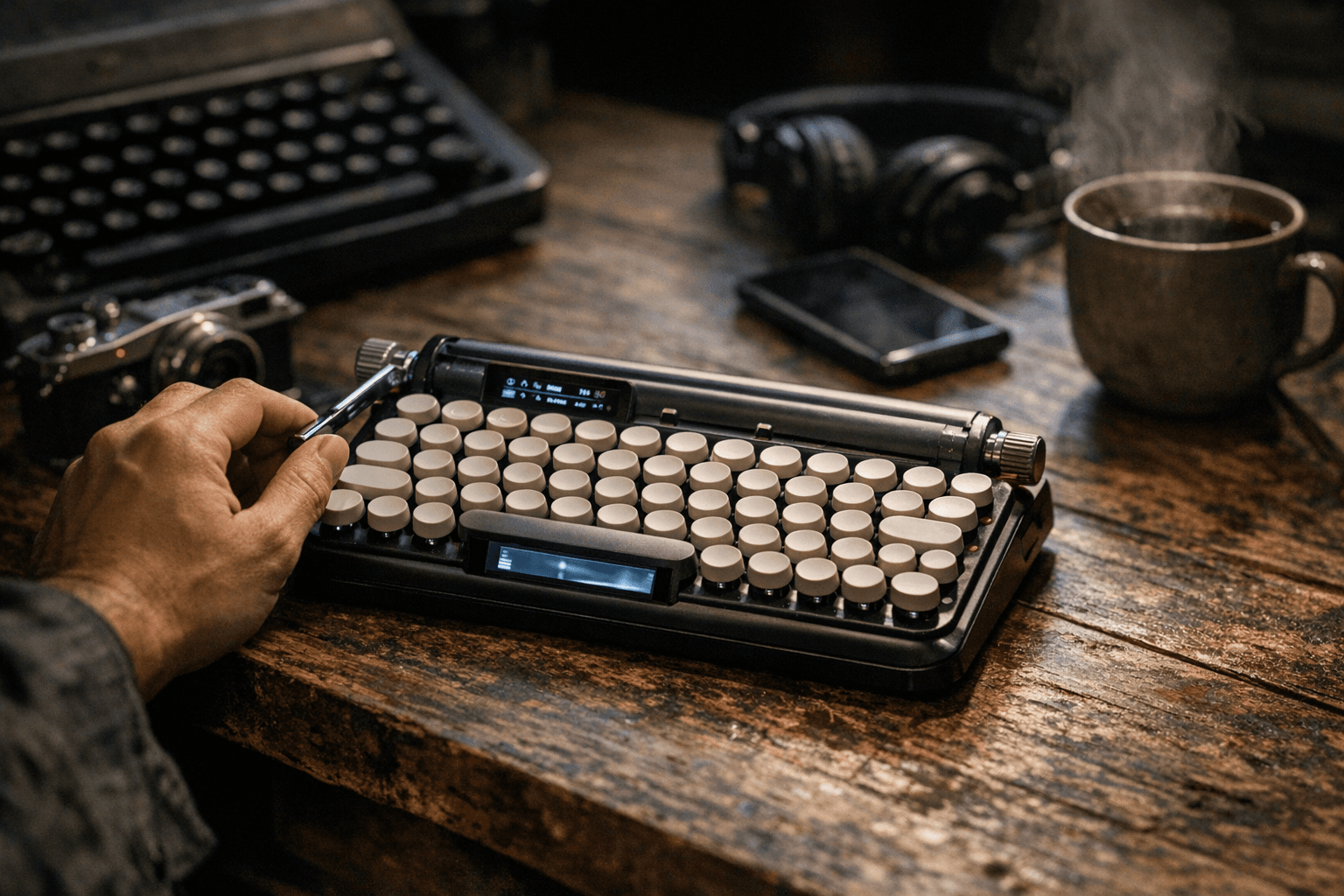
The keycap situation deserves its own flag. The 83 round "bottle-cap" PBT caps ship at a uniform height across all rows, which means virtually no standard aftermarket set, including Cherry-profile GMK runs or sculpted SA/MT3 options, will fit. The spherical uniform tops are the Glyph's most limiting compatibility constraint, and it's the detail most likely to frustrate a customization-focused buyer after the fact.
At $139 with a wrist rest, RGB, and tri-mode wireless included, the Glyph undercuts the typical build cost of a themed board plus dedicated macro pad by a meaningful margin. The closest single-product comparisons are the Royal Kludge retro-themed lineup and Epomaker's own RT85, both of which offer the typewriter look without the lever hardware. The Glyph beats them on gimmick density; neither can match the physical lever or dual-screen readout at that price. The trade-off is the keycap ecosystem, the lever's limited two-input ceiling, and a bright acoustic signature that the top-mount structure won't let you tune away without a switch swap. Production firmware depth and lever durability remain the two variables only physical testing will settle.
This article was produced by Prism’s automated news system from verified source data, official records, and press releases, then run through automated quality and moderation checks before publishing. The system is built and supervised by the people who set the standards it runs under. Read our full AI policy.
Did this article answer your question?