How QWERTY, CHERRY MX, and IBM PS/2 shaped mechanical keyboards
QWERTY fixed the interface, IBM made tactile keyboards mainstream, and CHERRY MX gave the hobby a common switch language that still shapes what you buy today.

Mechanical keyboards look like a modern obsession, but the hobby is built on decisions made long before enthusiasts were swapping springs and debating sound tests. QWERTY set the text-entry map, CHERRY turned switch feel into a shared standard, and IBM’s PS/2 made the mechanical keyboard a product people could notice, compare, and keep caring about.
The interface everyone inherited
Computer designers did not start with a blank slate. They reused teletypes and automatic typewriters, and that is why QWERTY survived as the default instead of being replaced by a cleaner experimental layout. The layout was patented in 1878 to reduce interference between commonly struck keys, an old design answer to a practical problem.
The keyboard hobby begins with a fixed assumption: your hands will probably meet QWERTY first, even if the rest of the board is wildly different. Dvorak and other alternatives existed, but they never seriously displaced QWERTY’s dominance. In other words, the enthusiast market grew around a stable interface, not around a reinvention of typing itself.
How CHERRY turned switch feel into a language
CHERRY began manufacturing computer keyboards in 1973. The company dates the first keyboard switch patent in the USA to February 6, 1973. The MX switch arrived in 1983, and the original MX patent later expired, which opened the door for many MX-like switch families to enter the market.
That standardization is one of the biggest reasons the hobby became so modular. Once the core switch format had a recognizable shape and feel, buyers could compare linear, tactile, and clicky behavior across brands, then drill into spring weight and actuation feel instead of treating every keyboard as a sealed appliance. MX-standard switches have been at the heart of high-quality mechanical keyboards since the 1980s, which helps explain why the phrase “MX-compatible” has become such a powerful shorthand.
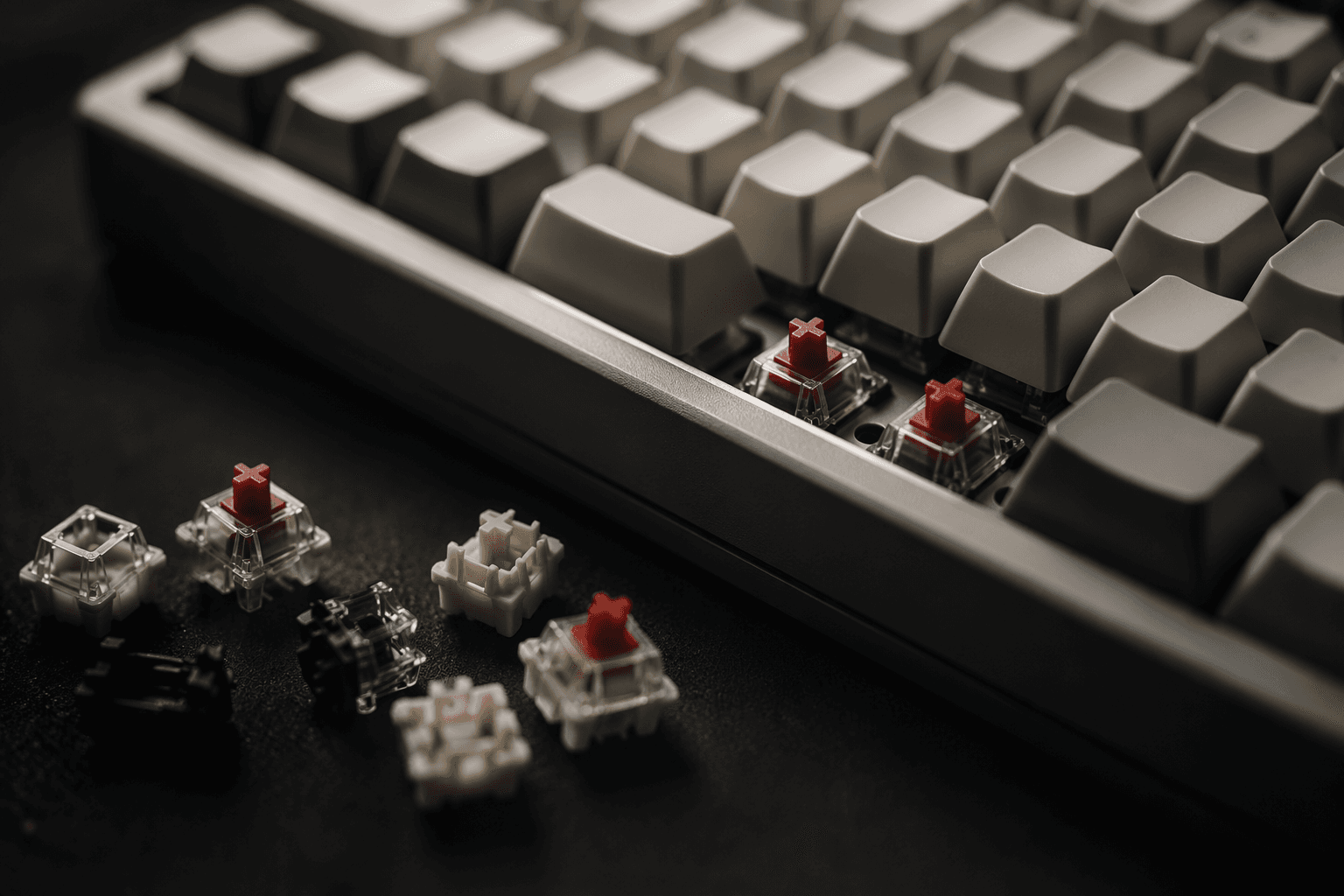
The market now speaks a common mechanical language. A board can feel light, heavy, sharp, smooth, or muted, but those differences only become meaningful when the underlying switch format is standardized enough for people to compare them side by side.
IBM’s PS/2 made the keyboard worth spec sheets
IBM took the keyboard out of the background and made it part of the computer’s identity. The PS/2 was the first IBM system to feature the smaller Model M keyboard, and it launched alongside other changes that were easy to notice at a glance or a checkout counter, including 3.5-inch floppy drives, 16550 UART serial ports, and 72-pin SIMMs. The keyboard was no longer just a utility; it was one of the visible signs that a system had changed.
The Model M did not appear out of nowhere. IBM’s Model F buckling-spring design dates to 1981, and the Model M was designed in 1984 to be less expensive to produce than the Model F. The earliest Model M-style membrane buckling-spring keyboards showed up first in IBM’s Wheelwriter 3, Wheelwriter 5, and Quietwriter 7 typewriters in 1984 before the familiar enhanced keyboard reached the PC market.
The Model M was not prized only because it was loud or old. The mechanism produced a distinct force curve, clear tactility, and a memorable sound. Millions of Model M keyboards were sold, and their positive tactile feedback became one of the defining reasons people remembered them.
The custom scene grew because there was finally something to customize
Once QWERTY stayed fixed, MX became a common switch language, and IBM had shown that keyboard feel was worth caring about, the custom scene had the raw material it needed. By 2010, the early Western custom keyboard world was still heavily dependent on prebuilt and vintage boards. Group buys then became the backbone of custom keyboard culture, giving hobbyists a way to pool demand for cases, keycaps, and limited-run parts.
That pivot point still defines the market. Enthusiasts were no longer choosing only between “good” and “bad” office keyboards. They were choosing among layouts, switch families, and vintage references, then building boards that reflected exactly how they wanted a keyboard to type and sound.
The result is a hobby that mixes restoration with engineering. A buckling-spring board can be treasured for its IBM-era feel, while an MX-based board can be tuned through spring weight, switch type, and compatibility with the wider ecosystem that CHERRY helped standardize.
What still shapes what you can buy, mod, and resell
Mid-2020s estimates put the mechanical keyboard market at roughly $1.76 billion to $2.66 billion.
This article was produced by Prism’s automated news system from verified source data, official records, and press releases, then run through automated quality and moderation checks before publishing. The system is built and supervised by the people who set the standards it runs under. Read our full AI policy.
Know something we missed? Have a correction or additional information?
Submit a Tip