Modular Mechanical Keyboard Transformed Into a Full Compact Workstation
A builder known as anurag.id turned a boring knob replacement into a full 3D-printed workstation, with 6 custom knobs, an iPad stand, and magnetic wrist rests, all mounted on one keyboard.
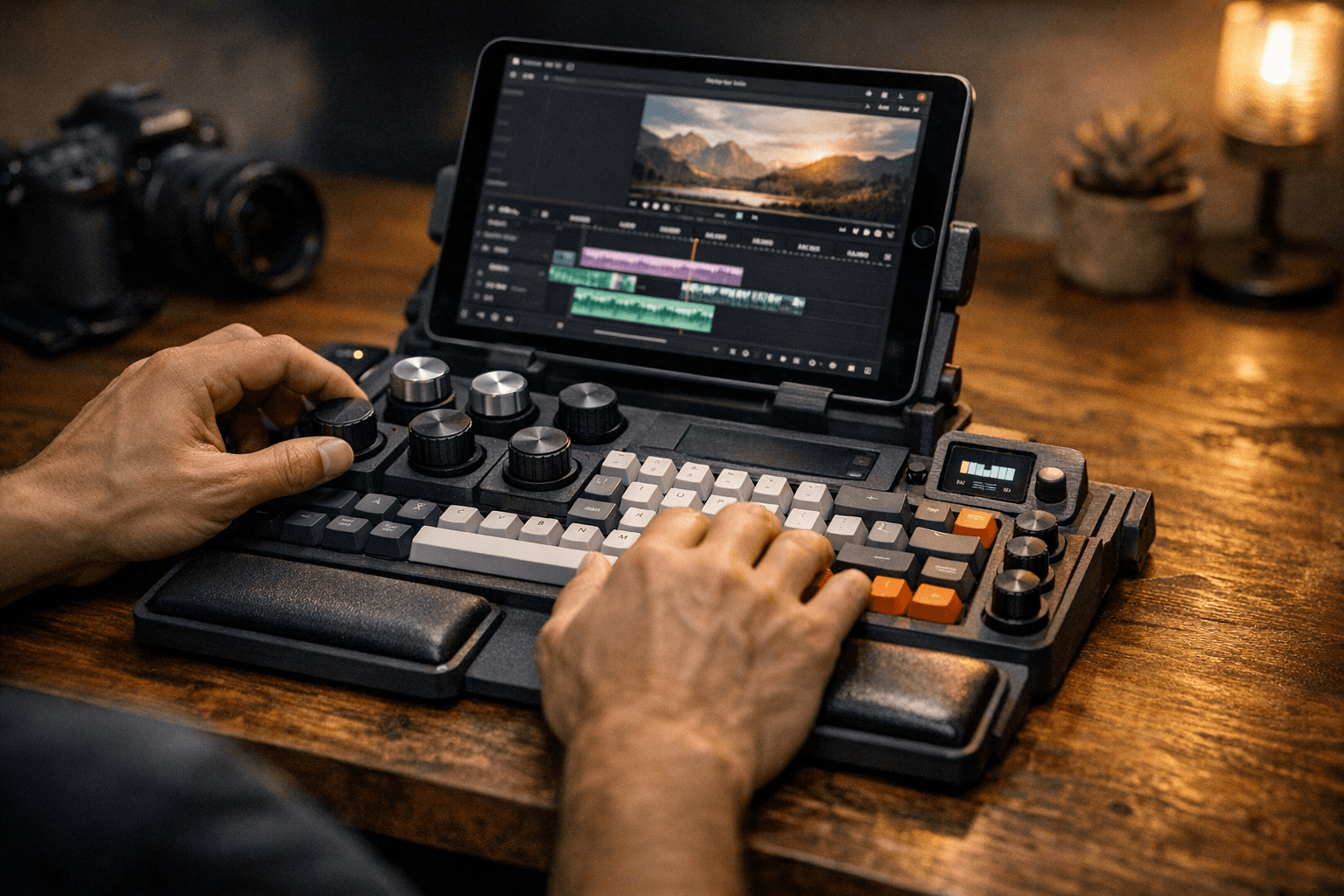
What started as a complaint about a dull knob ended up as something far more ambitious. Builder anurag.id set out to replace the stock rotary knob on a modular mechanical keyboard and walked away with a fully self-contained compact workstation built almost entirely from 3D-printed parts.
The project's architecture reveals exactly how scope creep, when channeled well, produces genuinely useful results. The first module was a single "retro style" replacement knob. Then a second design. Then a third. By the time anurag.id stopped iterating, the keyboard had six distinct knob designs, each printable and swappable depending on aesthetic preference or function. That accumulation of interchangeable knobs is itself a replicable approach: design once in CAD, print in whatever material and color matches your build, swap without tools.
The second module solved a real desk clutter problem. Rather than adding a separate iPad stand to an already crowded surface, anurag.id mounted the stand directly onto the keyboard body. The keyboard becomes the base, the stand becomes an upright extension of it, and the result is a single footprint where there used to be two. For anyone running a compact setup where desk real estate is scarce, that integration is the build's most transferable idea.
The finishing module locked everything together ergonomically: magnetically-attached wrist rests that snap into place on the keyboard's front edge and detach just as cleanly. Magnetic attachment is the design decision that makes the whole system work. It means each module, knob cluster, iPad stand, wrist rest, can be added or removed in seconds without screws, adhesives, or brackets. The keyboard stays portable. The workstation configuration assembles on demand.
3D printing is what makes this tierable for different budgets. At the entry level, a basic FDM printer and PLA filament covers the knobs and wrist rest bodies. A mid-tier approach uses flexible TPU for the wrist rest contact surfaces, improving comfort noticeably over rigid PLA. At the premium end, resin printing sharpens the detail on decorative knobs and allows tighter tolerances on the magnetic attachment points, which matters when the wrist rest needs to seat consistently in the same position every time.
The real problem anurag.id solved is not exotic: most keyboard enthusiasts have a secondary device, usually a tablet or secondary display, sitting awkwardly beside the board with no clean integration. Anchoring that device to the keyboard itself, via a printed stand designed to the exact dimensions of the keyboard's housing, collapses two objects into one unit. Paired with the magnetic wrist rests, the entire assembly travels as a single piece and sets up without adjustment.
The project is a strong example of what the mechanical keyboard community does best: taking a commercially finished product and layering functional, printable modifications until it becomes something the market never thought to offer.
This article was produced by Prism’s automated news system from verified source data, official records, and press releases, then run through automated quality and moderation checks before publishing. The system is built and supervised by the people who set the standards it runs under. Read our full AI policy.
Did this article answer your question?