Tucky Two Times cuts thumb keys to ease typing strain
Thumb pain pushed Stephan Møller to strip Tucky Two Times down to one thumb key per side, turning a familiar split-board idea into a sharper ergonomic bet.
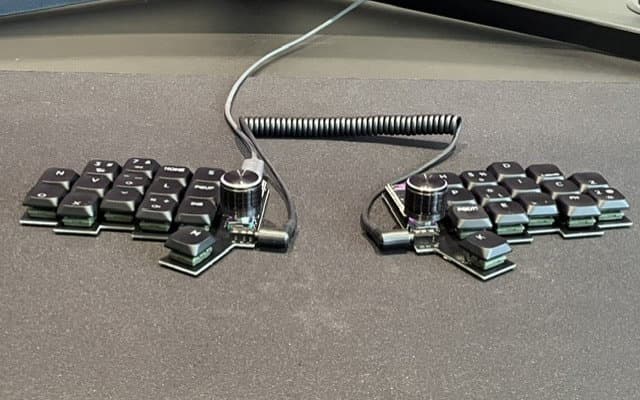
Thumb pain is what makes Tucky Two Times interesting. Stephan Møller, who publishes as Rollercole, built a 30-key low-profile split keyboard around a simple challenge to the usual ergo playbook: if multiple thumb keys are causing strain, why keep adding more of them?
Each half of Tucky Two Times uses just one thumb key, a choice that cuts against the common assumption that the thumb is the strongest finger and therefore the obvious place to stack layers, modifiers, and shortcuts. Møller said his own thumb pain from multiple thumb keys pushed him toward that layout, so this was not a minimal build for aesthetics. It was a design answer to a real typing problem.

The board supports hotswap Choc V1 and Choc V2 switches, uses a Pro Micro footprint for the controller, has encoders on both sides, and runs zigmkay firmware. That mix makes it feel very much like a serious hobbyist board rather than a one-off proof of concept. The public repository also shows the PCB and schematic living under a YetAnotherKeyboard naming pattern in the KiCad files, which suggests the design went through earlier prototype stages before settling into its current form.
The tradeoffs are part of the story. The thumb position ended up too tucked in for the author, and there is a routing issue, so this is clearly a build-with-caution project rather than a polished commercial release. That matters because the board shows the exact pressure point in split-keyboard design: you can shrink the thumb cluster, change the geometry, and chase comfort, but every ergonomic gain can create a new problem in placement, wiring, or long-term usability.
That tension is not just theoretical. Peer-reviewed research has found that split and angled keyboard designs can reduce awkward wrist and forearm postures and improve some discomfort measures. A 2015 PLOS One study found that an angled split virtual keyboard significantly reduced wrist ulnar deviation compared with standard or wide designs. Other work on fixed-split ergonomic keyboards has also linked those layouts with less pain and better functional status in symptomatic users.
Møller’s own keyboard history adds context. His GitHub profile includes wilson26, skinnypete32, mike-typeson, zigmkay, and clacky-chan, which makes Tucky Two Times feel like another step in a broader design arc rather than a detached experiment. The board also lands in a landscape already shaped by commercial split boards like Logitech’s ERGO K860 and by compact ergonomic ecosystems such as Miryoku, where 36-key splits and multiple thumb keys are the norm.
Tucky Two Times pushes in the opposite direction. Instead of asking how many useful actions can fit under the thumbs, it asks when fewer thumb keys, less reach, and a cleaner split may be the healthier answer. That is a much more interesting ergonomic question than simply making the thumb cluster bigger.
This article was produced by Prism’s automated news system from verified source data, official records, and press releases, then run through automated quality and moderation checks before publishing. The system is built and supervised by the people who set the standards it runs under. Read our full AI policy.
Did this article answer your question?