Deadmesh brings Internet protocols to Meshtastic LoRa networks
Deadmesh stretches Meshtastic into a true Internet bridge, but that power comes with more complexity, more airtime pressure, and a narrower sweet spot than native mesh messaging.

Deadmesh is trying to do something Meshtastic never set out to do out of the box: carry ordinary Internet protocols across a LoRa mesh. That makes it an intriguing add-on for people who want more than text, GPS coordinates, and sensor telemetry, but it also changes the tradeoff. The moment you turn a decentralized radio mesh into a gateway for web traffic, email, DNS, and proxies, you gain reach and lose some of the clean off-grid simplicity that makes Meshtastic appealing in the first place.
What deadmesh actually adds
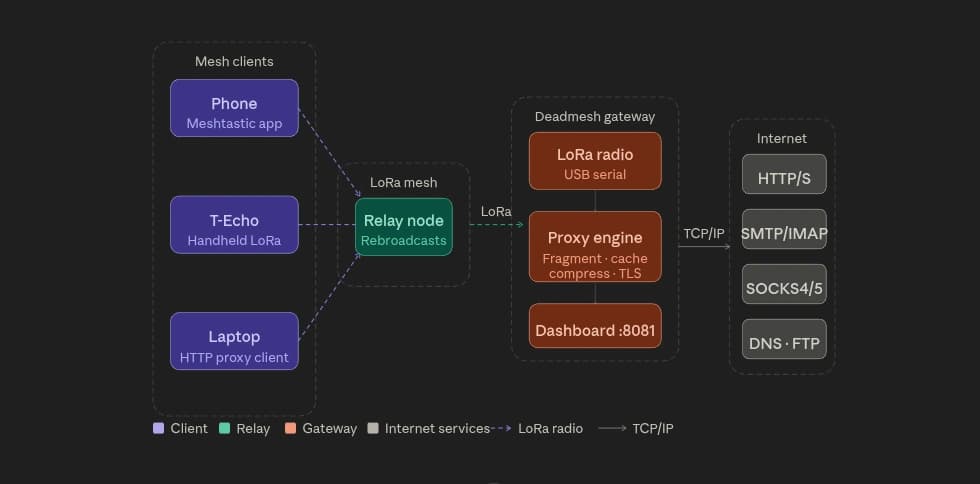
At the core, deadmesh behaves like a translator between two very different worlds. On the Meshtastic side, it uses the project’s native protobuf serialization API. On the Internet side, it speaks protocols that look familiar to any network operator or tinkerers who have spent time in a shell: HTTP, HTTPS, SMTP, IMAP, DNS, FTP, SOCKS4, SOCKS5, and WebSocket. That means the project is not just forwarding chat messages. It is trying to make a mesh radio look, in limited ways, like a general-purpose network connection.
The gateway is the key piece. A machine such as a Raspberry Pi or another Linux box connects to the Meshtastic radio over USB serial and reaches the wider Internet through Ethernet or another uplink. When deadmesh starts, it opens the serial port at 115200 baud, asks for configuration data, and builds a live node table with IDs, hop distances, battery levels, and the last time each node was heard. That is a crucial detail: this is not a dumb pipe. It is a mesh-aware relay that tries to understand the network before it pushes traffic through it.
How the traffic moves
Deadmesh forwards radio traffic in a binary format, then splits application traffic into small LoRa-sized chunks before reassembling it on the far side. That fragmentation matters because LoRa airtime is precious and packet sizes are tight. The project says it uses transparent fragmentation and reassembly, with unique packet IDs to avoid deduplication problems on multi-chunk sessions, which is especially important when a packet has to survive several hops and then be stitched back together correctly.
The repository also describes a full MITM proxy with caching, compression, ad-blocking, and rate-limiting. That combination makes the system sound less like a simple tunnel and more like a traffic management layer. It can reduce airtime and make web access more tolerable over a slow radio link, but it also adds more moving parts that have to stay healthy for the bridge to work.
Why this is tempting for Meshtastic users
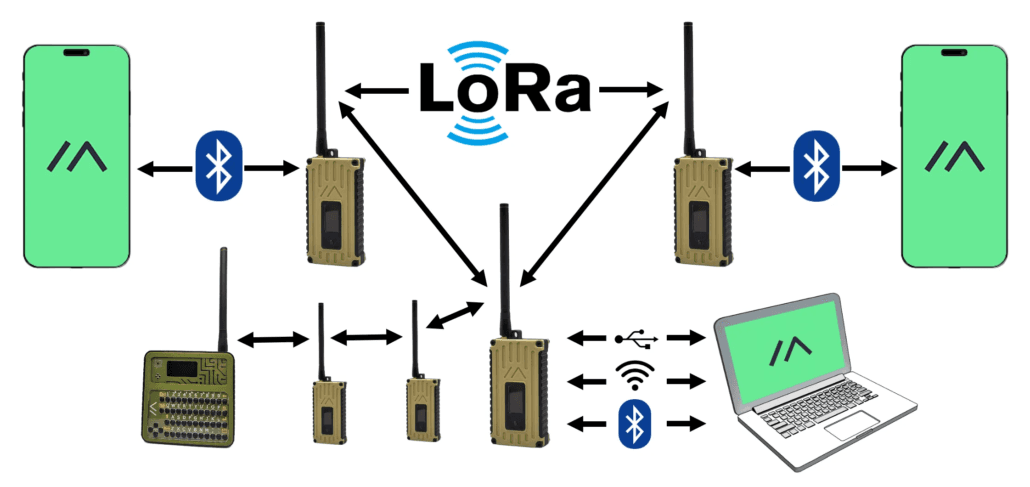
Meshtastic already has a strong identity: it is an open-source, off-grid, decentralized mesh network built on affordable, low-power devices. Users can connect by Bluetooth, Wi-Fi, or USB and communicate without internet or cell service. That has made it a go-to tool for local messaging, backcountry coordination, and small emergency setups.
Deadmesh widens the use case. If you want offline publishing, remote administration, or text-first workflows over a radio link, a bridge that understands standard Internet protocols is immediately more useful than a pure chat relay. It also fits the kind of experimental culture that has grown around Meshtastic. Meshtastic’s June 2025 2.6 preview said the release had been 1.5 years in the making and introduced a new routing algorithm for direct messages after extensive implementation, simulation, and real-life testing. In other words, the ecosystem is already moving toward more capable routing, and deadmesh pushes that idea further by reaching beyond radio-native traffic.
The community is clearly paying attention. The Meshtastic Discord server pages show roughly 48,789 members, which is the sort of audience that tends to try unusual bridge architectures as soon as they appear. The deadmesh repository itself also looks alive, with around 42 stars and 222 commits when crawled, so this is not a one-off sketch. It is an active open-source effort in the Deadlight ecosystem.
Where it helps, and where it does not
Emergency use
Deadmesh can be useful in an emergency, but only in a narrow sense. If you have a gateway with power and Internet backhaul, it can help move structured data between a mesh and normal network services. That could mean relaying status, sending email, or reaching a remote service when local radios are still working.
The caveat is obvious and important: if the Internet is down, deadmesh does not create the Internet. It only bridges to it when a working uplink exists. For a real emergency setup, that means the gateway becomes a critical dependency. If the Raspberry Pi loses power, the Ethernet line fails, or the uplink vanishes, your bridge collapses even if the radio mesh itself still lives on.
Experimentation
This is where deadmesh looks strongest. If you want to test how far Meshtastic can stretch, or you want to build a hybrid radio and Internet lab, deadmesh gives you a serious sandbox. The repository’s emphasis on gateway-side stability, live mesh visibility, connection pooling, TLS session reuse, and reduced airtime suggests a project aimed at people who care about tuning, not just novelty.
It also has a pragmatic promise that will get attention: the project frames itself as a way to deliver satellite-terminal-like capabilities on roughly $30 hardware with no monthly fee. That is the project’s own positioning, not a guarantee, but it explains the appeal. A low-cost Linux gateway plus an existing radio can be enough to explore a very different communications model.
Neither, without caveats
If what you want is the cleanest possible off-grid experience, deadmesh may be the wrong layer to add. Meshtastic’s native design already gives you decentralized messaging, rebroadcasting, and direct device connectivity without depending on the Internet. The more you push web protocols through a mesh, the more you risk congestion, higher latency, and a bigger reliability burden.
That matters because the bridge does not just add capability. It adds complexity, state, and dependency. A mesh that is best at passing small text messages can become fragile when asked to carry web requests, email sessions, and proxy-managed traffic. The more serious your use case, the more you have to test airtime usage, node stability, and what happens when the gateway is unavailable.
The reality check
Deadmesh is most convincing as a specialist tool, not a default Meshtastic mode. It is a smart fit if you want to experiment with protocol translation, build a hybrid emergency lab, or see how far low-power mesh can be pushed toward conventional networking. It is a poor fit if your main goal is simple, resilient, Internet-free communication.
That is the dividing line readers should keep in mind. Meshtastic is getting better at being a mesh. Deadmesh is trying to make that mesh speak Internet. Those are compatible ambitions, but they are not the same mission, and the difference determines whether this project feels like a breakthrough or a complication.
This article was produced by Prism’s automated news system from verified source data, official records, and press releases, then run through automated quality and moderation checks before publishing. The system is built and supervised by the people who set the standards it runs under. Read our full AI policy.
Did this article answer your question?