Father and son uncover WWII ammunition cache near Czech-Polish border
A father and son found 110 WWII artillery rounds buried 30 centimeters deep in a Czech forest, triggering a two-day police disposal operation.

A father and son’s metal detecting trip in the Orlické Mountains ended with Czech police sealing off a wartime ammunition cache buried just 30 centimeters under the forest floor near Bartošovice v Orlických Horách. The find, made on Oct. 28, 2025, turned out to be a reminder that a promising signal can hide live danger as easily as history.
Police said the pair, a 48-year-old father and his son, spotted a suspicious reading while searching a forest near the Czech-Polish border. What they uncovered was a dense stash of rusty ordnance believed to date to World War II. Karolína Macháčková, speaking for the Police of the Czech Republic, said explosives technicians later confirmed the cache included 110 pieces of 105 mm artillery ammunition, 13 pieces of 75 mm ammunition and three cartridges.
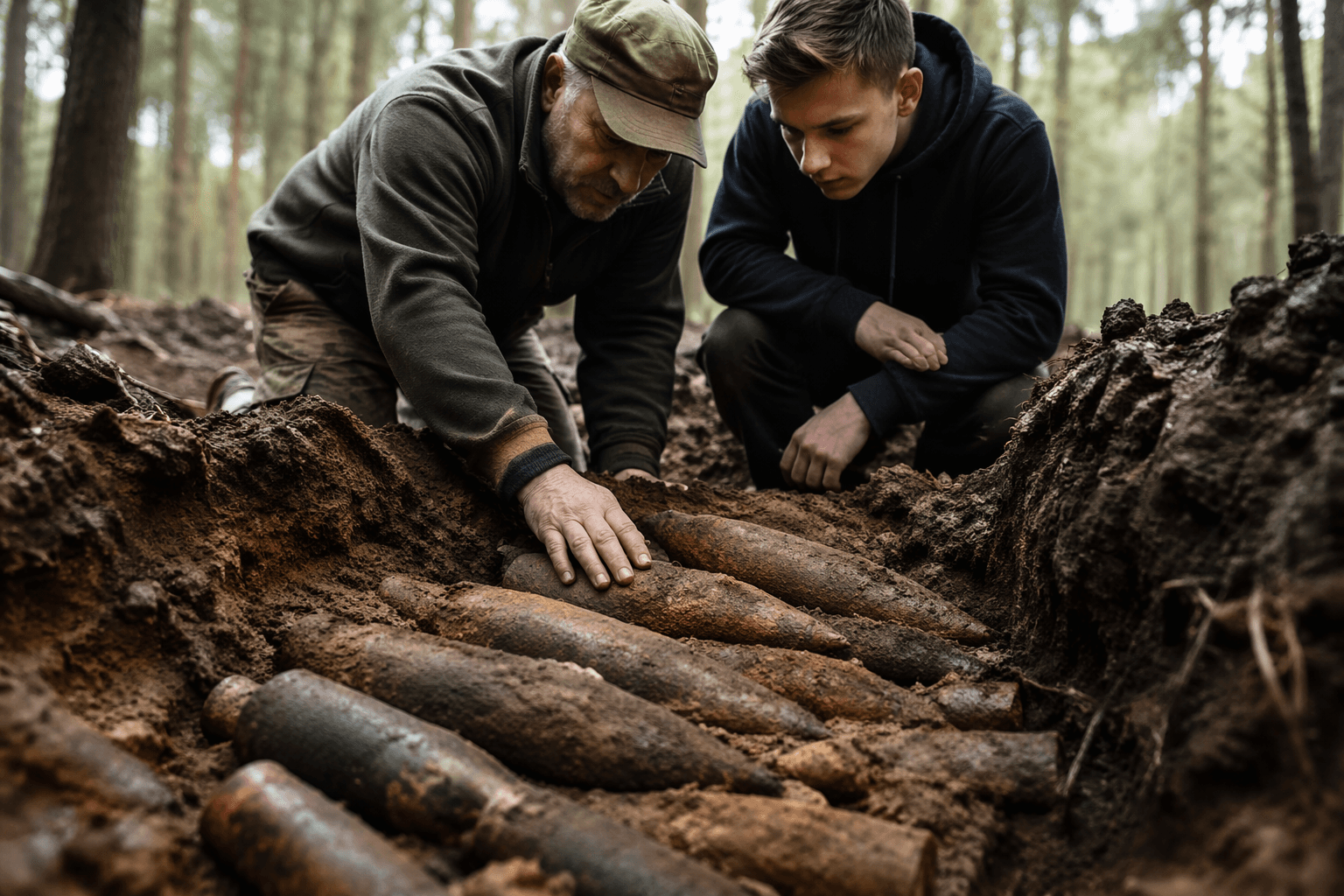
It took two days and heavy equipment to clear the site safely. Police brought in explosives technicians, secured the area and then transported the ammunition for disposal. The depth, the condition of the rounds and the number of separate pieces made the recovery more than a quick field callout, even though the cache was only about 30 centimeters down.
For detectorists, the story lands squarely in familiar territory: old military ground can produce everything from buttons and shell fragments to much more dangerous material. In this case, the father and son did the most important thing correctly by stopping once they realized the find was not a harmless relic. Czech police warned the public not to touch, move or dig up suspected ordnance and to contact authorities immediately instead.
The incident also fits a wider pattern across the Czech Republic and neighboring countries, where wartime contamination still turns up in forests, fields and construction zones. Even nearly eight decades after the end of World War II, unexploded ordnance remains a recurring hazard across Central and Eastern Europe, and a fresh signal in the dirt can still lead straight to explosives technicians instead of a trophy for the finds pouch.
This article was produced by Prism’s automated news system from verified source data, official records, and press releases, then run through automated quality and moderation checks before publishing. The system is built and supervised by the people who set the standards it runs under. Read our full AI policy.
Did this article answer your question?