Old house hunt yields Indian cents, war button, 1928 campaign token
A second pass at an abandoned house site produced two Indian cents, a 1928 Harry M. Carpenter token and two miner’s tags. The first hunt there had already turned up a large cent, a Barber half and a Barber dime.
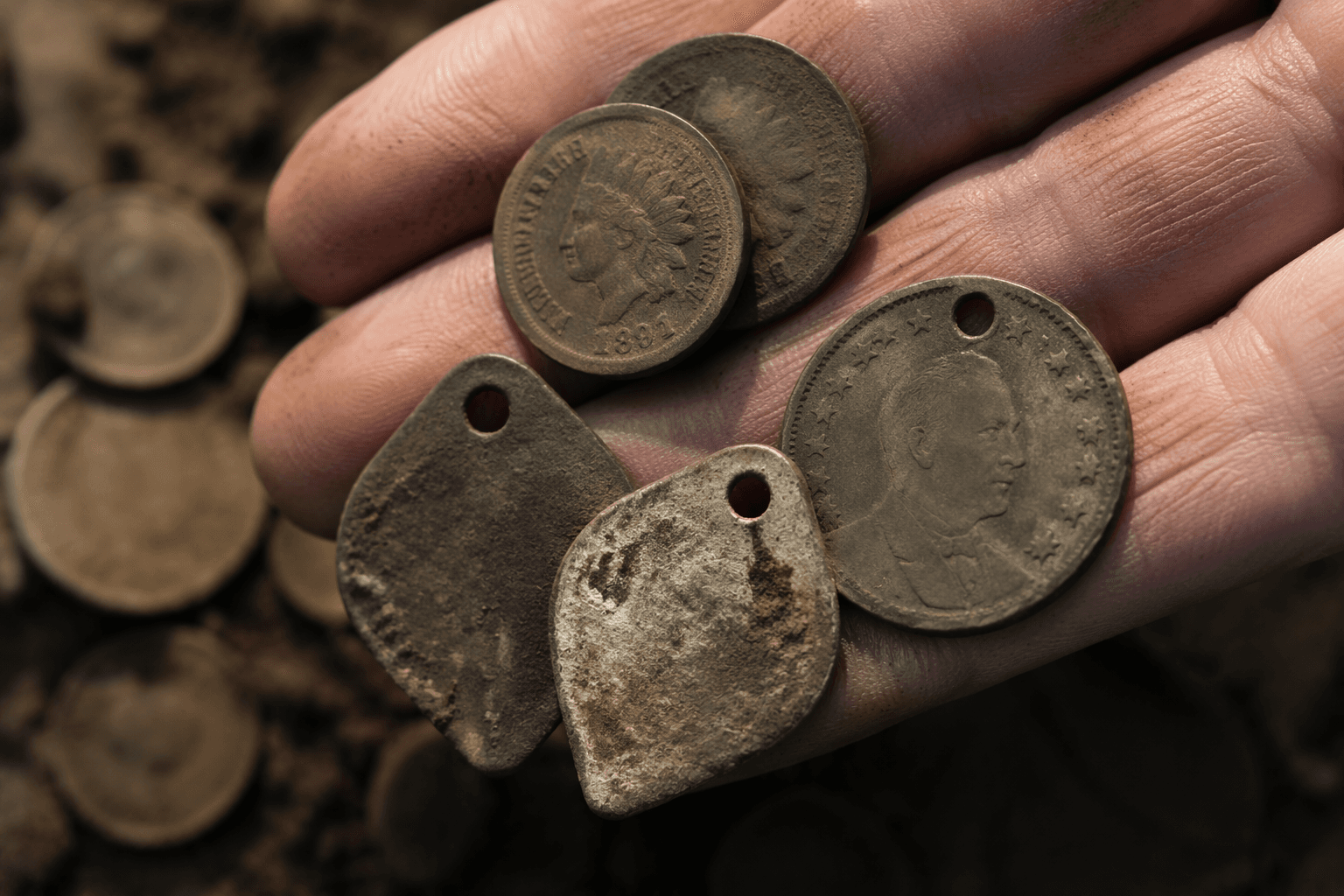
A return trip to an old abandoned house site on July 13 added two Indian Head cents, a 1928 Harry M. Carpenter campaign token and two miner’s tags to a site that had already given up a large cent, a Barber half dollar and a Barber dime on an earlier hunt. The detectorist worked mainly the backyard and the woods behind the house, and the spread of finds showed just how much old ground still had left to give.
Along with the 1891 and 1898 Indian cents, the hunt produced four wheat cents dated from 1910 to 1945 and about 19 newer clad coins that were not shown in the photos. A World War I U.S. Army coat button added another layer to the site’s timeline, while the two miner’s tags pushed the story beyond household loss and into the working history of the area.
The political token was the standout non-coin recovery. The piece reads “Vote for Harry M. Carpenter for Senator” and carries the date Aug. 14, 1928. A similar verified example describes the obverse as a request for support and influence for Harry M. Carpenter in the Republican primaries, with the reverse urging voters to back him for state senator on Aug. 14, 1928. The token was aluminum and about 33 mm across.
Harry M. Carpenter fits the token’s local footprint. Forum biographical notes identify him as a Steubenville, Ohio figure born in 1878 who worked as a school teacher and principal, served as president of the Jefferson County Board of Examiners, and later became an Ohio state senator. That makes the campaign piece more than a generic political relic. It ties directly to a named candidate with roots in Steubenville, a city long shaped by coal, rail and steel.
The miner’s tags make equal sense in that setting. Museum and historical-collection material on lamp checks, tokens and tallies explains that mining companies used them to track who was underground, and that they could become vital in an emergency because they showed how many men were actually inside the mine. In a place like Jefferson County, those little brass or aluminum discs fit the landscape as naturally as the coins.
The bigger lesson was in the second pass itself. The first hunt had already produced trophy coins, but the return trip showed how an old house site can keep paying out when the yard, the woods and the deeper pockets of the site get worked again. The mix of Indian cents, a wartime button, miner’s tags and a 1928 campaign token made the date range on that property feel wider, and the story of the site feel far from finished.
This article was produced by Prism’s automated news system from verified source data, official records, and press releases, then run through automated quality and moderation checks before publishing. The system is built and supervised by the people who set the standards it runs under. Read our full AI policy.
Did this article answer your question?