Japanese Zen monk brings a 30‑second nervous‑system reset to corporate wellness programs, reaches Fortune 500 firms
Toryo Ito, vice abbot of Kyoto's oldest Zen temple, teaches Meta and Sony employees a 30-second nervous-system reset designed to fit between back-to-back meetings.
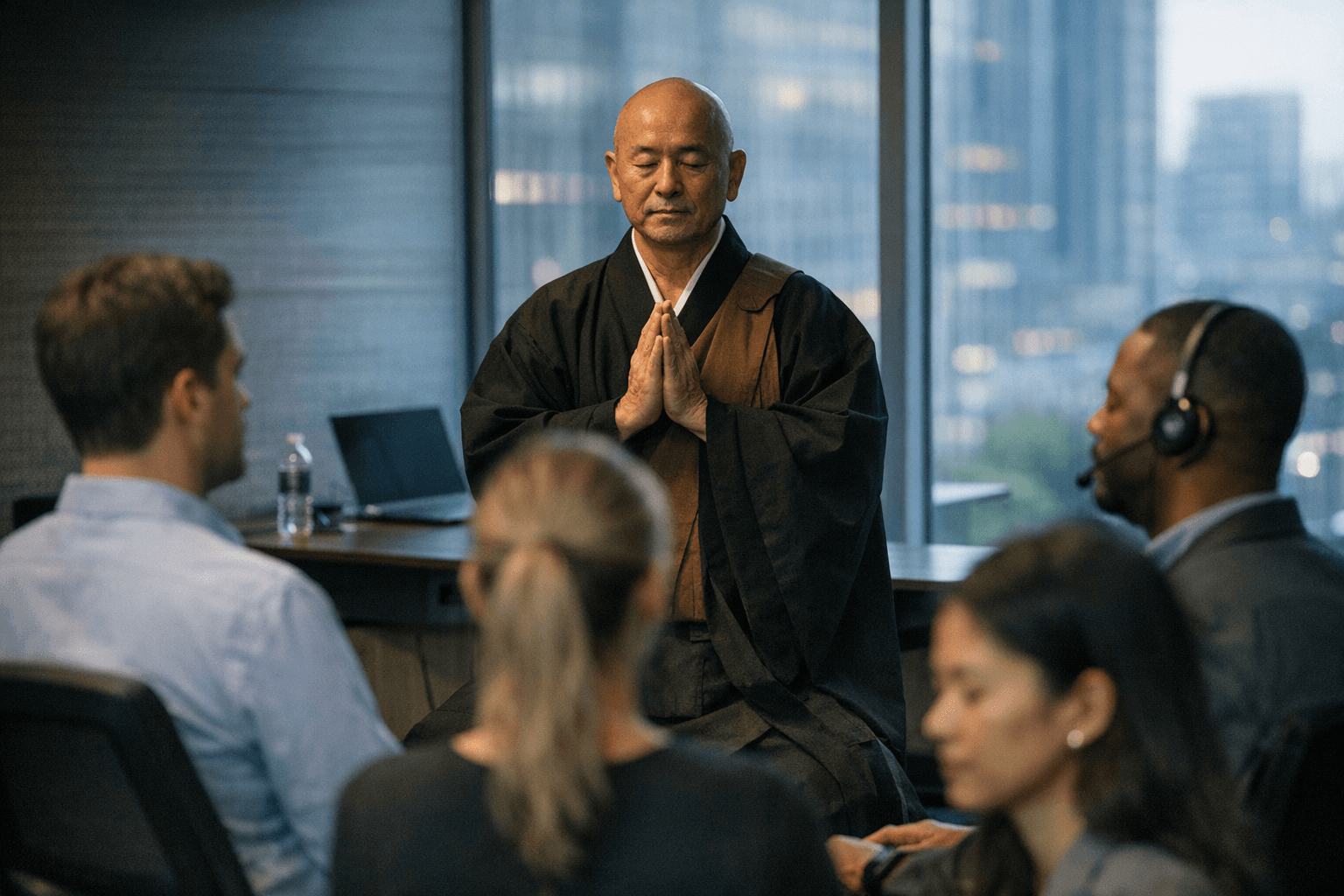
Corporate wellness directors have spent years pitching hour-long guided sessions and app subscriptions to skeptical employees who barely have time for lunch. Toryo Ito's pitch is different: thirty seconds, no cushion required, deployable before the next calendar alert fires.
Ito is the vice abbot of Ryosokuin, the oldest Zen temple in Kyoto, and he is bringing meditation-based practice to the corporate world to help workers cope with high-pressure careers. The fact that his work is gaining traction at the highest levels of global industry is not a wellness trend piece in the usual sense. It is a genuine wrinkle in the story of how ancient contemplative traditions survive contact with quarterly targets.
The monk and the temple behind the method
Born in 1980, Ito underwent rigorous training at a specialized dojo affiliated with the Kenninji Temple sect and has subsequently offered Zen meditation guidance to over 150,000 individuals. Ryosokuin itself carries nearly six centuries of history, rooted in the Rinzai school of Zen Buddhism, a lineage known for its disciplined, direct approach to awakening through practice rather than study alone.
Distinguished for seamlessly bridging the realms of contemporary and traditional practice, with a particular emphasis on the arts, Ito actively cultivates a harmonious coexistence of these facets. That balancing act is precisely what has made him legible to corporate audiences who might otherwise dismiss a monk in robes as an unlikely productivity consultant. In 2023, Ito received recognition in both Forbes Japan's "Next100" and Newsweek's "100 Japanese People the World Respects," credentials that tend to open boardroom doors considerably faster than lineage alone.
Zen meets the Fortune 500
Ito's modern approach to Zen has made him something of an ambassador for mindfulness in the corporate world, leading meditation workshops for companies like Meta, Sony, and Tatcha. His corporate consulting trail stretches back to 2012, which means he was navigating workplace wellness long before the pandemic made employee burnout a boardroom agenda item. His international impact spans Zen seminars conducted at Meta headquarters in the U.S., and guiding Zen practices across Asia, Europe, and beyond.
The relationship with Tatcha is particularly illustrative of how Ito works. In 2016, Tatcha's founder Vicky Tsai met Ito at Ryosokuin Temple in Kyoto, and the two found many similarities between his meditation philosophy and her vision for the brand, namely the mind-body connection and a holistic approach to well-being. Ito now works with Tatcha as its Global Director of Mindfulness, marrying timeless Japanese wisdom with emerging scientific research to create sensorial rituals that engage the senses and uplift the spirit. It is a corporate partnership that has lasted a decade, which is not the behavior of organizations chasing a trend.
What "returning to origin" looks like on a Tuesday afternoon
Ito's philosophical anchor is a principle he calls "returning to origin," and understanding it is the difference between seeing his work as a gimmick and seeing it as a coherent system. In his own words, the goal is to reframe what strength actually means in a professional context: "I want to shift their awareness of the definition of 'strong.' People who are very good at business tend to focus on the power [and] force. My definition of [strength] is how you get back to the core of your idea, how to come back to your body and heart in daily life."
That reframe has a practical application. Rather than asking employees to carve out meditation time they do not have, Ito's method prioritizes integrating practice into existing routines rather than demanding additional time commitments from already-stretched professionals. The 30-second nervous-system reset is the flagship expression of that logic: a technique grounded in sensory attention and bodily awareness, the same principles that structure hours of monastic zazen, compressed into something executable between a Slack notification and a standing meeting.
Ito's own meditation style is rooted in activating the five senses to elevate awareness of body and mind, and from his teaching, Tatcha's founder learned that the "mind" is not just in the brain, but throughout the body. That five-sense framework is what gives his micro-practices structural integrity: they are not random breathing cues borrowed from wellness culture, but distillations of a specific Zen approach to perception and presence. As Ito has put it, meditation is "an act of reacknowledging what you already think you know."
The honest critique
The growing acceptance of mindfulness in workplace settings has also generated a growing body of skepticism, and Ito's model is not immune to the harder questions. Short practices can lower friction and improve uptake across large employee populations, which makes them attractive to corporate wellness directors measured on participation rates. But the questions of dose, fidelity, and long-term impact remain genuinely open.
Whether a 30-second reset produces durable change in stress regulation, or whether it functions more like a coping technique that treats symptoms without building the reflective infrastructure needed for lasting transformation, is not something a workshop can resolve. Corporate environments rarely supply the conditions that make contemplative depth sustainable: quiet, consistency, community, and a cultural permission to actually slow down. The contrast between Ryosokuin's 600-year-old walls and an open-plan office in Silicon Valley is not just atmospheric; it is a structural tension that no amount of skillful packaging entirely dissolves.
The one thing worth taking
If there is a micro-practice from Ito's teaching that translates cleanly into a demanding workday, it is the pre-meeting arrival ritual. Focusing on your steps and entering the room intentionally, Ito says, helps build up "your personal ritual" before a high-stakes encounter. It requires no app, no props, and no cleared schedule. Walk to the meeting slowly. Feel each step. Notice what you see and hear in the hallway. You are activating exactly the five-sense attention that Ito has spent years teaching, in the thirty seconds you already have.
The boundary worth holding alongside that practice is equally simple: resist the framing that thirty seconds of Zen is a substitute for systemic change. Ito's techniques work because they point inward, toward the body and the senses, not because they make an unsustainable workload sustainable. The monk's deeper teaching, the one underneath the corporate packaging, is that genuine strength means knowing when to come back to yourself, not how to endure more.
This article was produced by Prism’s automated news system from verified source data, official records, and press releases, then run through automated quality and moderation checks before publishing. The system is built and supervised by the people who set the standards it runs under. Read our full AI policy.
Did this article answer your question?