Mindfulness Association May Calendar Links Ancient Wisdom to Daily Practice
A monthlong calendar turns mindfulness into habit architecture, pairing ancient contemplative ideas with daily prompts, recordings, and a practical path into steady practice.
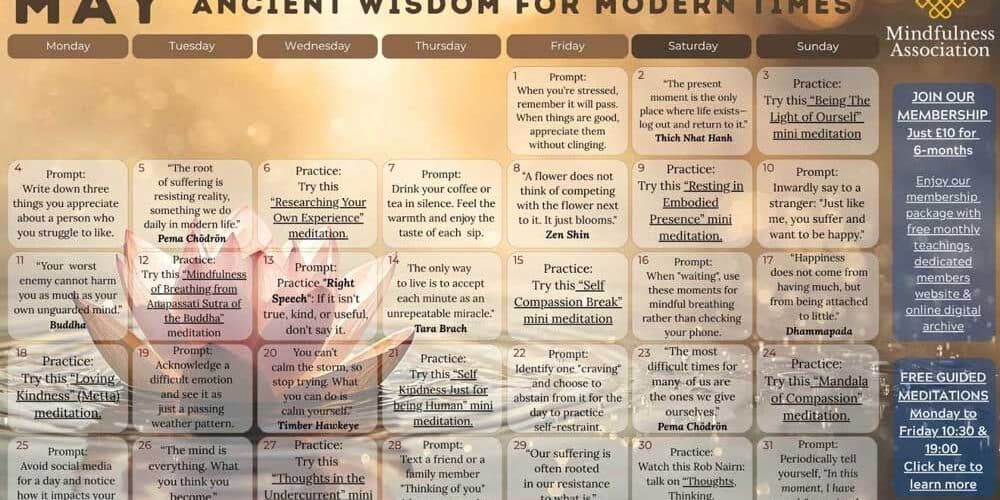
A calendar built to be returned to
The strongest thing about the Mindfulness Association’s May calendar is not that it offers more mindfulness, but that it gives the practice a shape. Published on April 29, 2026, the monthlong resource turns “Ancient Wisdom for Modern Times” into quotes, daily practice prompts, and recordings that make it easier to show up again tomorrow.
That structure matters because mindfulness often lives in bursts of good intention. A calendar format changes the task from finding the perfect retreat moment to building a repeatable rhythm, one day at a time. For meditation practitioners trying to move from sporadic effort to an actual practice, that is the real story here.
Why the monthly format works
The May calendar is part of a recurring series, and that continuity is part of its design. The April 2026 calendar used the theme “New Beginnings, Beginners Mind” and offered 30 prompts, which shows the Association is not treating this as a one-off content drop. It is creating a public-facing practice cycle that invites return, not just attention.
The May edition extends that idea by pairing short reflections with recordings, which lowers the barrier for beginners and still leaves room for experienced practitioners to work deeply. In practical terms, the format answers three questions for you: when to practice, what to focus on, and how to keep going when motivation dips.
Finding the right doorway into practice
The calendar’s value is that it can hold several styles of engagement at once. Some days call for community energy, some for a themed session, and some for a quieter encounter with contemplative tradition. Instead of forcing one approach, the May calendar gives you a way to choose the right doorway for the day you are actually living.
- Community events work best when you need accountability, shared language, or the momentum that comes from practicing alongside others.
- Themed sessions are useful when you want a clear focus, especially if a topic like stress, attention, or compassion helps you settle in.
- Contemplative traditions suit the days when you want depth, lineage, and a slower pace that connects modern practice to older wisdom.
That mix is what makes the theme “Ancient Wisdom for Modern Times” feel more than decorative. It suggests that mindfulness is being presented as something alive in ordinary life, not sealed off as a purely spiritual exercise.
What SG-MBIs add to the picture
The Mindfulness Association says its teachings align with second-generation mindfulness-based interventions, or SG-MBIs. In the literature, SG-MBIs are described as a step beyond first-generation programs such as MBSR and MBCT, with a stronger emphasis on ethical, compassion-based, and Buddhist-rooted elements. A 2015 scholarly article described these approaches as aiming to be more comprehensive and more authentic to traditional contemplative roots.
That matters here because the calendar is not just a wellness product. It sits inside a live debate about what mindfulness should include, who it is for, and how much of its original context should remain visible. A 2026 meta-analysis also examined the effectiveness of SG-MBIs on depressive and anxiety symptoms, showing that this is still an active research area, not a finished doctrine.
What the broader evidence says
The wider clinical conversation helps explain why a calendar like this has traction. The U.S. National Center for Complementary and Integrative Health says mindfulness and meditation may help people manage anxiety, stress, depression, pain, and withdrawal-related symptoms. Johns Hopkins Medicine describes mindfulness meditation as nonjudgmental self-awareness that may improve mood and anxiety, while the American Psychological Association notes that mindfulness meditation has become a popular way to manage stress and improve well-being, with research pointing to positive effects on brain and biology.
That said, mindfulness is not risk-free or universally beneficial. NCCIH cites a 2020 review of 83 studies involving 6,703 participants, and 55 of those studies reported negative meditation-related experiences. For anyone treating the May calendar as a new routine, that is an important reminder: steadiness matters, but so does discernment.
A realistic May plan
The best way to use the calendar is not to do everything. It is to build a pattern you can actually keep. A simple May plan might look like this:
1. Pick one daily anchor. Use a quote, prompt, or recording as your baseline practice, even if it is only a few minutes long.
2. Choose one community touchpoint each week. Let one session carry the social side of practice so you are not relying only on solo willpower.
3. Rotate emphasis, not commitment. Some days lean into contemporary stress, some into ancient teaching, some into quiet reflection.
The point is consistency, not sameness.
4. Leave room for return. If you miss a day, treat the next prompt as a re-entry point rather than a reset failure.
That approach fits the calendar’s real function. It is less about filling squares on a page than about helping you notice how practice can live in the middle of work, distraction, and ordinary obligations. The May theme gives you a way to stay in touch with the tradition without pretending modern life has disappeared.
More than a schedule
The Association also offers a 2026 wall calendar for sale, with 25 percent of profits going to The Everyone Project, which adds a fundraising dimension to the program. That detail reinforces the sense that the calendar is not just instructional, but communal. It helps finance broader good while keeping practice visible month after month.
Taken together, the May calendar, the April “New Beginnings, Beginners Mind” prompts, and the SG-MBI framing all point in the same direction: mindfulness works best when it becomes a rhythm you can revisit. This is not about chasing a perfect session. It is about building a practice that keeps showing up, one day in May at a time.
This article was produced by Prism’s automated news system from verified source data, official records, and press releases, then run through automated quality and moderation checks before publishing. The system is built and supervised by the people who set the standards it runs under. Read our full AI policy.
Did this article answer your question?