Mindfulness meditation may reshape self-criticism and resting brain networks
This study asks a sharper question than “does meditation relax you?” It probes whether mindfulness changes self-judgment, self-kindness, and rumination in the resting brain.
Mindfulness often gets sold as a way to feel calmer, but this new paper asks a more pointed question: does practice actually change the inner critic when the brain is left alone? The answer matters because the biggest claims around meditation are often about the self, not just stress, and this study looks for those shifts in the resting brain rather than in the middle of a task.
What the new paper is testing
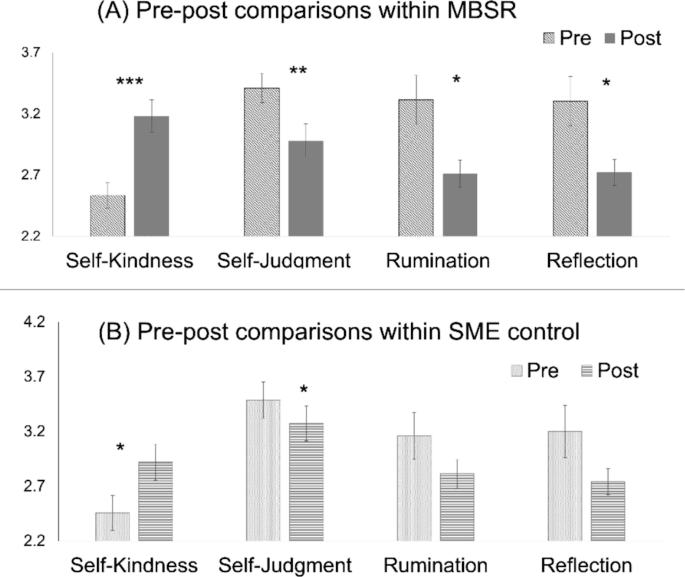
Published June 4, 2026 in *Mindfulness*, the study is titled *Neural Correlates of Meditation-Induced Changes in Self-Related Traits: A Resting State fMRI Study*. The paper, by Diane Joss, David Rahrig, David R. Vago, Hadley Rahrig, and Aviva Berkovich-Ohana, uses secondary data analyses to look for neural correlates of changes in self-judgment, self-kindness, rumination, and reflection after mindfulness meditation training.
That design matters because resting-state fMRI is about intrinsic brain organization, not performance on a scanner task. In plain language, the study is trying to see whether meditation leaves behind a measurable trace in the brain’s default mode of operating, the kind that governs self-evaluation, repetitive thought, and the background commentary people carry around all day.
Why self-related traits are the real story here
For a lot of meditators, the headline benefit is not simply “I feel less stressed.” It is the more personal shift of noticing the harsh inner narrative sooner, getting less caught in it, and responding with more self-kindness. This paper puts those changes front and center by focusing on self-judgment, self-kindness, rumination, and reflection, four traits that are easy to talk about in a meditation room and harder to pin down in a lab.
That is what makes the study feel more concrete than a generic claim about mindfulness making people happier. It asks whether training changes the brain’s resting patterns in ways that map onto the lived experience of being less fused with self-criticism and less trapped in repetitive thought, which is the kind of outcome many practitioners notice before they ever think about neuroscience.
How this fits with earlier mindfulness brain research
The new paper lands in a field that has already been circling the same question from different angles. A 2022 meta-analysis pulled together 12 studies, including 226 mindfulness participants and 204 controls, and found that mindfulness training altered resting-state functional connectivity, especially in the default mode network, the salience network, and the frontoparietal control network.
Those three networks are useful shorthand for what meditators often talk about in less technical language. The default mode network is closely tied to self-referential thought, the salience network helps tag what feels important, and the frontoparietal control network supports regulation and cognitive control. Put together, they hint that mindfulness may not just lower arousal, but also change how the mind notices, prioritizes, and redirects its own thoughts.

A 2025 *Frontiers in Human Neuroscience* study pushed that idea further by looking at experienced meditators. It reported that they spent more time in two resting brain states linked to sensory perception and attention-related processing, and less time in a frontal state associated with higher cognitive functions. That does not mean meditation turns off thinking, but it does suggest that long-term practice may bias the resting brain toward different modes of processing.
Why the self-compassion pilot matters
There is also a more targeted line of evidence around self-criticism itself. A 2024/2025 pilot study of mindful self-compassion used resting-state fMRI in 24 adult patients with anxiety or depressive disorders and found neural correlates of reduced self-judgment after an eight-week intervention.
That is a small sample, but it is important because it connects a very specific psychological change to a very specific training format. Instead of treating mindfulness as one broad wellness bucket, it shows that an eight-week program designed around mindfulness and self-compassion can be linked to a shift in how people relate to themselves, which is exactly the kind of mechanism-level evidence this new *Mindfulness* paper is trying to build on.
What this means for practice, not just theory
Taken together, the studies point to a more practical reading of mindfulness research. The familiar benefits, like stress reduction and improved attention, are still part of the picture, but the newer work suggests that self-related processes may be just as important, and possibly more revealing, when you want to understand what practice is really changing.
That is a useful reality check for anyone who has heard the claim that meditation changes your sense of self and wondered what that actually means. In the emerging science, it does not mean a dramatic identity overhaul; it looks more like subtle shifts in self-judgment, self-kindness, and repetitive thought, paired with changes in resting brain networks that support those habits.
The practical takeaway is simple: if you want to track whether mindfulness is doing anything meaningful, do not only ask whether you felt calm after a sit. Watch whether the next stressful thought lands a little differently, whether the inner critic softens faster, and whether an eight-week practice changes the way your mind behaves when you are doing nothing at all.
This article was produced by Prism’s automated news system from verified source data, official records, and press releases, then run through automated quality and moderation checks before publishing. The system is built and supervised by the people who set the standards it runs under. Read our full AI policy.
Know something we missed? Have a correction or additional information?
Submit a Tip