Mindfulness meditation traces its roots to Indian philosophical traditions
Mindfulness-based therapies came from sakshi and dhyana, not nowhere. Knowing that root changes whether you treat mindfulness as a stress tool, an ethical practice, or both.
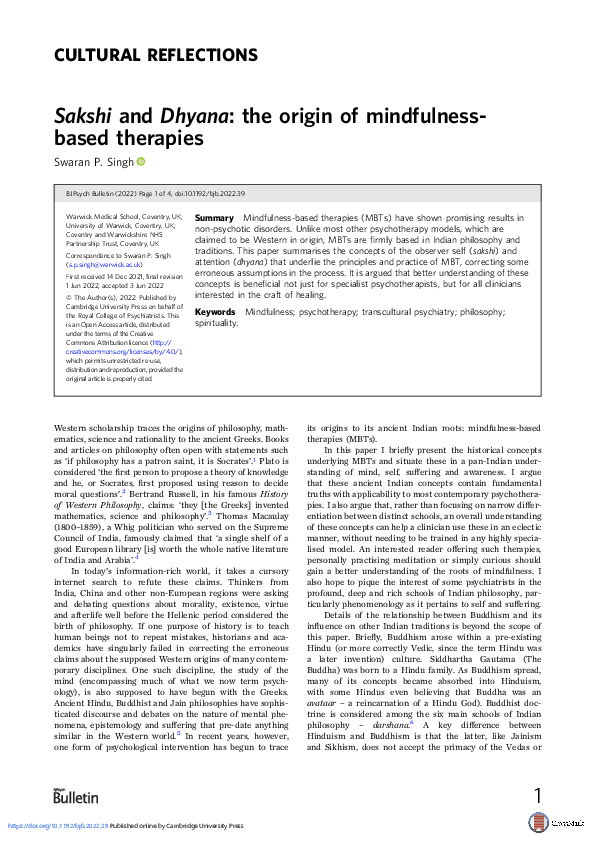
Mindfulness looks clean and clinical in therapy rooms, but its modern form did not materialize out of thin air. Swaran P. Singh’s paper, published online by Cambridge University Press and later appearing in BJPsych Bulletin, traces mindfulness-based therapies back to Indian philosophical traditions, especially the ideas of sakshi and dhyana. That origin story matters because it changes what mindfulness is asking you to do: not just relax, but learn how to witness experience and train attention without being dragged around by it.
The Indian ideas behind the clinical habit
Singh centers the argument on two concepts that do a lot of heavy lifting in modern mindfulness language. Sakshi is often translated as the observer self or witness consciousness, the stance that notices thoughts, feelings, and sensations without collapsing into them. Dhyana is the meditative mode of focused attention and contemplation, the disciplined practice that gives that witnessing quality shape.
Taken together, those ideas make mindfulness less like a wellness hack and more like a training in how to relate to your own mind. The point is not to empty the mind or force constant calm. It is to observe clearly, keep attention steady, and stay present even when the mental weather is messy.
What got translated, and what got left behind
When mindfulness moved into clinical psychology, it was translated into a secular, evidence-informed language that fit hospitals, psychotherapy, schools, and workplace programs. In that setting, it is usually presented as a tool for stress reduction, emotional regulation, pain coping, and attention training. That translation helped it travel far beyond religious or philosophical settings.
But the translation also stripped away some of the original framing. The therapeutic version usually keeps the observing stance and the discipline of attention, while setting aside the wider philosophical commitments that accompanied those practices in Indian traditions. That is why people can end up treating mindfulness as a technique for feeling better, while missing that the older model also had something to say about how to live and how to see the self.
Why the clinical world took it seriously
Singh’s paper notes that mindfulness-based therapies have shown promising results in non-psychotic disorders, which is a big reason the subject landed in clinical psychiatry instead of staying in the wellness aisle. Once a practice has evidence attached to it, the conversation changes fast. It stops being an abstract import and becomes something clinicians can teach, measure, and compare with other interventions.
The paper’s footprint in the literature reflects that interest. The PubMed and Mendeley record lists 10 citations and 58 readers, a modest but clear sign that the origin question has traction among researchers who care about where these methods came from, not just how they are packaged now. That matters because the deeper the clinical use gets, the more important it becomes to know whether the practice is being treated as a neutral stress tool or as a practice with ethical and philosophical roots.
The bridge that made mindfulness mainstream
If you want the clearest bridge from contemplative tradition to modern medicine, it is Mindfulness-Based Stress Reduction. Jon Kabat-Zinn developed MBSR in 1979 at the University of Massachusetts Medical School and founded the Mindfulness-Based Stress Reduction Clinic that same year. He later founded the Center for Mindfulness in Medicine, Health Care, and Society in 1995.
MBSR is commonly described as an eight-week program built around present-moment awareness through meditation, body scanning, and mindful movement. That structure is a good example of what modern clinical mindfulness kept from older traditions: repeated attention training, disciplined observation, and direct contact with experience. What it changed was the setting, the vocabulary, and the claim. Instead of a path embedded in a full philosophical system, it became a standardized intervention that could be taught in clinical and institutional settings.
The beginner myth this origin story clears up
A lot of new meditators still imagine mindfulness as a way to shut the mind off or stay calm all the time. The sakshi and dhyana framework makes that mistake easier to spot. Witness consciousness is not blankness, and focused contemplation is not denial. Both point to the same practical skill: noticing what is happening without being swept away by it.
That shift in expectation matters in day-to-day practice. If you come to mindfulness expecting permanent calm, you will think you are failing every time anger, grief, or distraction shows up. If you understand the older roots, you are more likely to see those moments as the practice itself, because the task is to observe clearly and stay with the experience long enough to understand it.
Why the roots matter now
A related line of scholarship, including Bhikkhu Anālayo’s 2018 article on ancient Indian education and mindfulness, reinforces that modern usage has older Indian precedents. A later review on mindfulness and culture makes the broader point even more bluntly: mindfulness has spread worldwide, and different cultures interpret it differently. That is exactly why the origin story is not just academic background.
For today’s meditator or patient, the practical takeaway is simple. If you are using mindfulness as a stress-reduction tool, you are working with one translated layer of a much older tradition. If you are using it as an ethical or contemplative practice, you are closer to the fuller frame that Singh points back to. The most honest modern mindfulness sits somewhere in between: clinically useful, culturally translated, and still rooted in the older discipline of learning how to witness the mind.
This article was produced by Prism’s automated news system from verified source data, official records, and press releases, then run through automated quality and moderation checks before publishing. The system is built and supervised by the people who set the standards it runs under. Read our full AI policy.
Did this article answer your question?