Mt. Airy Meditation Sangha Grows Through Community, Hybrid Practice
Bob Chapra credits Springboard Sangha's community support for turning his occasional sits into a daily practice; the group's free hybrid model is the how.
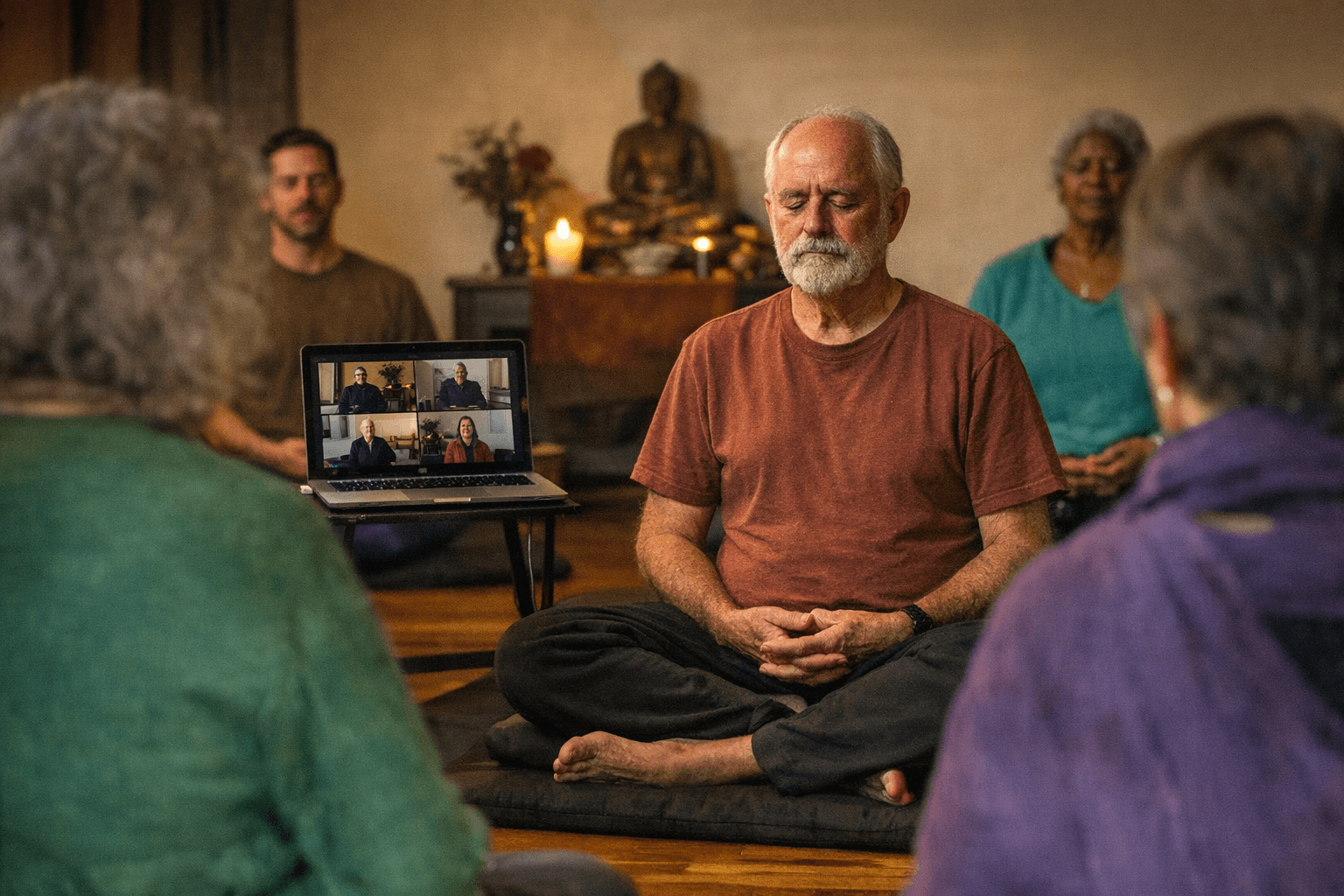
Springboard Meditation Sangha, a nondenominational Buddhist nonprofit founded in 2011 and rooted in the Mt. Airy neighborhood of Northwest Philadelphia, has expanded both its membership and its programming on a single operational premise: every online offering is free and open to the public.
The sangha's anchor event is its Sunday 8am Meditation and Dharma session, its most attended gathering. Senior Teacher Brian Arnell, or an invited guest, leads 45 minutes of silent sitting followed by a Dharma talk. That session runs hybrid simultaneously: participants join in person at the Unitarian Society of Germantown or via Zoom. A Friday noon Sound Sangha, led by Michael Reiley, pairs mindfulness practice with structured discussion of sound, listening, and attention. A monthly book group facilitated by Beth Adelson meets on second Fridays, online only. Each format carries a distinct facilitator and purpose, distributing leadership across the community rather than concentrating it in any single teacher.
Newcomers enter through a Meditation Orientation Class led by meditation teacher Bob Chapra, a low-stakes introduction covering basic sitting technique and beginner questions. Chapra also offers one-on-one mentoring via Zoom on the first Sunday of each month, in sessions ranging from 15 to 45 minutes and open to practitioners at any experience level.
Chapra, who became a daily meditator after joining the group, describes his first visit as an immediate recognition. "When I walked in, I just felt very much at home," he said. "By having the support of having a sangha, a place where people support each other in their practice, that's what got me to really do a daily practice." Another participant identified the same mechanism from a different angle: "It's also deepened my journey because it reminded me how important discipline is, even if it's just a few minutes a day."
The hybrid structure took firmer shape after the COVID-19 pandemic, when groups that maintained Zoom access held on to geographically dispersed members who would otherwise have drifted away. Springboard formalized what the disruption exposed: that community infrastructure, not just technique, is what converts sporadic sitting into consistent practice. Public-health researchers studying real-world delivery of mindfulness-based interventions have flagged exactly this point: community context moderates long-term adherence in ways that apps and self-guided courses cannot reliably replicate.
For a local group aiming to replicate the model, Springboard's structure offers a workable template. Anchor the week with one high-attendance flagship session on a fixed schedule and keep its format predictable. Assign a named facilitator to each sub-program rather than rotating leadership informally. Build an explicit, low-barrier entry point for newcomers with a single named contact. Make online access permanently free. And layer in individual mentoring, even briefly, to create the one-to-one accountability that carries practitioners through the gaps between group sits. Springboard's growth is traceable: it follows from treating the sangha itself as a practice worth designing carefully.
This article was produced by Prism’s automated news system from verified source data, official records, and press releases, then run through automated quality and moderation checks before publishing. The system is built and supervised by the people who set the standards it runs under. Read our full AI policy.
Did this article answer your question?


