Short mindfulness session lowers anxiety and boosts motor skill learning
A 10-minute guided meditation lowered heart rate and anxiety, and it raised circle-tracing accuracy by 4.2 percent for the trained hand.
A short guided mindfulness session did more than settle nerves. In a small controlled trial, 24 meditation-naive adults who spent 10 minutes in guided mindfulness meditation before practice not only reported less anxiety, they also learned one finger-tracing task better than peers who simply sat at rest.
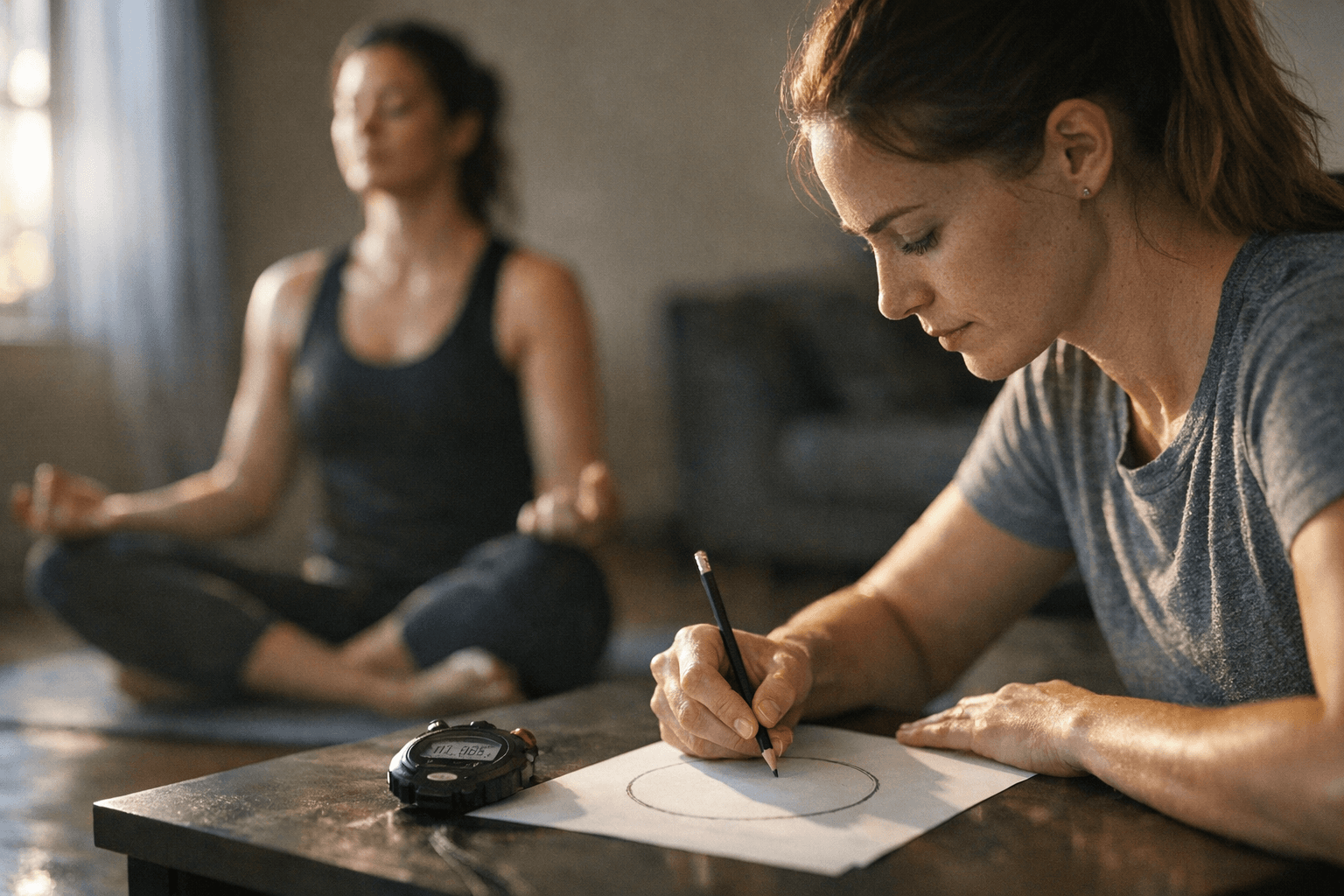
The open-access paper in Frontiers in Psychology, titled Guided Mindfulness Meditation as a Priming Strategy for Reducing Anxiety and Facilitating Motor Skill Learning, lists Merwyn Yu Xian Lee, Megan Wan Ting Tay, Meng Leong Chia, Pei Ling Choo and Xiang Ren Tan as authors. It was received on Sept. 2, 2025, and accepted on March 20, 2026. The team randomly assigned participants to either the meditation session or a seated-rest control, then had them practice circle tracing with the dominant hand, the nondominant hand and an inverted-screen version designed to make the task novel and more demanding.
The clearest effect showed up in the body before it showed up in the hand. Heart rates were lower during guided mindfulness meditation, with the study reporting F3.3,36.6 = 3.495 and p = 0.022. Self-reported anxiety on the visual analogue scale also fell after a single session, with p = 0.012. That gives the routine a practical appeal for anyone who wants a calmer start before a piano run-through, a rehab drill or a first pass at a new tennis stroke.
Learning gains were narrower, but they were measurable. Only the mindfulness group showed improvement on the trained-hand circle-tracing task, posting a 4.2 percent jump in accuracy, with p < 0.001. The benefit did not carry over in the same way to the untrained hand or to the novel inverted-screen task, which points to a task-specific effect rather than a broad upgrade to every kind of motor learning. A post-learning Parametric Go/No-Go test also showed no difference between groups, suggesting this design did not produce measurable changes in inhibitory control, sustained attention or processing speed.
That restraint matters. The study adds a concrete, skill-based example to a growing literature that already includes a 2023 Frontiers in Psychology paper on acute mindfulness and bimanual coordination, plus a 2024 meta-analysis that found mindfulness-based interventions reduced test anxiety across 18 primary studies and 20 comparisons. The American Psychological Association describes mindfulness meditation as attention training and links it with stress reduction and positive changes in brain and biology. Here, the takeaway is tighter and more usable: a brief guided session may be enough to quiet anxiety and give a practiced movement a better launch, even for people new to meditation.
This article was produced by Prism’s automated news system from verified source data, official records, and press releases, then run through automated quality and moderation checks before publishing. The system is built and supervised by the people who set the standards it runs under. Read our full AI policy.
Did this article answer your question?