Aicon Art Gallery Showcases Historic Indian Miniature Painting in New York Exhibition
Aicon Art's first-ever Indian miniature show runs through May 2 in New York, and 400-year-old works on 7-inch folios map directly onto five painting tactics for 28-32mm figures.
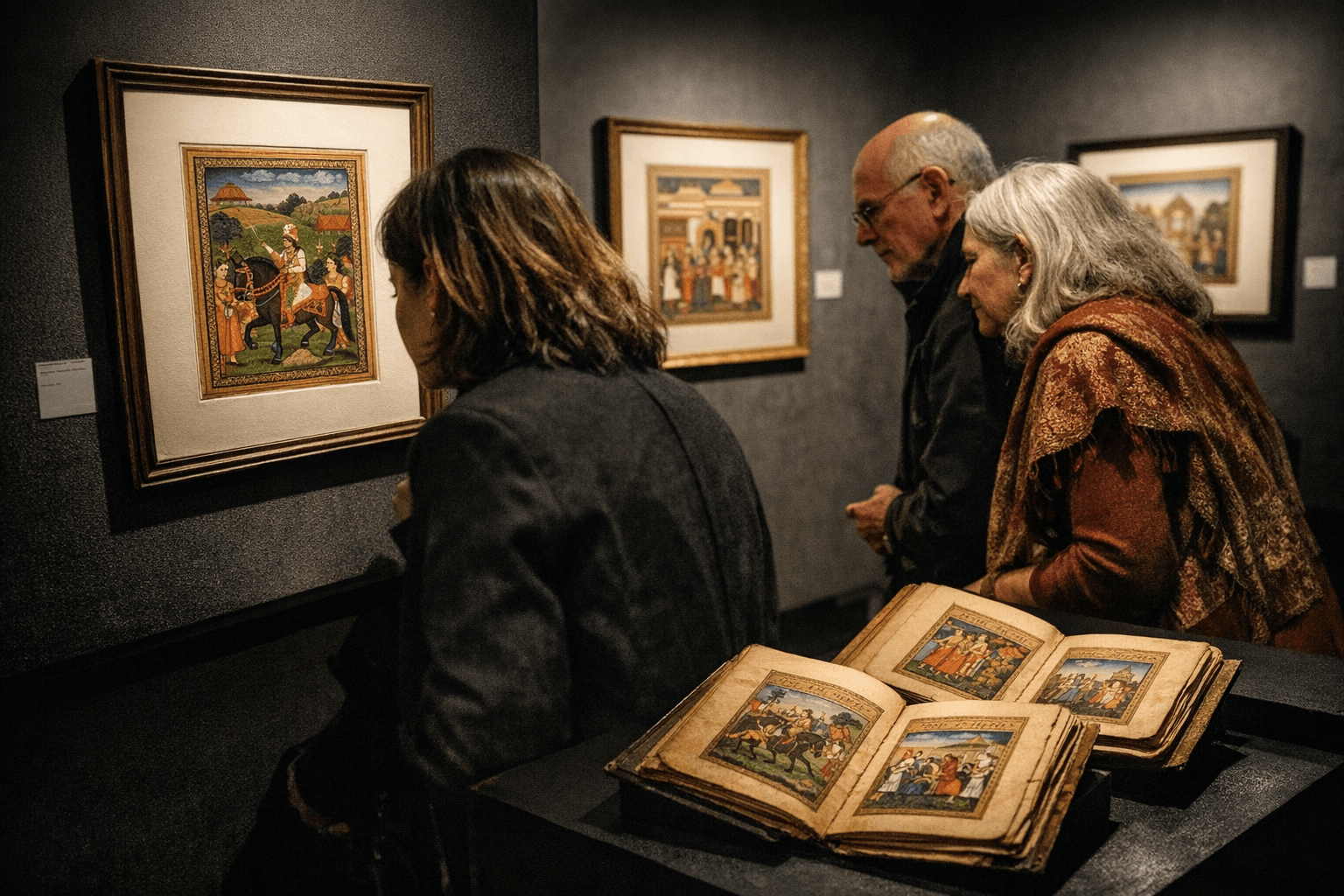
Aicon Art's "Courtly Visions: Indian Miniature Painting" is on view in New York through May 2, the gallery's first exhibition devoted exclusively to the genre. The show draws together works from Mughal, Deccani, Rajasthani, and Pahari courts spanning roughly 1630 to the early 19th century, and for anyone painting at 28 to 32mm scale, it reads as a crash course in every technical problem the hobby still hasn't fully solved.
The share hook is this: "Baz Bahadur and Rupmati Riding at Night" (Probably Awadh, Mughal, ca. 1800), one of the show's anchor pieces, measures 7¾ by 10⅛ inches. That's smaller than an iPad screen. Artists working four centuries ago were solving the same density, hierarchy, and finish problems that competition painters agonize over at 32mm, and they did it in a physical format that makes a well-painted Space Marine look oversized.
Five tactics come through clearly when you walk the show. The first is pattern density. The Rajasthani and Pahari works, including "Phālguna Court Festivities on a Lakeside Palace Terrace" (attributed to Amar Chand, Kishangarh, 1792, a sprawling 15 by 13 inch panel), fill micro-scale space with repeated geometric and floral motifs that create visual richness without muddiness. On a 28mm figure, this is the logic behind painted cloth patterns, heraldic trim, and embroidered borders: not decoration for its own sake, but pattern as storytelling density.
The second tactic is edge lines. Every court tradition in this show uses a crisp bounding outline to separate figure from ground, applied over completed color fields. That sequencing matters. Hobby painters who line before highlighting lose the precision these folios demonstrate. Line last, over your finished color, and the figure sharpens immediately.
Third is jewel-tone layering. The gallery catalogue lists "opaque watercolor heightened with gold on paper" for piece after piece across every regional school. Jewel-tone saturation comes from opacity, not from saturation alone. Opaque pigment layered over a prepared ground, then punched with gold, is the same optical principle behind Scale 75 and Vallejo Model Color at their most effective. Thin washes kill this effect.
Compositional hierarchy is the fourth tactic, and "Phālguna" teaches it better than any painting theory text. The patron figure is larger, placed higher, and given more surrounding negative space than the servants, even in a composition packed with revelers and architecture. On a diorama base, relative scale and intentional empty space control where a viewer's eye lands first.
Fifth is narrative iconography: encoding story through object, posture, and color before any viewer reads a label. The indigo night sky in "Baz Bahadur and Rupmati," the gold-heightened horse, the isolated riders, tell the entire romantic legend through pigment choices alone. Character models and narrative bases work in this same tradition when the painter commits to thematic intent rather than just technical execution.
"The gallery's mainstay has long been South Asian modernism (particularly the Bombay Progressives)," said Aicon Art Associate Hannah Matin, "but amid the growing momentum and global attention around South Asian art, it felt essential to expand that narrative by incorporating its foundational sources." She pointed out that S. H. Raza's early color development was shaped by his study of Rajasthani and Jain miniatures, and that M. F. Husain's "Ragamala" series drew its musical subjects directly from Indian folios of the same name.
The process detail that most mini painters will find genuinely surprising: artists worked on wasli paper, a hand-made, layered, burnished paper processed to achieve a smooth surface, using natural mineral and plant pigments, gold and silver highlights, and squirrel-hair brushes for fine detailing. No wet palette. No flow improver. No synthetic brushes. A single whisker pulled to a point, mineral pigment ground from stone, and a burnished ground. The control visible in these folios at sub-10-inch scale, centuries later, came entirely from preparation and deliberate layering sequences that translate directly to how a disciplined hobby painter should approach any figure worth finishing.
"Courtly Visions" closes at Aicon Art on May 2.
This article was produced by Prism’s automated news system from verified source data, official records, and press releases, then run through automated quality and moderation checks before publishing. The system is built and supervised by the people who set the standards it runs under. Read our full AI policy.
Did this article answer your question?