Hattiesburg Artist Transforms Alley Into Mississippi's Tiniest Museum With Miniature Dioramas
Vicki and Rick Taylor's free Hattiesburg Pocket Museum drew 300,000+ visitors using miniature dioramas built on an $800 budget, and it's boosted local tourism by over 40%.

The alley behind Hattiesburg's Saenger Theater is not where you'd expect to drop to your hands and knees to peer at tiny figurines canoeing down a drainage pipe, but that's exactly what more than 300,000 people have done since Vicki and Rick Taylor opened the Hattiesburg Pocket Museum in 2020. The Taylors launched the installation, also known as "Mississippi's Tiniest Museum," hoping to bring joy and traffic to the city's downtown during the COVID-19 shutdown. Now drawing international wire coverage, the free, 24/7 installation is the clearest public proof yet that miniature-scale craft can rewire how a downtown functions, and it started on an $800 budget.
Vicki, who serves as the museum's assistant curator, assembles the scenes in the cramped backroom of the theater, gluing together tiny figurines that peer over electrical boxes, canoe down drainage pipes, and hide in nooks and crannies waiting to be found by someone curious enough to get on their hands and knees to search. The centerpiece is a 36-inch by 48-inch window fitted with four display shelves. A hidden display features a cat typing at a computer. Scenes rotate monthly and grow more elaborate over time. The techniques are immediately recognizable to any miniature painter: fine brushwork, colour layering, and scenic micro-basing applied to figures set into constructed terrain.
Rick Taylor is the executive director of the Hattiesburg Convention Commission, the agency that runs both the museum and the Saenger. The Convention Commission estimates more than 300,000 people have visited since the museum opened, coinciding with a more than 40% increase in Hattiesburg's tourism economy. Vicki put the stakes plainly: "Hattiesburg is not a beach town, and it doesn't have mountains. There's got to be something to get people to come off the highway."
The museum started as a small window display facing into the alley behind the Saenger Theater and has since grown to include a tiny art gallery, a movie theater, colorful murals, a keychain and DVD exchange, a rainbow bridge for the collars of departed pets, and a motion-activated dance spot that plays music along with disco lighting. Mural artist Gabby Smith used the alley as a proving ground while pivoting to pursue art full-time. Local resident Brianna Moore, who brings her two sons regularly, captured the experience directly: "You may come feeling down, but you're going to leave excited."
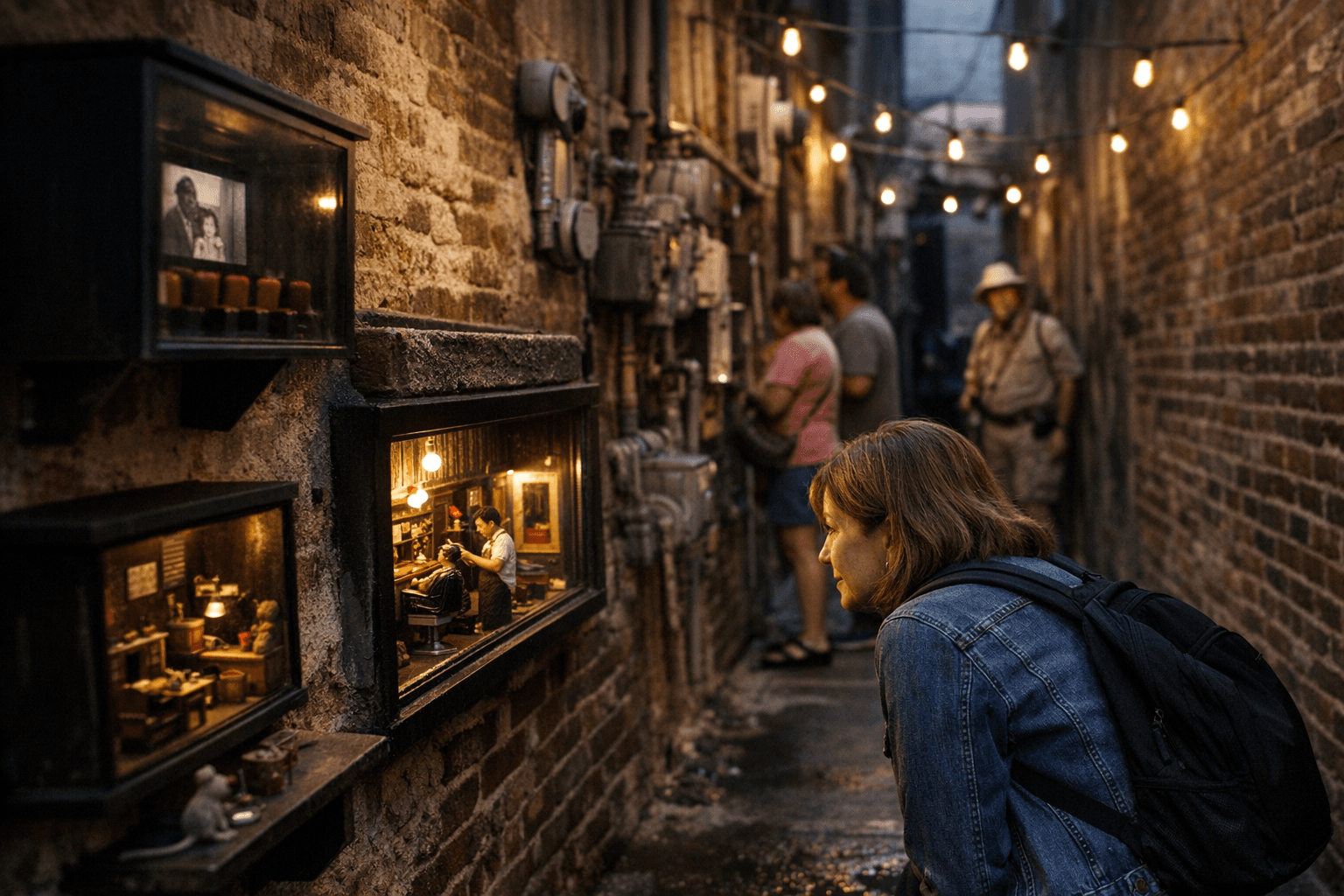
For painters thinking about moving work off the hobby table and into public space, the Pocket Museum runs through several concrete lessons worth stealing. Outdoor placement makes durability the first concern: the Taylor installation uses security glass over the main display window, and any outdoor diorama meant to survive more than a weekend needs an exterior-rated varnish, positive drainage away from the scene base, and UV-stable pigments or protected siting out of direct sun. The museum's "find and seek" structure, placing ever-changing miniature model dioramas across a variety of utility boxes in the alley to create a discovery component, also solves the core challenge of miniature storytelling in a tiny public footprint: each scene reads completely on its own, but together they reward repeat visits.
Pitching a similar project to a local arts body or convention commission follows the Taylor model closely. Identify an underused alley or exterior wall adjacent to an existing venue with foot traffic, start with a single protected window display rather than a full installation, recruit a local theater or tourism agency as the operating partner, and let word-of-mouth and phone photos do the rest. Rick Taylor noted the museum has no address and launched with no advertising, which caused it to become notable because of the challenge of finding it; visitor photos eventually placed a pin on mapping apps. That frictionless discovery loop is itself the blueprint.
This article was produced by Prism’s automated news system from verified source data, official records, and press releases, then run through automated quality and moderation checks before publishing. The system is built and supervised by the people who set the standards it runs under. Read our full AI policy.
Did this article answer your question?