Building Lenoon’s Warhound Titan, structure, pose, and learning on the fly
Bowen has already locked Lenoon’s Warhound into a one-leg-up stance, and that commitment is the lesson: on a titan this big, the structure decides everything.

Structure first, paint later
The hardest part of Lenoon’s Warhound is no longer whether it will look like a titan. It is whether the build reads as intentional, because Bowen has already pushed the model past the point where wishful thinking can fix the pose. The result is a Warhound that is part engineering problem, part sculptural decision, and part lesson in knowing when to stop imagining and start committing.
A year-long build that is really a learning exercise
This is the second chapter after *Warhound: Intent*, and that matters. Bowen framed the project as a long-form build over the course of a year, not as a weekend resin assembly, and that slower pace shows in every choice he describes. The point is not simply to finish a titan, but to learn from makers, artists, craftspeople, professionals, and friends while the model is still in motion.
That makes the article useful for anyone staring at a large kit on the bench and wondering why it feels harder than a normal build. The answer is usually that a big centerpiece model forces you to think in layers: pose, structure, balance, and then, only after that, surface detail. If those first decisions wobble, paint cannot save them.
Why the torso is not the real problem
Bowen says the Warhound is already at a stage of “two legs, a waist and a blocky interior,” which is exactly the kind of phrase that should make any titan builder sit up. That is the in-between stage where the model has mass but not personality, and where the wrong decision can leave the whole silhouette dead or awkward. At this point, the body exists, but the story of the stance still has to be told.
The head and the feet are doing most of that storytelling. Bowen is explicit that those parts will give the model focus and structure, and that is the right way to think about it. On a titan, the head tells the viewer where the machine is looking and thinking, while the feet tell the viewer how much weight the pose can actually carry.
The cockpit forced a change in plans
One of the best takeaways from the build is how quickly a strong idea can die when it meets the actual dimensions of a kit. Bowen started with a real bird skull concept, then abandoned it after measuring the Warhound cockpit. That is not a failure of imagination. It is the kind of practical correction that keeps a grand idea from turning into an expensive mistake.
Snafu came in with the fix, scaling and producing a raven skull through printing and digital sculpting. That detail says a lot about where the hobby is now: hand-built resin work and digital tools are not rivals, they are just different parts of the same toolkit. When a project needs a shape that is too specific, too small, or too exact to wing by eye, digital assistance can save hours of rework.
Once the joints are glued, the pose is yours forever
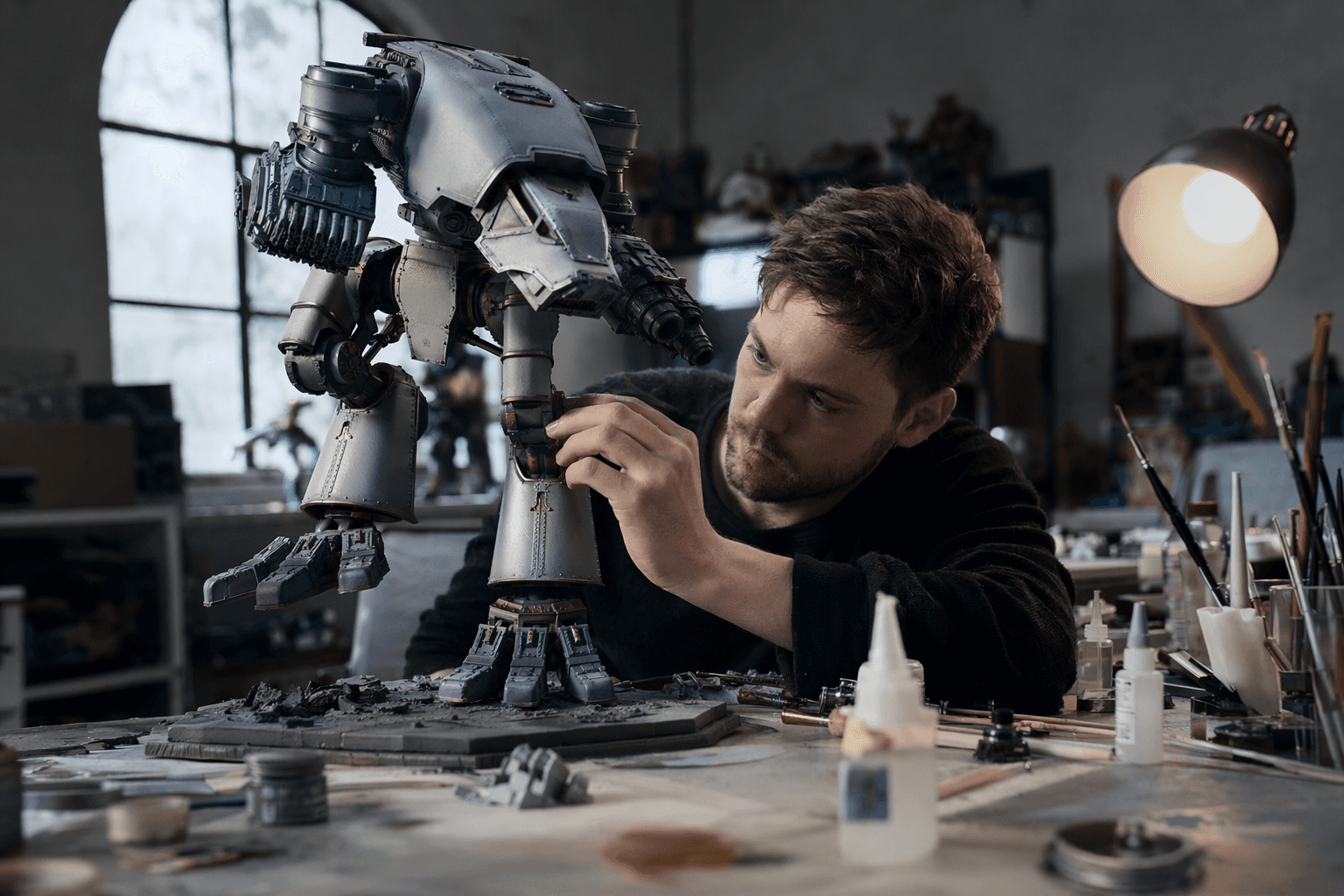
Bowen has already committed the model to “one leg up, one down” with superglue, epoxy and pins, and that is the critical engineering lesson in the piece. On a Warhound, pose is not a late-stage cosmetic choice. It is a structural commitment, and every dry-fit, pin hole, and contact point decides how much freedom you have left.
That is why the older Goonhammer build guidance still matters. It treated the Warhound as a six hundred dollar resin model and a serious commitment to build and paint, and the recommended toolkit was exactly what you would expect from a model this unforgiving: a power drill, drill bits, brass rod, a saw, and 5-minute epoxy. Those are not optional luxury items. They are the difference between a titan that stands and a titan that slowly becomes a box of regrets.
Why the Warhound is such a brutal test piece
Games Workshop describes the Warhound Titan as the smallest class of “true” titan, but small is relative when the body-only kit is listed at £453.50. It is still a resin expert kit, still a scout titan, and still the kind of project that sits in the same mental category as Legio Titanicus and Titan Legios centerpieces: large, ambitious, and impossible to rush if you want it to look right.
That scale is exactly why the build decisions matter so much. A Warhound does not disappear into a crowd of smaller models. Every tilt of the head, every angle of the knee, and every placement of the foot becomes part of the finished identity. If the structure is vague, the model looks uncertain. If the structure is clear, the whole thing feels alive before paint ever touches it.
The paint job starts in the pose
This is the part painters should pay attention to, even if the article is about structure rather than color. A titan with a clean silhouette is easier to prime, easier to photograph, and easier to make dramatic on the shelf because the viewer reads the shape before they read the weathering. Bowen’s build makes that obvious: the more deliberate the head and feet are, the more the final paint job has something to sell.
That is the real value of the piece. It shows that a huge resin kit is never just a pile of parts to be cleaned up and glued together. It is a chain of decisions, and every decision either supports the pose or weakens it. Bowen’s Warhound is teaching the old lesson the hard way: if you want a centerpiece model to look inevitable, you have to engineer that inevitability long before the first coat of paint.
This article was produced by Prism’s automated news system from verified source data, official records, and press releases, then run through automated quality and moderation checks before publishing. The system is built and supervised by the people who set the standards it runs under. Read our full AI policy.
Did this article answer your question?