Casca Bust Painting Deepens, Goonhammer Tackles Non-Metallic Metal
Casca’s armour turns Part 3 into a real NMM test: keewa shifts from setup and portrait work into light mapping, contrast, and edge control on a centerpiece bust.
Why Casca is the right model for non-metallic metal
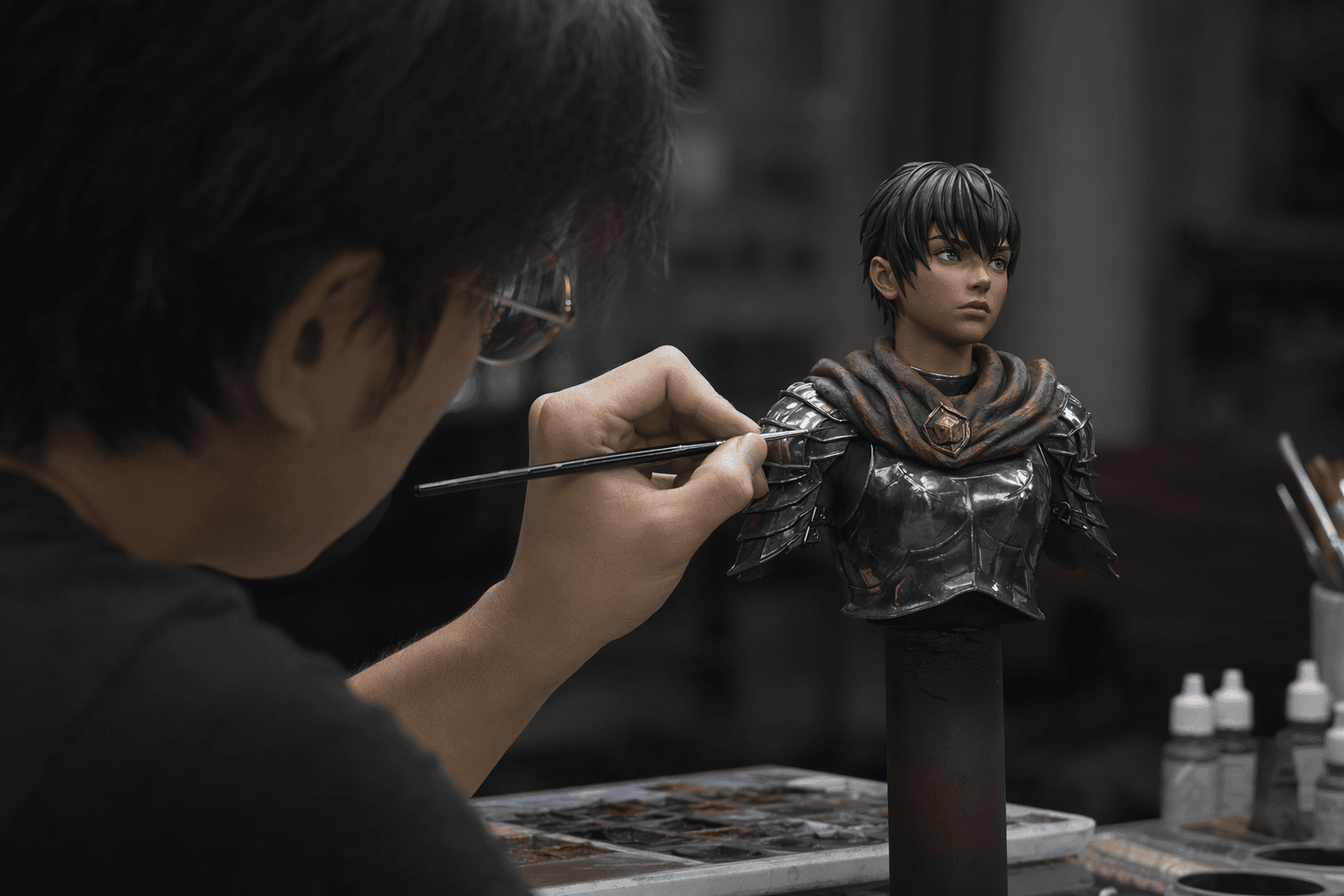
Casca’s armour is exactly the kind of surface that exposes whether non-metallic metal is working. The character is instantly recognizable to Berserk fans, and the bust version Goonhammer has been following shows her in her Golden Age pre-Eclipse attire, which puts the armour at the center of the composition. That matters because Casca is not a generic fantasy knight, she is one of Berserk’s most beloved and tragic figures, a former unit commander of the Band of the Falcon and an estranged companion of Guts, so the viewer brings real expectations to the piece before the first highlight even lands.
That recognition gives the NMM work higher stakes. On a smaller tabletop miniature, a loose metallic read can still pass in motion. On a bust, especially one built for display, the armour occupies enough visual space that weak reflections or muddy edges immediately flatten the whole figure. This is why Casca is such a useful test subject: if the metal reads correctly here, the technique has done more than decorate a model, it has sold the material.
What changed in Part 3
The third chapter of A Brush With Greatness is where the project stops being an introduction and becomes a material challenge. Part 1 on April 7 set up the journey, Part 2 on April 14 focused on Casca’s face, and a previous installment also dealt with the practical realities of working on the resin figure, including cleanup and preparation. By April 28, the series has reached the point where keewa is deep into the bust itself, trying to make the armour read as metal without relying on metallic paint to do the heavy lifting.
That shift is what makes Part 3 feel like an evolution rather than another update. The early chapters establish the model and the character, but this installment asks for judgment: where does the light live, how hard should the contrast jump, and how controlled do the edges need to be for the viewer to believe in the finish? Goonhammer’s own companion Hobby 102 piece on April 9 already framed non-metallic metals as an advanced topic, so Part 3 reads like the first serious application of that knowledge on a real centerpiece model.
How NMM actually works on a bust
Non-metallic metal is the art of painting metal without metallic paints, using regular acrylics, shadows, highlights, and contrast to simulate reflection. The Army Painter describes it in exactly those terms, and Richard Gray Creations’ armour tutorials underline the practical side of the method: plates, trims, and shoulder rims live or die on clear light mapping and controlled edge highlights. That is the logic keewa is working inside here, and it is why the technique matters most on large, readable forms like Casca’s armour.
The central lesson is that metal is not painted as a color, it is painted as an effect. You need to decide where the brightest points will sit, where the darks will sink, and where the hard transitions should sharpen into believable edges. On armour, the viewer expects crisp reflected planes, so the technique rewards confidence more than softness. Too little contrast and the piece goes dull; too much chaos and the illusion breaks.
For a centerpiece bust, that means treating every plate like a tiny stage. The broad surfaces give you room to map the reflection, while the trims and rims give you the chance to sell the material with precise lines. The effect is especially powerful on a character like Casca because the armour is not an accessory, it is part of the figure’s silhouette and identity.
What you can copy from the approach
The practical value of Part 3 is not that it turns NMM into a mystery, but that it shows how to break the job into readable decisions. If you are working on your own centerpiece model, the same logic can be copied without cloning Casca’s exact palette.
- Start with the shape of the reflection, not the color of the metal. The armor must read as a reflective surface before it reads as bronze, steel, or gold.
- Push your contrast enough for display viewing. NMM depends on strong value jumps, because the illusion only works when highlights and shadows are clear from a distance.
- Use edge highlights to define the form. Richard Gray Creations’ emphasis on plates, trims, and shoulder rims is the useful part here, because those crisp edges are what make the light feel intentional.
- Keep the light map coherent across the model. If one plate catches light from one direction and the next plate behaves differently, the illusion collapses.
- Treat NMM as a surface study, not a shortcut. The Army Painter’s framing is helpful here: this is still traditional acrylic painting, just aimed at a more demanding illusion.
That last point is why the Casca bust works so well as a case study. The project is not about hiding behind metallic pigment or letting a pot do the work. It is about showing how far regular paints can go when the painter is willing to place highlights, deepen shadows, and control the edges with purpose.
Why this series matters for the hobby
A lot of hobby coverage stops at the finished hero shot, but this series keeps the learning visible. That is valuable because NMM often gets treated like a contest-only trick, something reserved for gold-medal display pieces and painters with endless patience. Part 3 argues for a more useful view: you can build toward NMM on one major model, learn from the errors, and still end up with a bust that reads as complete and convincing.
That is the real payoff of keewa’s Casca project. It ties a beloved Berserk character to a demanding technique, then turns the process into something other painters can actually use. If Part 1 introduced the journey and Part 2 established the face, Part 3 is where the armour teaches the lesson: the metal illusion has to earn its place, and when it does, the entire bust feels sharper, richer, and far more alive.
This article was produced by Prism’s automated news system from verified source data, official records, and press releases, then run through automated quality and moderation checks before publishing. The system is built and supervised by the people who set the standards it runs under. Read our full AI policy.
Did this article answer your question?