Mandi Kalam Miniature Painting Workshop Concludes, Officials Urge Regional Craft Revival
Twenty women artisans completed a month-long Mandi Kalam workshop in Mandi, Himachal Pradesh, reviving a Pahari tradition whose brushwork techniques translate directly to 28mm scale.
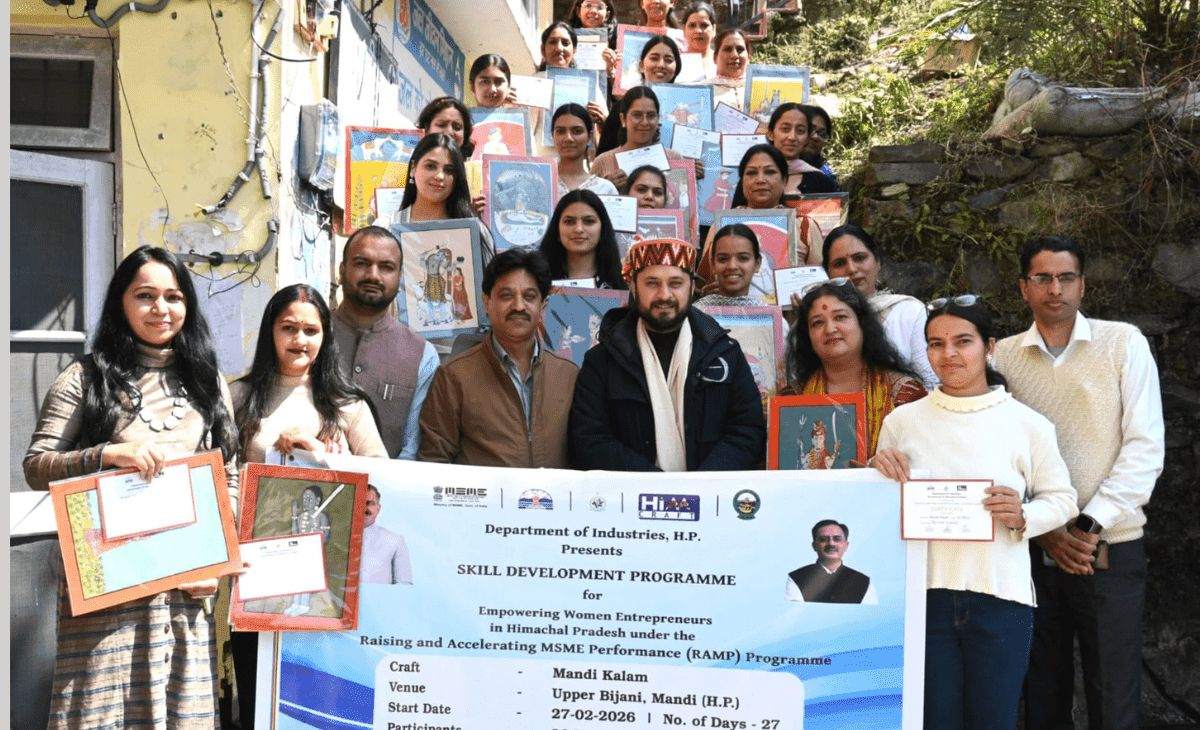
Mandi Kalam's defining technical demands, intricate linework laid with extremely fine brushes, patient pigment layering, and disciplined composition on a surface measured in inches, map directly onto what painters chase at 28 to 75mm scale. A month-long structured program reviving exactly those techniques wrapped up last week at Upper Bijni in Mandi, Himachal Pradesh, with a closing ceremony presided over by Deputy Commissioner Apoorv Devgan.
The workshop was organized by the Himachal Pradesh State Handicrafts and Handloom Corporation (HIMCRAFT) and funded by the Ministry of Micro, Small and Medium Enterprises. Twenty women artisans completed the program under master craftsperson Rajesh Kumar and designer Anshul Malhotra, covering miniature painting techniques alongside design skill upgradation and entrepreneurship development. HIMCRAFT District In-Charge Akshay Singh Dode welcomed Devgan to the valedictory session and presented him with a Mandi Kalam painting as a token of appreciation; the Municipal Corporation provided the venue.
Devgan distributed certificates to all 20 participants and said they "demonstrated notable improvement and artistic finesse over the training period." He described Mandi as historically "a centre of cultural preservation and artistic excellence" and noted the style "is witnessing a gradual resurgence and holds significant potential for expansion," adding that "sustained efforts and innovation are key to ensuring its wider recognition."
Mandi Kalam is one of the Pahari schools of miniature painting, historically flourishing from roughly the 16th to the 19th centuries. Its characteristic features are intricate linework, vibrant natural dyes, and scenes drawn from local legend and courtly life. The technical demands are unambiguous: extremely fine brushes, patient layering, disciplined composition. That description doubles as a skill rubric for any 32mm historical figure. The courtly scenes and compressed narrative that define the style present exactly the compositional problems we solve on a 40mm scenic base.
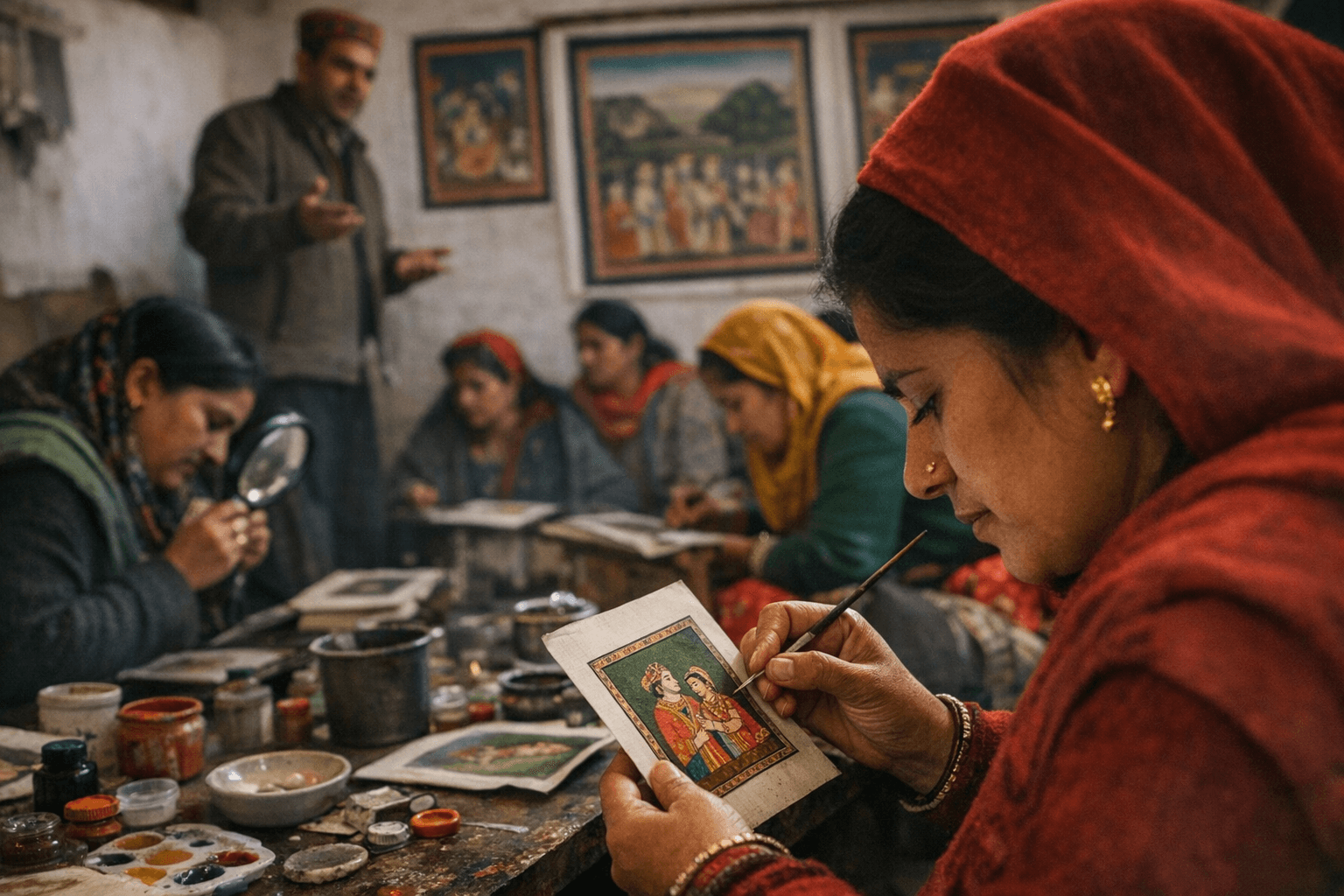
The revival angle is a prompt for a focused skills drill this week. Pull one ornamental motif from Pahari reference images, a single face or repeating border element, work it entirely with a 10/0 or 000 brush, and hold the palette to three values plus one saturated accent. The constraint forces the controlled linework and tonal restraint that Rajesh Kumar spent a month teaching. For reference material, the Victoria and Albert Museum's South Asian collection holds strong Pahari examples, and Google Arts and Culture carries digitised works from the broader school. Workshop photographs, if HIMCRAFT releases them ahead of any planned exhibition, would offer the most targeted technical reference for replicating the specific palette and linework the 20 participants trained on.
The administration is considering organising a public exhibition to showcase the workshop pieces and build market linkage for the artisans; no date has been confirmed. HIMCRAFT frames the program as both cultural safeguarding and livelihood creation, a dual aim that has historically made craft revival workshops more durable than single-event demonstrations.
A 400-year-old technique reaching 20 new practitioners through a structured, government-backed curriculum is worth tracking. The fundamentals it transmits are the same ones that matter at every scale.
Know something we missed? Have a correction or additional information?
Submit a Tip