Hammer’s stripped-back studio method for faster, more creative tracks
Hammer’s shortcut is ruthless subtraction: he opens an old session, strips it to the bones, and turns leftover groove into faster, tighter club tracks.
Why the empty DAW slows everything down
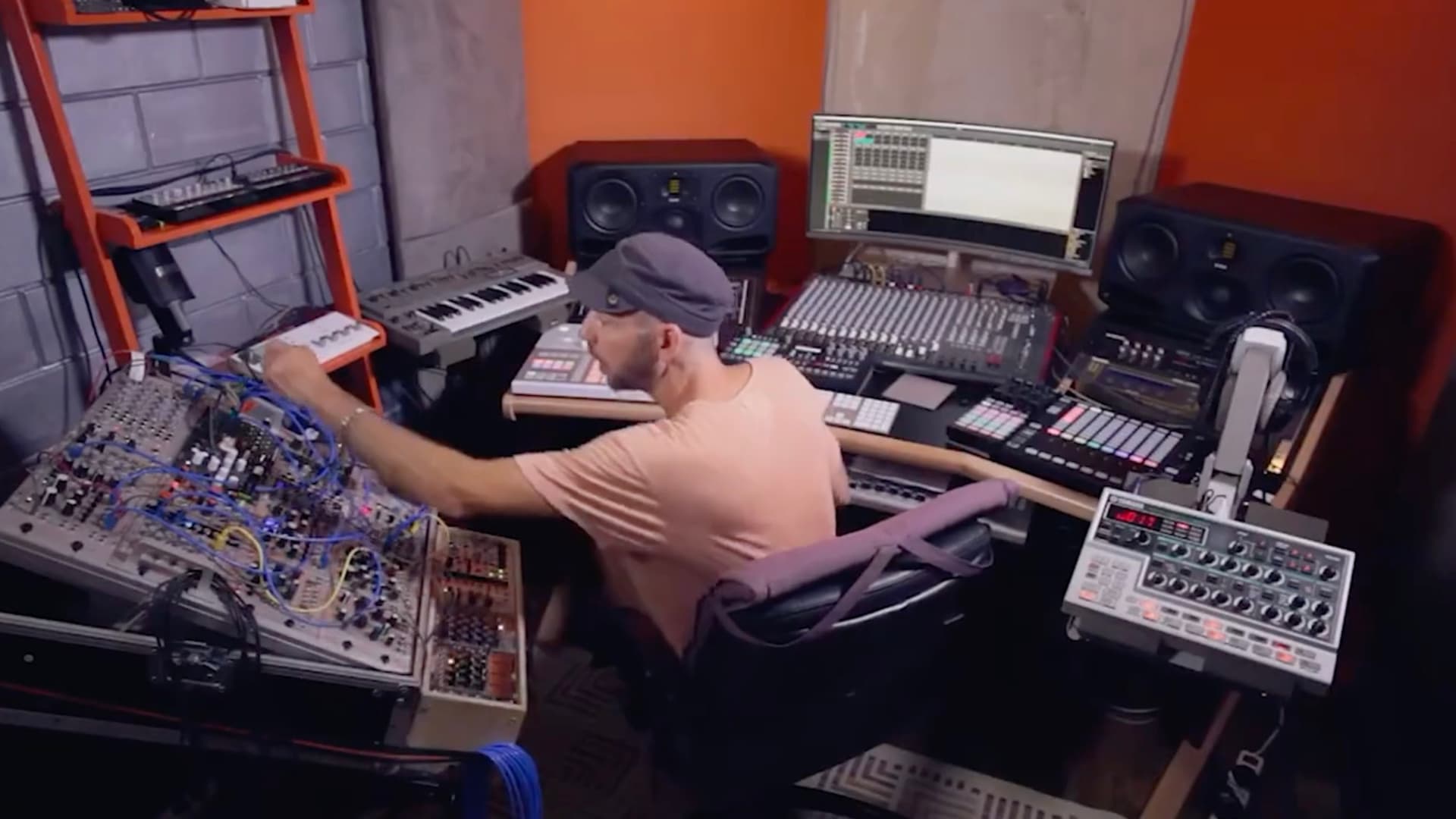
Hammer’s most useful lesson for minimal techno producers is also the least glamorous: do not always start from zero. In the MusicRadar studio session, Rory Hamilton, the Belfast-born, Glasgow-based producer better known as Hammer, says he often opens an old project and strips it back instead of staring at a blank timeline. That single shift turns the studio into a place of decisions, not paralysis.
For minimal techno, that matters more than it might in a denser style. When your track depends on groove, tension and negative space, every unnecessary layer blunts the impact. Hammer’s method keeps the writing process moving because it begins with something already alive: a drum loop, a bass idea, a chord stab, or a fragment of arrangement that still has momentum.
Start from the residue of a previous idea
The strongest practical takeaway here is to treat old sessions as raw material, not failures. Hammer’s approach preserves continuity from one record to the next, letting him reuse promising drum ideas, reshape them, and push into new territory without losing pace. That is a big reason the workflow feels so productive: the best parts survive, while the weak parts get cut away before they can clutter the track.
This is exactly the kind of discipline that suits stripped-back club music. If you already have a kick pattern with the right swing, a hat line that pulls the groove forward, or a bass motif that locks with the drums, you do not need to rebuild the world around it. You need to isolate the strongest elements and let them breathe. In minimal techno, subtraction is not a compromise. It is the arrangement.
What the session reveals about building with less
The related MusicRadar video gives the process a concrete shape, and that shape is useful for anyone making lean dance music. The track build moved through drums, bass, chords, sampled vocals and arrangement, rather than starting with a finished harmonic bed and adding percussion at the end. The gear list was equally telling: a Roland TR-808, a Roland SH-101 and a Yamaha CS1x.
Those choices line up with Hammer’s broader reputation in Glasgow’s house and techno scene, where he is known for deep rolling arps, old analogue synths and euphoric melodies. He sits at the intersection of house, techno, disco and UK garage, so his studio decisions are never academic. They are about function, feel and movement. For minimal producers, the lesson is simple: let the drums establish the spine, then introduce only the harmony and vocal fragments that sharpen the tension.
A practical way to translate that workflow looks like this:
- Begin with one old session that already has a convincing pulse.
- Strip out anything that competes with the kick and groove.
- Keep only the drum parts that survive the mute test after a few bars.
- Add bass only after the rhythm feels strong on its own.
- Use chords or sampled vocals sparingly, as accents that open space rather than fill it.
Groove first, then atmosphere
Hammer’s background helps explain why this method works. MusicRadar identifies him as Rory Hamilton, and other verified bios place him in Belfast, Glasgow and London, with roots in a scene where hardware, swing and club function matter as much as melodic identity. Insomniac describes him as a Belfast-born artist shaped by Glasgow’s house and techno ecosystem, while Resident Advisor places him among producers known for rolling arps and euphoric synth work.
That background matters to a minimal techno reader because it shows how a groove-first mindset can still lead to emotional records. Hammer’s sound is not minimal in the academic sense, but the logic transfers cleanly: build the track from a few high-value pieces, and let the arrangement come from contrast rather than accumulation. A spare kick pattern, a filtered bassline and one repeated vocal slice can do more work than a dense, over-decorated session.
The real advantage here is speed with intent. When you start from a previous project, you are not merely saving time. You are cutting out the dead air that often makes tracks feel overworked. That means more room for instinct, more room for swing, and more room for the tiny variations that keep a loop feeling human instead of mechanical.
Why Hammer’s workflow keeps records moving
There is also a bigger career-level reason this approach lands so well. A recent Bandcamp page says Remmah is home to Hammer’s labels Remmah, Italo Hiits and The Hammer Hits, and Resident Advisor notes that Remmah started in 2020 and was heading toward its 10th release. That is a useful clue: this is not just a studio trick, it is a system for turning ideas into finished records at a steady pace.
For producers who release into a scene built on momentum, that kind of infrastructure matters. A repeatable method makes it easier to keep a sound coherent across multiple records while still finding new corners to explore. Hammer’s workflow gives you the same advantage on a smaller scale. You can carry one useful drum idea forward, swap the bassline, reframe the chords, and end up with a track that feels deliberate rather than crowded.
The minimal techno translation
If you strip Hammer’s method down to its essentials, the lesson for minimal techno is not “work faster” in the abstract. It is: work from something already moving, then prune until the groove becomes obvious. That means starting with a session that has useful residue, keeping the drum patterns that actually breathe, and resisting the urge to overwrite silence with more parts.
The result is a track that feels functional on the floor and easier to finish in the studio. Instead of chasing inspiration through an empty grid, you are shaping what is already there. That is how Hammer turns a stripped-back process into a creative one: by trusting that the best groove often appears after you remove almost everything else.
This article was produced by Prism’s automated news system from verified source data, official records, and press releases, then run through automated quality and moderation checks before publishing. The system is built and supervised by the people who set the standards it runs under. Read our full AI policy.
Did this article answer your question?