ICYKOF’s Space Talk EP bridges Chicago, Detroit and UK techno roots
ICYKOF’s Space Talk turns a fashion-to-techno crossover into a credible floor record, tying Chicago, Detroit and UK roots together through three sharp DJ tools.
Why Space Talk matters beyond the novelty
ICYKOF’s Space Talk EP works because it does not lean on its backstory for shortcuts. The record arrives as a three-track release on RSPX, Radio Slave’s Rekids Special Projects offshoot, catalogued as RSPX85, and it frames ICYKOF not as a one-off outsider but as an artist shaping a clear techno language. That matters in a scene where visual identity often travels faster than low-end credibility, because this EP still has to survive where it counts: on dark systems, in long blends, and in rooms that care more about kick pressure than origin stories.
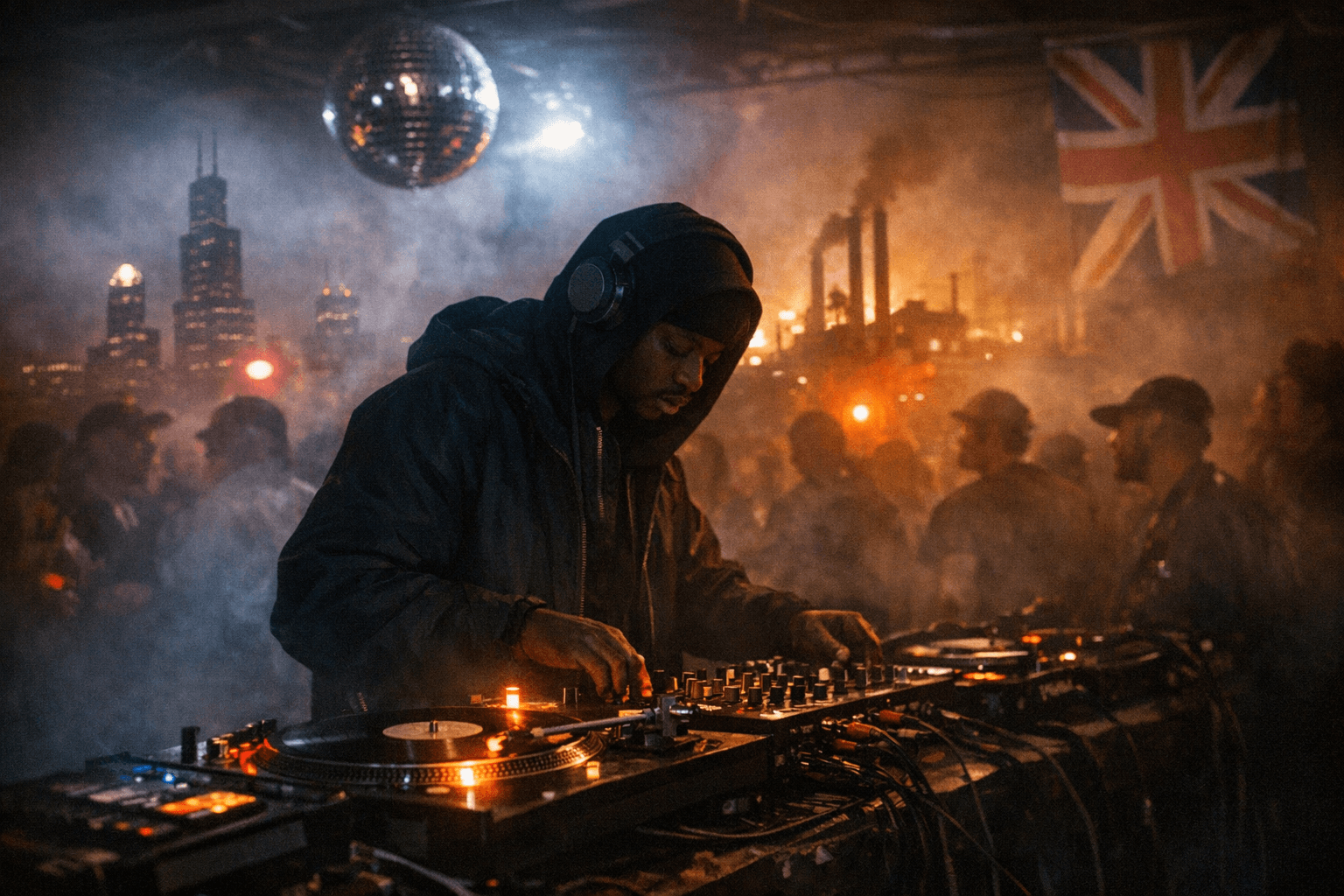
The striking part is how naturally the record folds together geography and lineage. Bandcamp positions Space Talk as rooted in house and techno while reflecting a London perspective, and DJ Mag hears it as a transatlantic statement connecting Chicago and Detroit traditions to the UK’s post-Windrush sonic identity. For minimal techno listeners and DJs, that bridge is not cosmetic. It is the difference between a record that references heritage and one that actually translates into functional, modern club language.
The artist behind the move from fashion to the booth
ICYKOF, whose real name is Kofi Mc Calla, has spent the last few years turning a much larger online profile into a serious electronic-music path. Dazed reported in 2024 that his fashion platform The Unknown Vlogs had accrued tens of millions of views, which gives a sense of how far his visual footprint already reached before the music fully took over. But the more relevant detail for this EP is that he did not simply drop into techno by accident. He has said lockdown gave him time to reflect, and that he used that period to start learning music production and DJing, a pivot that now reads less like reinvention than disciplined accumulation.
His influences make the bridge on Space Talk even easier to hear. In interviews, he has named Robert Hood, Carl Craig, Juan Atkins, Moodymann and Cajmere, a list that neatly tracks the Detroit and Chicago DNA running through the release. He has also spoken about learning early production techniques with Roland 909 and 303 machines in James Rand’s studio, which helps explain why the EP’s programming feels grounded in machine logic rather than laptop abstraction. That background, combined with his work on Bonne Nuit Studios and Rave Nuit, shows an artist building a world around sound rather than borrowing one for a single release cycle.
How the three tracks function on the floor
The opening cut, Get Outta My Head, sets the tone with muscular kicks, sharp percussion and flashes of synth around ICYKOF’s spoken vocal. DJ Mag describes the track as driven by a deep bassline, with vocals moving across the stereo field as if trying to break free from surrounding dubby synth pads. It is the kind of opener that does not rush to impress with density. Instead, it creates pressure through spacing, which is exactly why it can work in a long mix or at the start of a deeper set.
I Remember is the EP’s most stripped-back statement, and it is the track that will matter most to minimal techno heads. Electrobuzz tags it at 137 BPM, while the review identifies it as the most minimal cut on the record, built from relentless kicks and subs punctuated by pulsing synth lines. That combination gives it the kind of negative space and forward motion that DJs use to reset a room without losing tension. If Space Talk has a track that proves ICYKOF understands restraint, this is it.
Glitter Trap closes the EP by widening the palette. Bandcamp says it leans into darker territory with tense synth textures and a weighty bassline built for late-night club systems, while DJ Mag notes acidic arpeggiations, burly kicks and jittering percussion that push the finish into slightly more dramatic territory. Electrobuzz places it at 68 BPM, which makes the record’s pacing feel even more deliberate as a three-part sequence. The final track does not just end the EP, it changes the weather, moving from hypnosis into something more open and charged.
What the tempos and textures tell DJs
The tempo spread is unusual enough to be useful. Electrobuzz lists Get Outta My Head at 69 BPM, I Remember at 137 BPM and Glitter Trap at 68 BPM, which signals that Space Talk is not built as a straightforward club-banger sequence. Instead, it works like a toolkit for different moments in a set, whether that means a half-time mood reset, a peak-time stretch, or a closing passage where texture matters as much as propulsion. For selectors who like records that can pivot between head-nod pressure and full-room movement, that range is part of the appeal.
The review’s measured verdict also helps define the record’s use case. It notes that some grooves can feel more like individual loops than a fully unified whole, but that the EP still lands effectively as a collection of DJ tools. That is not faint praise in minimal techno. A record does not need to over-explain itself if the bass is controlled, the drums are disciplined and the arrangement leaves enough room for a mixer to do real work.
Why this release fits the current underground conversation
Space Talk arrives at a moment when underground techno keeps absorbing artists who come in with strong cross-disciplinary identities. The difference is that those artists are now expected to prove themselves in the same practical terms as everyone else: groove, sound design, low-end discipline and floor usability. ICYKOF’s record fits that shift cleanly. His earlier project ZERO SUGAR was already discussed as a debut EP marking a transition into music, and Space Talk extends that transition into something more confident and more connected to scene history.
That history matters because the record does not treat Chicago, Detroit and the UK as separate reference points. It treats them as a continuous conversation. Bandcamp notes that ICYKOF first appeared on Rekids’ mix series in 2025 and identifies him as a London-based DJ and producer of mixed Jamaican heritage, which sharpens the sense that this is not borrowed lineage but lived context. Resident Advisor’s profile adds another layer, listing past events in London, Berlin, Cologne, Darmstadt and Paris, alongside his mixed Jamaican heritage and the name Kofi Mc Calla, showing an artist already moving through the circuit rather than standing outside it.
He has also released on Astral People Recordings, KMS Records and his own Rave Nuit, all of which make Space Talk feel like part of a longer progression rather than a sudden crossover play. Put together, those details explain why the EP lands with more weight than a typical debut profile piece. It is not simply that a fashion figure made a techno record. It is that the record speaks fluently to a lineage where Chicago swing, Detroit precision and London’s post-Windrush pressure still define how a floor moves.
This article was produced by Prism’s automated news system from verified source data, official records, and press releases, then run through automated quality and moderation checks before publishing. The system is built and supervised by the people who set the standards it runs under. Read our full AI policy.
Did this article answer your question?