Rosa Pistola returns to stripped-down techno on Incorregible, with Nahua poetry
Rosa Pistola’s new LP swaps big-room pressure for tribal minimalism, and Maribel Galicia’s Nahuatl poems turn the shift into a statement about memory, not just club function.
A pivot with intent
Rosa Pistola’s *Incorregible* does not read like a routine follow-up. It lands as a deliberate reset, especially after *Dance All Night*, the 4-track EP she called her “first real experiment” in that style and which arrived on 11 February 2026. Where that record tested bigger techno pressure, this one pulls the frame inward and makes the reduction feel purposeful, not cautious.
That matters because the move changes how the music speaks. The new album, released on 10 April 2026, is built around a stripped-down pulse, rolling hand drums and light synthetic flourishes, so the power comes from motion and spacing rather than sheer size. For minimal techno listeners, that is the useful clue: this is not emptiness, it is control.
What the stripped-down design actually does
The strongest part of *Incorregible* is the way it keeps the arrangement spare without losing momentum. DJ Mag hears the record as a return to form for Pistola, and that tracks with the way the drums are used here: they do the work of a full mix without cluttering it. Instead of oversized drops, the album leans on an intimate rhythmic frame that leaves air around every hit.
That approach gives the record a very specific club function. It can sit in a set without demanding a reset, but it still carries enough lift to move a floor because the details are so disciplined. In practice, that means the hand percussion becomes the lead voice, the synthetic touches act like accents rather than hooks, and the whole thing feels more tactile than glossy.
Why Maribel Galicia changes the stakes
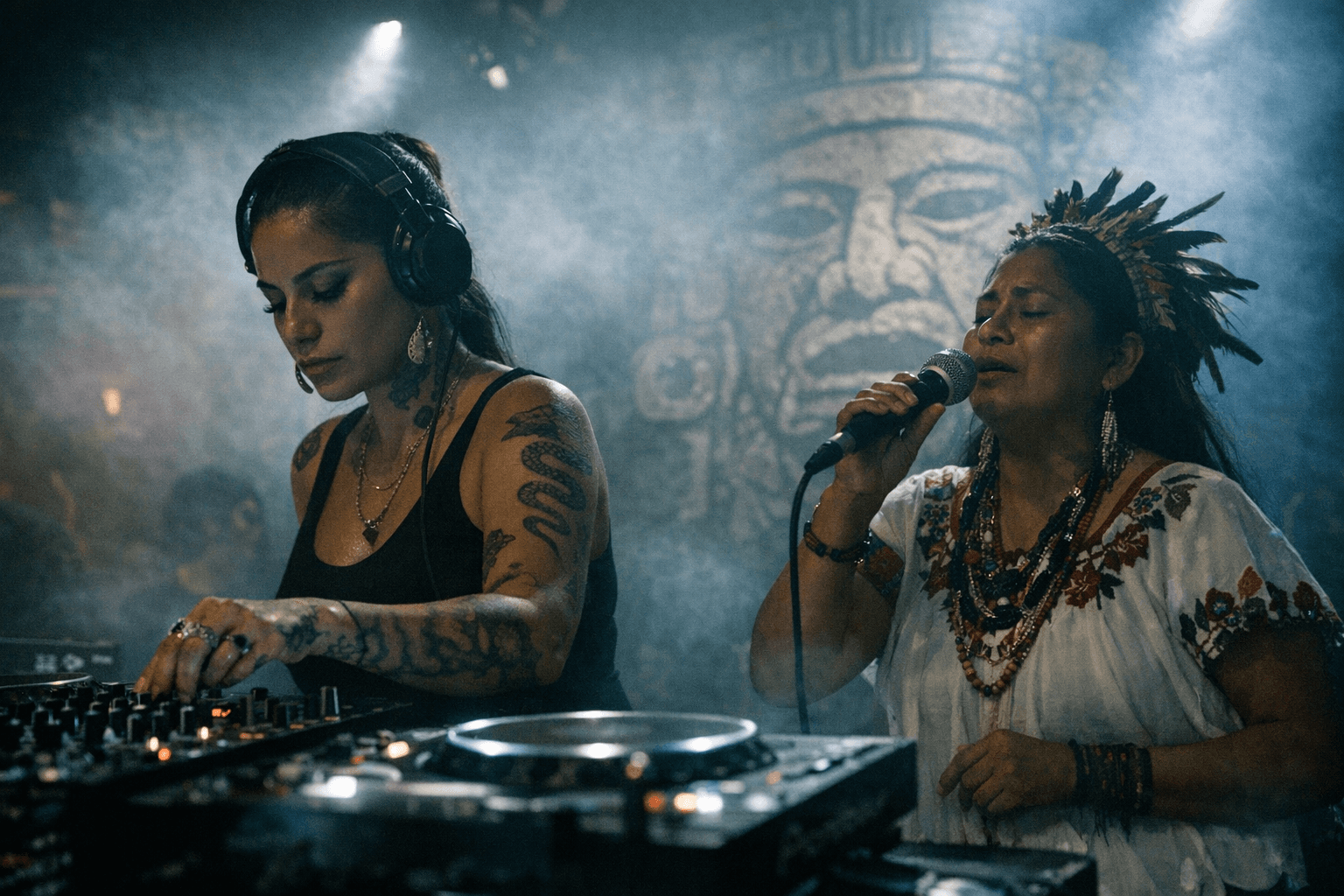
The big artistic pivot is not only sonic. The album’s most important differentiator is the presence of Maribel Galicia, whose Náhuatl chants and poems are written and recited on the record, and whose contributions are singled out on the opening track, “Conejo y Luna.” Resident Advisor identifies Galicia as Teotihuacán-born and a member of the Nahua people, while the release materials frame her work as part of a broader effort to honor cultural roots.
That shifts *Incorregible* from a club record with atmosphere into a record with ancestry. When the voice enters, it does not feel like decoration, and it definitely does not feel pasted on for mood. It changes the center of gravity, pushing the album toward something spiritual and elemental, where rhythm is not just a tool for dancefloor utility but a vehicle for memory, language and place.
The album’s structure matters as much as the sound
The eight-track sequence is clear and compact: “Conejo y Luna,” “Teonanacatl,” “Desierto,” “La Guitarra,” “Flauta Nahua,” “Niquitoa,” “Media Noche” and “Fierro Pariente.” That title run alone tells you the record is thinking in images of landscape, tradition and nocturnal club energy at the same time. It is not trying to disappear into abstraction; it is giving the music anchors.
Bandcamp also frames *Incorregible* as part of Rosa Pistola’s “TRIBAL SOUNDSYSTEM” performance, and that label is useful because it explains the record’s larger arc. The project is presented as a bridge between ancestral memory and the contemporary, and the distribution materials go further by describing electronic music as a meeting point between pre-Hispanic and modern sounds. In other words, the album is being asked to carry concept as well as groove, and it does.
How to hear the album if you come from minimal techno
If you live in the stripped-back end of techno, the right way to hear *Incorregible* is to listen for what gets removed and what gets elevated. The hand drums are the engine, the synthetic details are the seasoning, and Galicia’s poetry gives the arrangement a human edge that many club records avoid. That is why the record feels earthy, haunted and precise at once.
The practical lesson is that minimalism does not have to mean subtraction for its own sake. Here, the sparse design leaves room for voice, story and texture to matter more, not less. That is a stronger move than chasing spectacle, and it is exactly why the album lands as a statement about stance rather than just a release date.
What this pivot says about the wider scene
Rosa Pistola’s shift is interesting because it points beyond Rosa Pistola. An artist associated with one club-music identity choosing to strip things back and fold in Nahua poetry suggests that the underground has room right now for harder edges, hybrid forms and culturally specific references that are not trying to flatten themselves for generic dancefloor use. The appetite is not just for bigger kicks or faster tempos; it is for records that feel rooted and strange at the same time.
That is the broader signal here. *Incorregible* shows how a scene crossover can work without sounding opportunistic: keep the percussion tight, keep the concept legible, and let the voice carry meaning that the groove alone cannot. Rosa Pistola’s move from *Dance All Night* to this eight-track statement suggests that the next chapter of club music may belong less to maximal impact than to records that can hold rhythm, ancestry and atmosphere in the same frame.
This article was produced by Prism’s automated news system from verified source data, official records, and press releases, then run through automated quality and moderation checks before publishing. The system is built and supervised by the people who set the standards it runs under. Read our full AI policy.
Did this article answer your question?