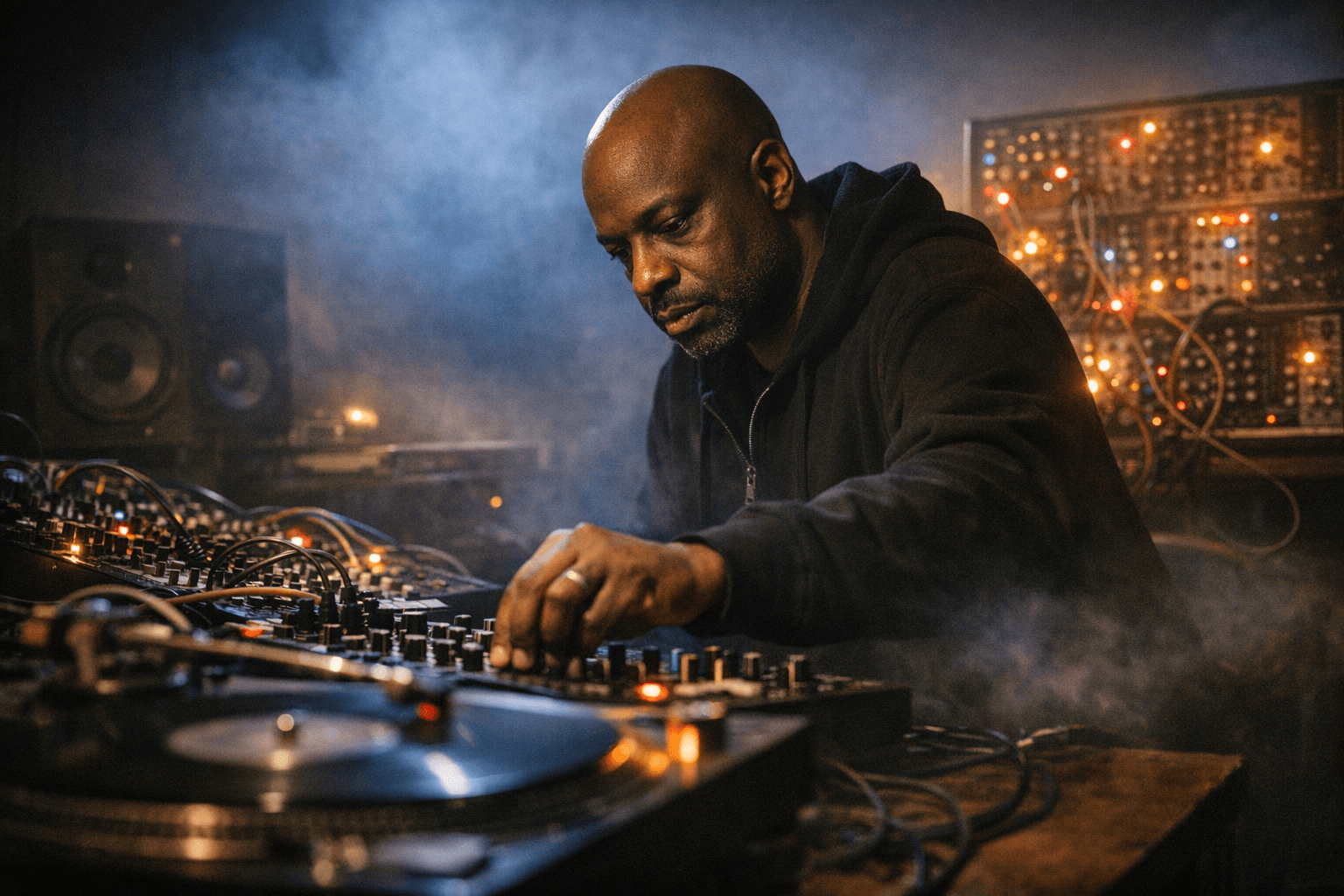
Larry Heard’s Leev Ur Mynd shows deep techno still thrives on space
Larry Heard is still proving that less can do more. Leev Ur Mynd turns space, melody and mood into a masterclass in deep techno restraint.
Leev Ur Mynd is a reminder that deep techno does not need to shout
Larry Heard is still proving that less can do more, and on **Leev Ur Mynd** he makes that argument without raising his voice once. Released on April 20, 2026 on his own Alleviated Records imprint, the 12-track Mr Fingers album feels less like a comeback than a continuation of a long Chicago language built on patience, pulse and emotional precision. It is his third album in four years, which says a lot about how active this late-career phase has become, but the bigger point is simpler: Heard still knows how to make space feel like movement.
That matters because Heard is not just any veteran working in the margins of house and techno. He is widely identified as one of the pioneering figures of 1980s Chicago house, a member of Fingers Inc., and one of the architects of the scene’s deeper emotional register. With landmark work like “Can You Feel It” and Fingers Inc.’s 1988 album *Another Side*, he helped define the idea that club music could be functional and inward-looking at the same time. *Leev Ur Mynd* carries that same logic forward, and for minimal techno listeners it offers a useful reminder that restraint is not emptiness, it is design.
How Heard turns austerity into groove
What makes this record hit is not density but control. Heard’s sound has often been described as unusually austere, with drum patterns that rarely deviate, circling basslines and chord sequences that seem reluctant to resolve too quickly. In lesser hands, that kind of structure can feel static. Here, it feels alive because the small details do the heavy lifting: a pad that swells at the right moment, a dry hit that leaves a pocket of air, a melody that hangs just long enough to change the emotional temperature.
That is why the album sits so naturally in the conversation around deep techno and minimal-adjacent music. It keeps club functionality intact, but it never mistakes pressure for impact. Instead of stacking layers until the track buckles, Heard lets mood, texture and repetition do the work, and the result is a set of records that breathe while still moving with intent.
The tracks show how far a sparse arrangement can go
The opening stretch makes the point quickly. “Plastic Nightmares” is the most obvious machine room on the album, built from gurgling pads, acid motifs and dry hits that keep the groove taut without overloading it. It is complex in the way good deep techno often is, where the arrangement feels engineered rather than decorated, and every moving part has a job.
Elsewhere, Heard loosens the grip and lets the music widen. “Barndance” opens up through hymnal chords and bluesy guitar lines, which gives the album one of its most human-feeling breaths. That contrast is crucial, because it stops the record from hardening into pure abstraction. Heard has always understood that emotion in dance music does not require a big chorus, only the right harmonic color at the right time.
Where the album gets most affecting
The more brittle material may be the most revealing. “Tension” and “Enceladus 5” lean into metallic tones and looped melancholy, and both tracks show how Heard can make a repeated figure feel like a changing landscape. The names alone suggest coldness and distance, but the music keeps pulling back toward feeling, not away from it.
Then there is “Menagerie,” which the review rightly frames as a deep techno psychodrama. That description fits because the track pushes the senses without losing clarity, and that balance is a big part of Heard’s appeal: he can introduce unease without collapsing the mix. “April Rain” lands differently again, as a fragile, almost resigned moment of isolation. It gives the album an emotional center that is easier to feel than to explain, and it is the sort of track that reminds you how much weight a simple sequence can carry when it is left alone long enough.
The full LP works like a conversation, not a pile of tracks
The tracklist helps the album feel like a complete statement rather than a loose collection of club tools. Alongside the pieces above, *Leev Ur Mynd* includes “The Happening Thing,” “Ribbons” and “Replicate,” plus two collaborations with Brianna on “When You Need Me” and “All I Need.” Those vocal features matter because they reinforce the human thread running through Heard’s sci-fi textures, giving the record another way to hold warmth without softening its edge.
That sense of continuity is part of why the album reads as more than a one-off release. Resident Advisor previewed it on April 14, 2026, and Alleviated Records had already issued *Vault Session 3* on March 2, 2026, a set of previously unreleased or out-of-print Larry Heard material. Put together, those releases show an artist in motion, not an archivist dusting off old victories. Bandcamp and retail listings present the album as part of a body of work that has shaped the core of house music for more than four decades, and that framing feels right.
What minimal techno can take from Larry Heard right now
If you care about minimal techno, this album is worth studying for a few practical reasons:
- Let the groove breathe. Heard keeps his arrangements open enough that each kick, chord stab and percussion hit can land with definition.
- Use repetition as pressure, not wallpaper. The loops on this album are never there just to fill time; they accumulate meaning by subtle change.
- Treat melody like atmosphere. Even when the tracks are club-ready, they carry emotional information in the chords, not just in the drum programming.
- Leave room for the listener to enter the track. The best moments here feel discovered, not forced.
That is the lesson *Leev Ur Mynd* keeps returning to. In a scene where it is still easy to confuse busyness with sophistication, Larry Heard makes the stronger case: deep techno thrives when it trusts space, and his music still knows exactly how to use it.
Know something we missed? Have a correction or additional information?
Submit a Tip