Behind the scenes of Model Railroader's MR&T boxcar program
MR&T boxcars were never just souvenirs. From 2019 to 2024, they became a sold-out extension of Model Railroader’s layout identity.

The MR&T boxcar program worked because it treated a magazine layout like a living railroad brand. Between 2019 and 2024, Model Railroader did not just drop out a few novelty cars and move on. It built a continuing line of limited-edition rolling stock for the Milwaukee, Racine & Troy, with each release tied to a real editorial culture, a real staff layout, and a collector base that knew exactly why these cars mattered.
A layout that became a collectible identity
The Milwaukee, Racine & Troy started as a concept in Kalmbach Media’s downtown Milwaukee offices in 1975, then grew into a 28 x 54-foot HO scale staff layout that became one of the hobby’s most familiar in-house railroads. By the time it celebrated its 35th anniversary in 2024, the MR&T had hosted nearly 150 operating sessions and served as a test bed for projects and magazine coverage. That history gave the boxcars more weight than a generic freelanced roadname ever could. They were not imaginary cars pasted onto a fantasy railroad. They were freight cars carrying the identity of a layout readers had followed for decades.
That is the first thing to understand about the program: the cars were collectibles, but they were also continuity pieces. Each one kept the MR&T visible in the same way a favored branchline keeps showing up in operating session after operating session. For readers who follow the layout, that continuity is the point.
Built like a real program, not a one-off stunt
The most interesting part of the MR&T story is how methodical it was. The releases from 2019 through 2024 were designed as a program, not a single commemorative event. Cody Grivno and the team selected the models, worked directly with manufacturers and illustrators, and wrote the photography and marketing copy that framed each release. That meant every car had to clear multiple hurdles: the prototype choice had to make sense, the paint scheme had to feel like MR&T, and the package had to sell the story as well as the model.
That behind-the-scenes work matters because it explains why these cars resonated. A good custom run is not only about decoration. It is about choosing a model that looks right on a layout, gives collectors something distinct, and still feels believable in an operating roster. The MR&T program was successful because it respected all three jobs at once.
Why the cars sold out so quickly
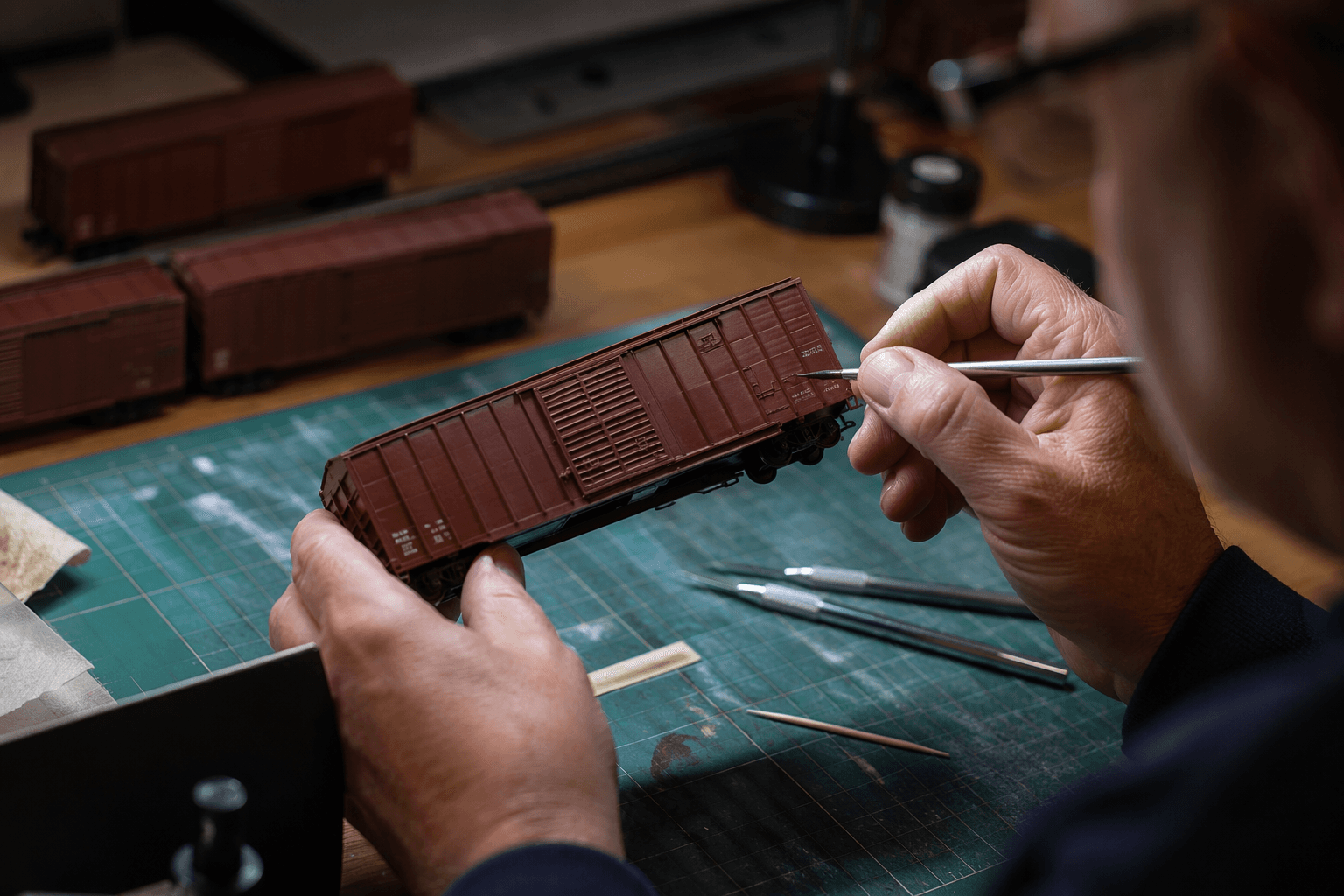
Model Railroader has said the MR&T freight cars were successful and sold out quickly on the former Kalmbach Hobby Store website. That reaction says as much about the audience as it does about the products. Readers were not buying a random freight car with a made-up roadname. They were buying a piece of the magazine’s own railroad, with the same kind of emotional pull as a signature structure or a famous locomotive in a layout roster.
The limited-run format only sharpened that demand. When quantities are small, every release becomes an event, and every road number becomes part of the story. The line also created a collector habit: once one MR&T car became hard to find, the next one suddenly mattered even more. That is how a custom-decorated program stops being a merchandising sidebar and starts functioning like a shared hobby artifact.
From classic freight cars to cabooses, and then to modern boxcars
The MR&T line did not stay in one lane. It began with cabooses and other freight cars, then expanded in 2022 into wide-cupola cabooses from Atlas in both HO and N scales. That move made sense because cabooses carry a special kind of layout identity. They are small enough to feel like signatures, yet visible enough to anchor a train and signal a railroad’s character.
Earlier MR&T partnerships also show how deep the roots go. Athearn produced HO scale MR&T wide-cupola cabooses for Model Railroader’s 70th anniversary in 2004, and Atlas released its own wide-cupola cabooses in the mid-2010s. Accurail, Atlas Model Railroad Co., and Tangent Scale Models all became part of the broader MR&T story over time, which tells you the program was built on long-term collaboration rather than a one-season promotion. That continuity is part of why the MR&T branding stuck.
The 2024 Greenville boxcar: the modern-era statement piece
The 2024 MR&T Greenville Steel Car Co. 86-foot high-cube double-plug-door boxcar pushed the concept into more modern territory. Trains.com Store described it as the biggest MR&T boxcar release to date, and the model was offered in limited quantities under road number 86011. Painted bright red with silver doors and lettered for August 1973+ service, it brought a more prototype-specific, high-capacity freight car into the line.
That choice says a lot about where the MR&T program had evolved. The early cars leaned into classic freight-car charm and familiar layout accessories. The Greenville car showed that the series could also speak to modelers who care about era fidelity, car type, and operating realism. Tangent Scale Models was the right partner for that job, since the company has been building HO and N scale freight car models since 2007 and has issued multiple variations of its Greenville 86-foot boxcar tooling. For MR&T, that meant a modern release could still feel as carefully curated as the older caboose runs.
The people behind the paint and herald
The branding of the MR&T cars was never accidental. The square MR&T herald used on later cars was designed by illustrator Alan Cerney, who worked in the Kalmbach Publishing Co. art department from 1975 to 1978. Earlier steam-era and transition-era schemes were developed with retired lead illustrator Rick Johnson, which gave the roster an internal visual logic instead of a grab bag of paint ideas.
That matters because hobby brands live or die on recognition. A strong herald, repeated across multiple releases, turns individual freight cars into a family. The MR&T cars reinforced the railroad’s identity precisely because they looked like they belonged together, whether the model was a short car, a caboose, or an 86-foot boxcar with silver doors.
The MR&T boxcar program worked because it understood what collectors and operators actually want from a custom run: a believable model, a recognizable railroad, and a reason to follow the next release. That is why the line felt bigger than a shelf item, and why the MR&T still reads less like a fictional railroad and more like a shared piece of the hobby.
This article was produced by Prism’s automated news system from verified source data, official records, and press releases, then run through automated quality and moderation checks before publishing. The system is built and supervised by the people who set the standards it runs under. Read our full AI policy.
Did this article answer your question?