Class 37/9s reveal British Rail’s experiment in heavy freight traction
The 37/9s turned six ordinary Class 37s into heavy-freight testbeds, and that strange mix of rebuilds, names and pair-working is pure model-railway gold.

The Class 37/9s are the kind of locomotives that make a roster feel personal. They began as six rebuilt Class 37s, but British Rail turned them into something far more interesting than a simple variant: a moving experiment in heavy-freight traction, with enough quirks to reward close inspection on a model or the prototype. For a layout set in the late BR and sectorisation years, they bring instant character, from Cardiff Canton metals work to iron ore traffic that needed two locomotives to do the job.
Why the 37/9s matter to a modeller
The standard Class 37 was already a giant of British diesel traction, with 309 built between 1960 and 1965 as BR Type 3 mixed-traffic diesel-electrics. English Electric built them at Vulcan Foundry and Robert Stephenson & Hawthorns, and that success is exactly why the class became such fertile ground for experiments later on. A broad, successful family gives you the ordinary roster; a subclass like the 37/9 gives you a story.
That story matters because the 37/9s were not just renumbered locomotives or cosmetic oddities. They were created in the mid-1980s as development machines for a future heavy-freight locomotive, tied to British Rail’s abortive Class 38 project. In other words, they sit at the crossroads of what BR already had and what it hoped to build next, which makes them ideal if you like prototype transitions rather than generic freight power.
What made them visually and mechanically different
There were only six of them, numbered 37901 to 37906, and that limited fleet is part of the appeal. Four were converted in 1986 and two more in 1987, so you are not dealing with a mass-production sub-class but a compact, carefully defined group. That makes it much easier to model one locomotive with a specific identity instead of reaching for a one-size-fits-all Class 37.
The first four 37/9s tested Mirrlees MB275T engines and Brush alternators, while 37905 and 37906 were fitted with Ruston RK270T engines and GEC alternators. The rebuilds also included new bogies and ballast that brought the locomotives to about 120 tons, which gave them the heavy, purposeful stance that sets them apart from a standard 37. Two members of the subclass, 37901 and 37904, had heavily modified roof sections, so if you are chasing accuracy, that is one of the most visible areas to study before you start cutting plastic.
37901 is the obvious anchor point if you want a named example. It began life as D6850, was rebuilt at BREL Crewe Works in October 1986, and later carried the name Mirrlees Pioneer. That name alone gives you a ready-made modeling subject, especially if you want a locomotive with a development-story identity rather than an anonymous number on the cabside.
How they worked on the real railway
The 37/9s were not museum pieces in service disguise. They were used on heavy freight, and enthusiast reporting records them working in pairs on Port Talbot to Llanwern iron ore trains of around 3,060 tonnes, replacing double-headed Class 56s. That is the kind of duty that gives a model railway a clear operating script: long rakes, concentrated traffic, and locomotives that look as though they were built for the exact train they are hauling.
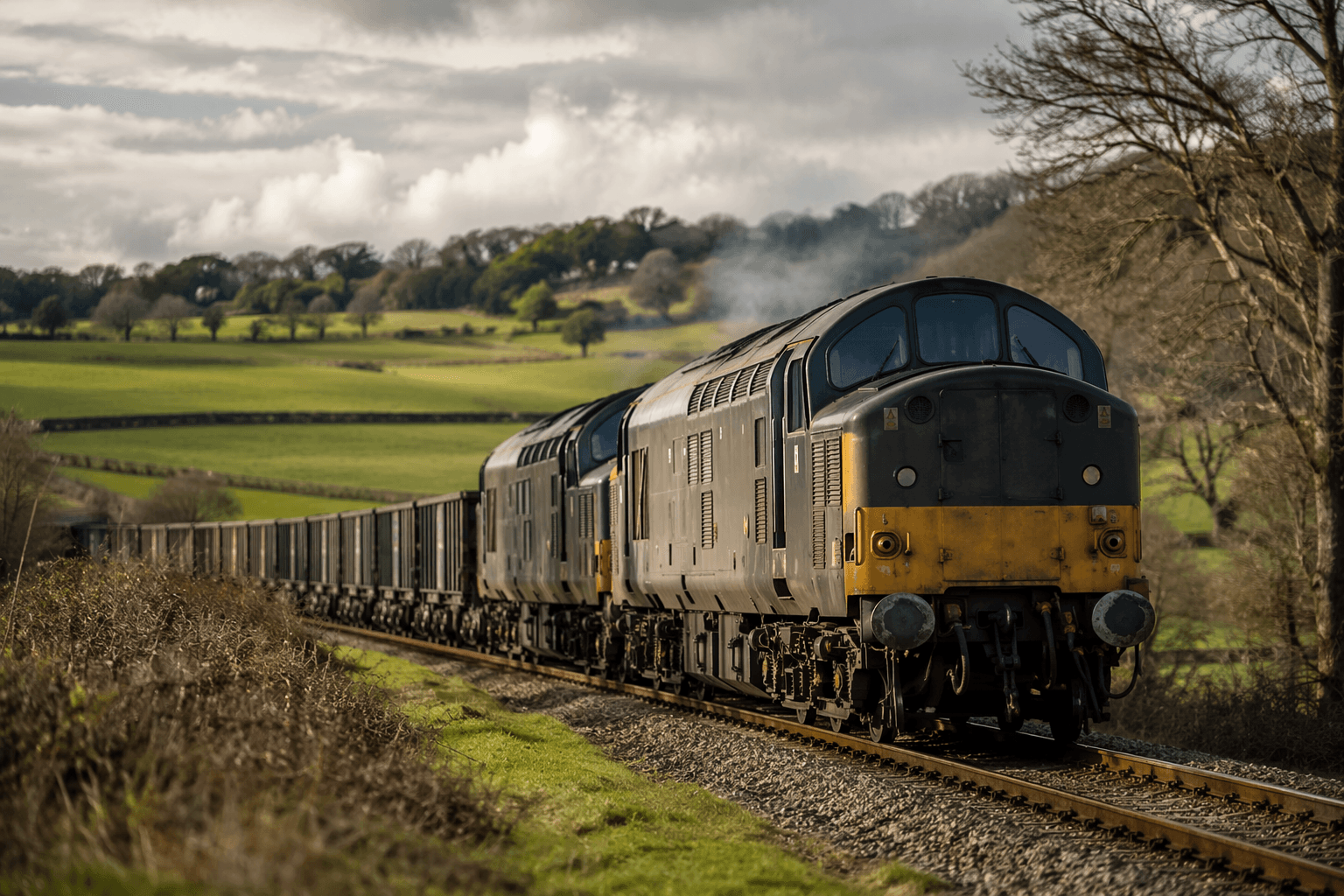
The class also had a reputation for being a little awkward early on. Class37.co.uk records 37901 and 37902 together at Exeter Riverside on 1 November 1986, along with a note that a driver refused them because they had different controls. That detail is gold for a modeller because it turns a technical rebuild into a living railway problem, the sort of thing that can shape a realistic operating session and remind you that prototypes are never as tidy as the finished model.
They were sometimes nicknamed slugs, which suits them perfectly. The word captures both the heavy-freight experiment behind the class and the slightly odd, heavily altered presence they brought to the line. On a layout, that nickname translates into visual authority: these are not locomotives you sprinkle casually into any train, but machines that belong to a defined duty and look best when given one.
How to model a 37/9 convincingly
The easiest route is to start with a good standard Class 37 model and decide which 37/9 you want to represent. Because the subclass was limited to 37901 through 37906, renumbering is not a vague exercise but a precise one, and that precision is half the fun. If you want the best-known example, 37901 gives you the Mirrlees Pioneer identity, the BREL Crewe Works rebuild date, and the Cardiff Canton Railfreight Metals connection.
From there, focus on the visible differences that make the subclass read correctly at a glance:
- Choose the late-BR heavy-freight era, not an earlier mixed-traffic setting.
- Use heavy weathering and a worked look, because these locomotives were part of hard freight diagrams.
- Add or emphasize roof alterations if you are modeling 37901 or 37904.
- Adjust the stance and underframe appearance to suggest the extra ballast and 120-ton rebuild weight.
- Pair it with long iron ore or metals trains if you want the scene to feel prototype-driven.
If you are building a layout with an operating identity, the 37/9s are especially satisfying because they sit between common and obscure. A standard Class 37 can be a catch-all machine; a 37/9 tells visitors that this is a railway with a story, a traffic pattern, and a period firmly rooted in British Rail’s search for more powerful freight traction.
That is the real appeal of the subclass. The 37/9s were only six locomotives, but they distilled a whole era of British Rail experimentation into something you can model, renumber and run with purpose. A standard Class 37 fills a roster; a 37/9 gives the roster a reason to exist, and that is the sort of oddball detail that keeps a model railway memorable.
This article was produced by Prism’s automated news system from verified source data, official records, and press releases, then run through automated quality and moderation checks before publishing. The system is built and supervised by the people who set the standards it runs under. Read our full AI policy.
Did this article answer your question?