Menards HO scale Sinclair tank adds a detailed propane scene
A compact Sinclair propane tank brings an industrial anchor to an HO layout, with factory-built detail and a footprint small enough for tight spaces.
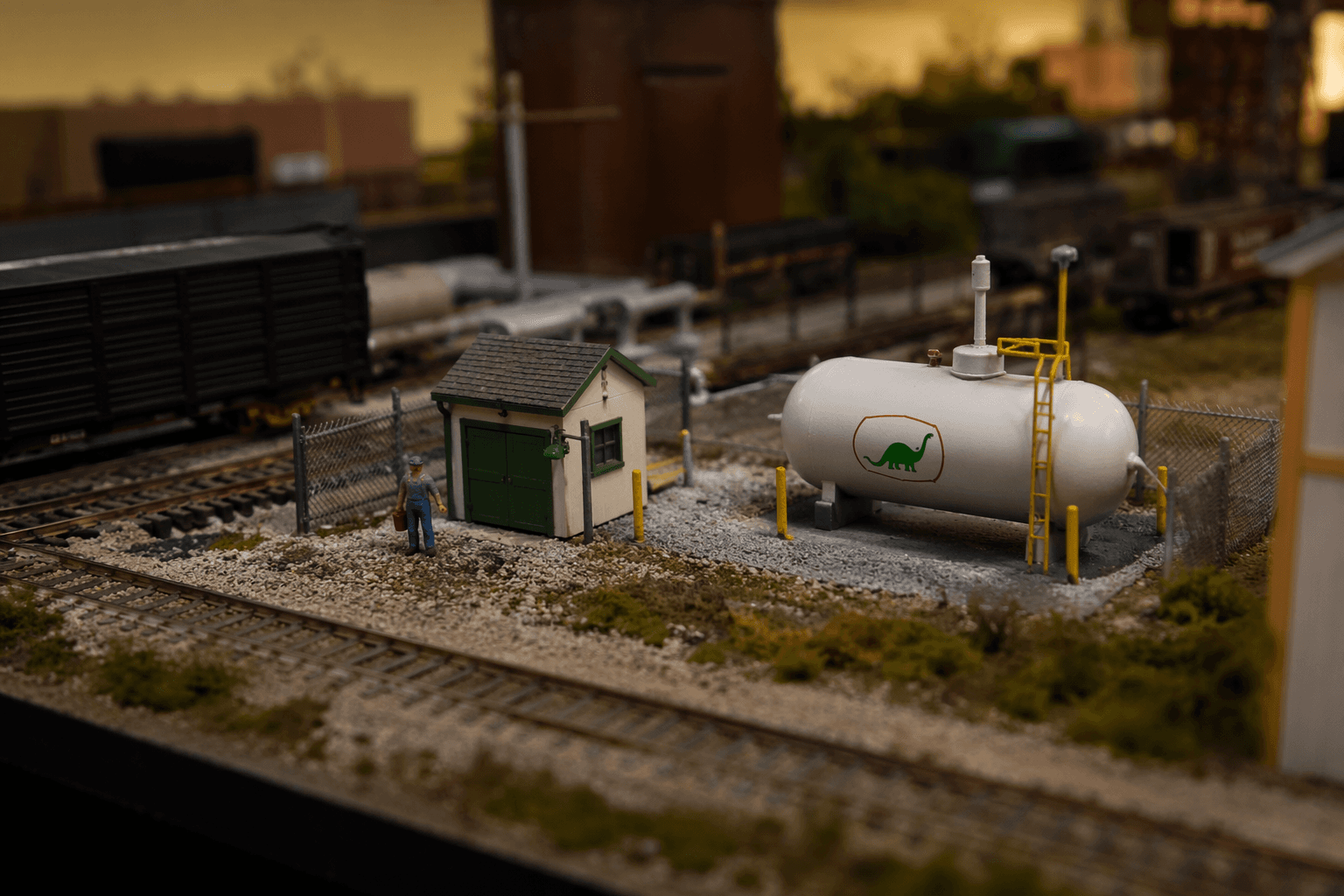
Menards’ HO scale Sinclair spherical tank is the kind of accessory that can give a modest layout an immediate industrial identity without forcing a rebuild. At 4-9/16 inches by 4-5/8 inches by 4 inches, it is small enough to tuck into a freight house district, a fuel dealer, a refinery edge, or an industrial spur, yet detailed enough to read as a complete scene the moment it lands on the benchwork.
A small footprint with a full scene built in
The strength of this piece is that it does more than place a tank on a base. The scene comes ready to install as a liquid propane storage tank setup, and the details carry the story: separate factory-applied support beams, diagonal braces, ladders, safety railings, warning signs, four workers in safety vests and hard hats, and Jack the German shepherd, all mounted on a simulated concrete base. That combination gives the model a lived-in look straight out of the box, not a bare structure waiting for surrounding details.
Menards’ product page adds another layer of realism with the globe finished in matte white and lettered with Sinclair branding. The accents are painted in safety colors, which helps the model read as active industrial equipment rather than a generic sphere. The lack of lighting keeps the unit simple, and at a listed price of $29.99, model number 2759657, with an 11% rebate that brings the value after rebate to $26.69, the package stays in the range of an impulse upgrade instead of a major investment.
Why the shape works so well on a layout
A spherical tank is one of those structures that instantly suggests a purpose. Even without a truck at the rack or a switchlist in hand, the shape implies fuel distribution, road service, and local switching, all of which add operating logic to a scene. That matters on a compact HO layout, where one well-placed structure can do the work of a much larger industrial complex by giving the viewer a reason to believe freight cars, tank trucks, and workers belong there.
It is also the right kind of detail for a corner that feels unfinished. A small-town fuel dealer can use it as a destination object, a refinery edge can use it as a boundary marker, and a spur can use it as an operational clue that the railroad still has business to serve. In each case, the tank does not need motion or lighting to justify itself; its silhouette and surrounding figures do the heavy lifting.
The same logic helps in modern scenes and mid-century ones. Propane distribution, truck loading, and rail-served tank facilities all fit comfortably into eras when industrial gas handling was part of the railroad’s daily life. That makes the Menards piece useful well beyond a single time period, especially if you want a scene that feels specific without locking the whole layout to one prototype.
The real industrial history behind the model
The shape itself has deep roots in industry. The spherical pressure vessel, often called a Horton sphere, is used for large-scale storage of liquefied gases such as liquefied petroleum gas, liquefied natural gas, and anhydrous ammonia. That gives the Menards model a strong prototype basis, because the form is not just decorative, it is tied to how real industrial gas storage has been built and used.
Horace E. Horton’s name matters here, too. His steel plate engineering expertise was carried into the oil and natural gas business as early as 1919, when a petroleum tank farm was built in Glenrock, Wyoming, for Sinclair Refining Company. That detail helps explain why a spherical storage scene feels at home in a petroleum or propane setting instead of looking like a random science-fiction prop dropped beside the track.
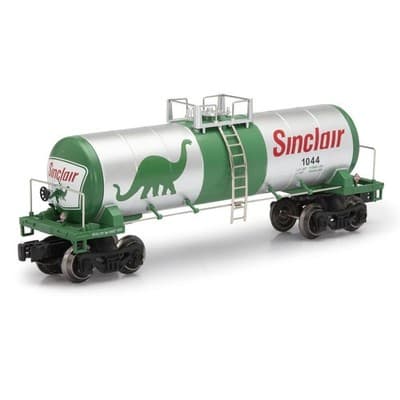
Sinclair itself carries enough brand history to make the scene feel rooted in the North American fuel business. Sinclair Oil was founded by Harry F. Sinclair on May 1, 1916, and the company’s dinosaur advertising began in 1930, with the Apatosaurus becoming the best-known mascot. That long-running imagery gives the Menards globe a familiar visual shorthand, connecting the model to real gasoline-and-propane infrastructure rather than to a generic industrial label.
How it fits into Menards’ and the hobby’s broader landscape
Menards places the tank within its Train Stuff line, and its trains section positions similar items as layout-completing structures across O gauge and HO scale. That matters because it shows the company understands these pieces as scene-setters, not just collectibles on a shelf. In practice, that is exactly how a good scenic accessory should behave: it should solve a visual problem while also giving the layout a believable jobsite, storage area, or industrial point of interest.
The model also sits comfortably alongside other products in the same subcategory. Walthers’ HO-scale propane and ammonia storage tanks kit is aimed at industrial complexes, grain elevators, and propane dealerships, which shows how established this type of detail is within the hobby. Menards is not inventing a new scenic idea here; it is offering a compact version of an industrial staple, one that works especially well when space is tight and the scene needs to look busy without looking crowded.
That makes the tank a smart choice when the goal is to turn a bland stretch of right-of-way into something purposeful. The 4-9/16-inch by 4-5/8-inch footprint leaves room for surrounding trackside context, while the factory-applied details give the impression that the industry has been operating there for years. For a layout that needs one strong visual anchor, this is the sort of accessory that delivers the scene before the first freight car even rolls past.
This article was produced by Prism’s automated news system from verified source data, official records, and press releases, then run through automated quality and moderation checks before publishing. The system is built and supervised by the people who set the standards it runs under. Read our full AI policy.
Did this article answer your question?