Model train track basics: sectional, roadbed, and standards explained
The costliest track mistakes come from the wrong rail code, turnout size, or roadbed choice, not the locomotive on top.
A starter oval gets trains moving, but the moment you want sidings, a yard, or a layout that looks right under longer cars, sectional size, roadbed, rail code, and turnout geometry start making the decisions for you. Modern track standards make it easier to mix brands and build with intent instead of locking yourself into the first box on the shelf.
Sectional track, roadbed, and what you are really buying
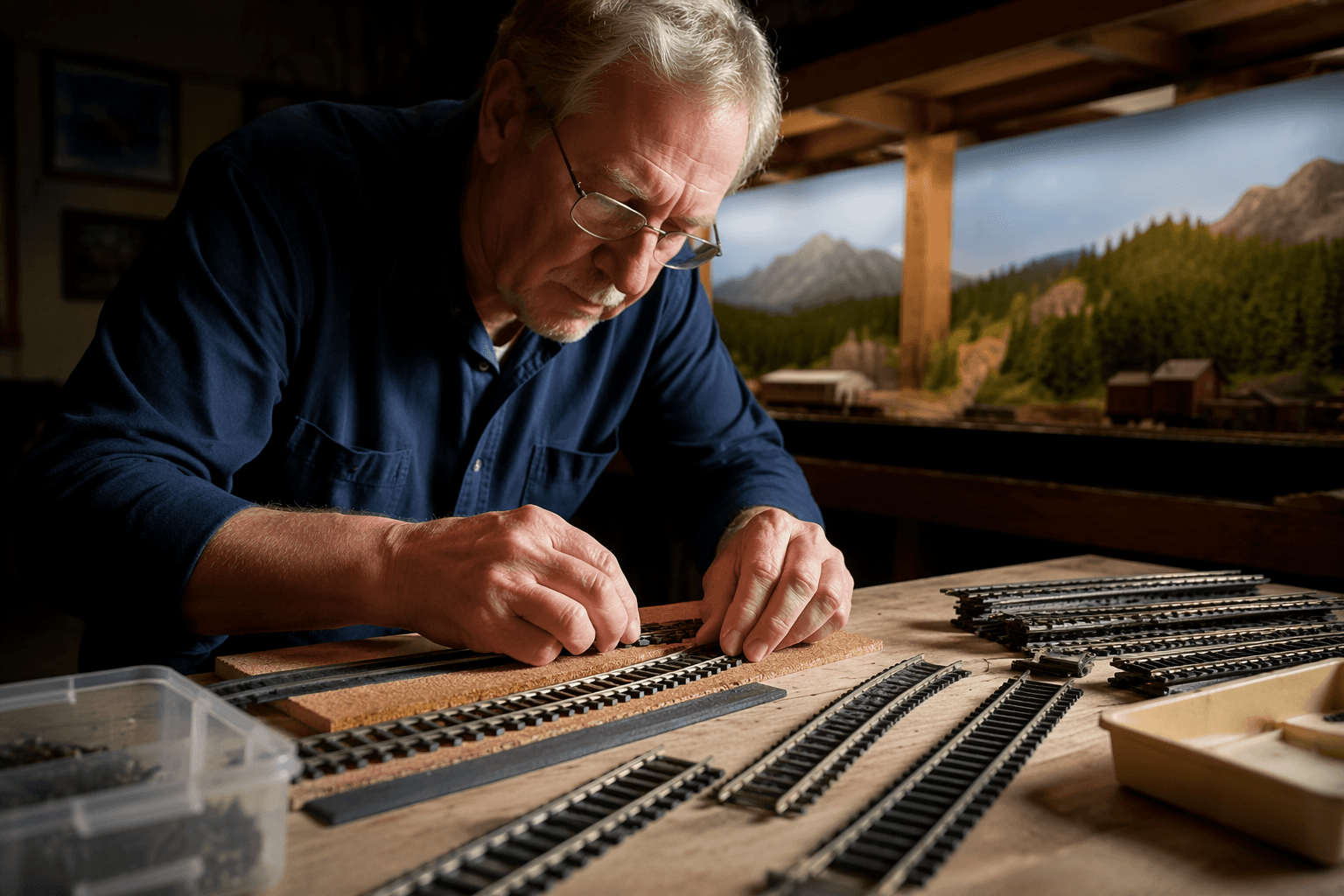
Sectional track is the familiar starting point: rails mounted on molded plastic ties, sold in standard lengths and curves so you can assemble a loop fast. All-in-one roadbed track goes a step further by adding a molded base that stands in for ballast under the ties, which cuts out a separate ballasting step and speeds up installation. Some systems let you remove the track from the roadbed later, while others are built as a single unit, so the way the pieces go together matters as much as the way they look.
Roadbed-equipped systems keep showing up in both starter sets and serious home layouts. Kato’s UNITRACK uses a UNI-JOINER connection system and is designed for easy temporary or permanent layouts, which makes it a strong choice when you want to keep reconfiguring without rebuilding from scratch. Bachmann’s E-Z Track takes the same idea in a different direction with integrated roadbed and multiple rail and roadbed combinations, including nickel silver with gray roadbed. If you want the sound and appearance work to happen separately, Woodland Scenics sells roadbed and track-bed products aimed at quieter, efficient, and more realistic trackwork.
Sectional track also remains the fastest way to get rolling. Atlas marketed its ready-to-lay sectional track in a 1975 catalog as a way to get trains running in short order, and the current HO Code 100 snap-track line still shows that logic in practice. Atlas lists straight sections and radius curves in 15, 18, 22, and 24 inches, which gives you a concrete set of building blocks when you are trying to fit a plan into an actual room instead of an idealized drawing.
Standards are what keep the hobby from splintering
The National Model Railroad Association exists because early model railroading was a compatibility mess. Before the 1930s, there were no common standards, and equipment from one manufacturer often would not work with another manufacturer’s track or rolling stock. The NMRA was officially formed on September 1, 1935, at a national convention in Milwaukee, Wisconsin, to develop standards and promote fellowship among model railroaders.
The NMRA’s standards and recommended practices are meant to make equipment interoperable across manufacturers, and many of the basic standards have remained virtually unchanged since 1936.
Rail code is a realism choice with compatibility consequences
When modelers talk about Code 100 or Code 83, code simply means the height of the rail in thousandths of an inch. In HO scale, Code 100 is 0.100 inches tall and Code 83 is 0.083 inches tall, with Code 70 at 0.070 inches for even finer work. The number looks small on paper, but on the layout it changes how the track reads visually and how forgiving it is in daily use.
Code 83 has become popular in HO because it looks closer to North American main-line rail proportions. Code 100 remains common because it is more forgiving and works better with older equipment, especially deep-flange wheels. If your fleet includes older rolling stock or legacy locomotives, Code 100 gives you a wider operating margin. If you are building for a more modern mainline look and your equipment is already compatible, Code 83 usually delivers the better visual fit.
Turnouts turn a loop into an operating railroad
A turnout, called a switch in prototype terms, is where a simple train set becomes a railroad with choices. It lets a train move from one track to another, which opens the door to sidings, yards, and passing moves instead of just a continuous oval. That is why turnout geometry matters so much in small spaces: the wrong angle can turn a neat plan into one that stalls, binds, or forces awkward compromises.
The NMRA’s RP-12 turnout tables are built expressly for model railroad use and cover frog numbers 4 through 10. Higher numbers produce a gentler path and a longer lead, while a No. 4 is a tighter, shorter diverging route and a No. 6 spreads more gradually. That difference is more than notation. It affects reliability, especially when longer locomotives and cars need to stay centered through the diverging route.
Atlas’ HO Code 100 line includes #4, #6, and #8 turnouts, which shows the practical range most layout plans have to work with. Atlas also lists an HO Code 83 curved turnout with an outside radius of 30 inches and an inside radius of 22 inches, a useful reminder that a curved switch can consume far more room than its label suggests. Atlas’ Code 83 Custom-Line turnouts share the same geometry as its Code 100 versions, which makes drop-in planning easier when you are mixing rail codes or revising a track plan.
A quick planning filter before you buy track
- Choose sectional track when you need speed, flexibility, or a first test loop that can be revised without major surgery.
- Choose a roadbed system like Kato UNITRACK or Bachmann E-Z Track when you want fast assembly and less ballast work.
- Choose separate roadbed and track-bed products when sound control and a more tailored finish matter more than speed.
- Choose Code 100 if older equipment, deep flanges, or maximum forgiveness are part of the fleet.
- Choose Code 83 if you want a finer mainline look and your rolling stock is already compatible.
- Choose No. 4 turnouts only where space is tight, and move to No. 6 or No. 8 when you want smoother operation and a more natural flow.
This article was produced by Prism’s automated news system from verified source data, official records, and press releases, then run through automated quality and moderation checks before publishing. The system is built and supervised by the people who set the standards it runs under. Read our full AI policy.
Did this article answer your question?