Phoenix Lane captures 1960s Fife’s steam and diesel transition
Phoenix Lane stands out with its 25ft Fife junction, exact North Queensferry station replica and dual DC/DCC operation, making it a true anchor layout.

Phoenix Lane brings 1960s Fife to life at full exhibition scale
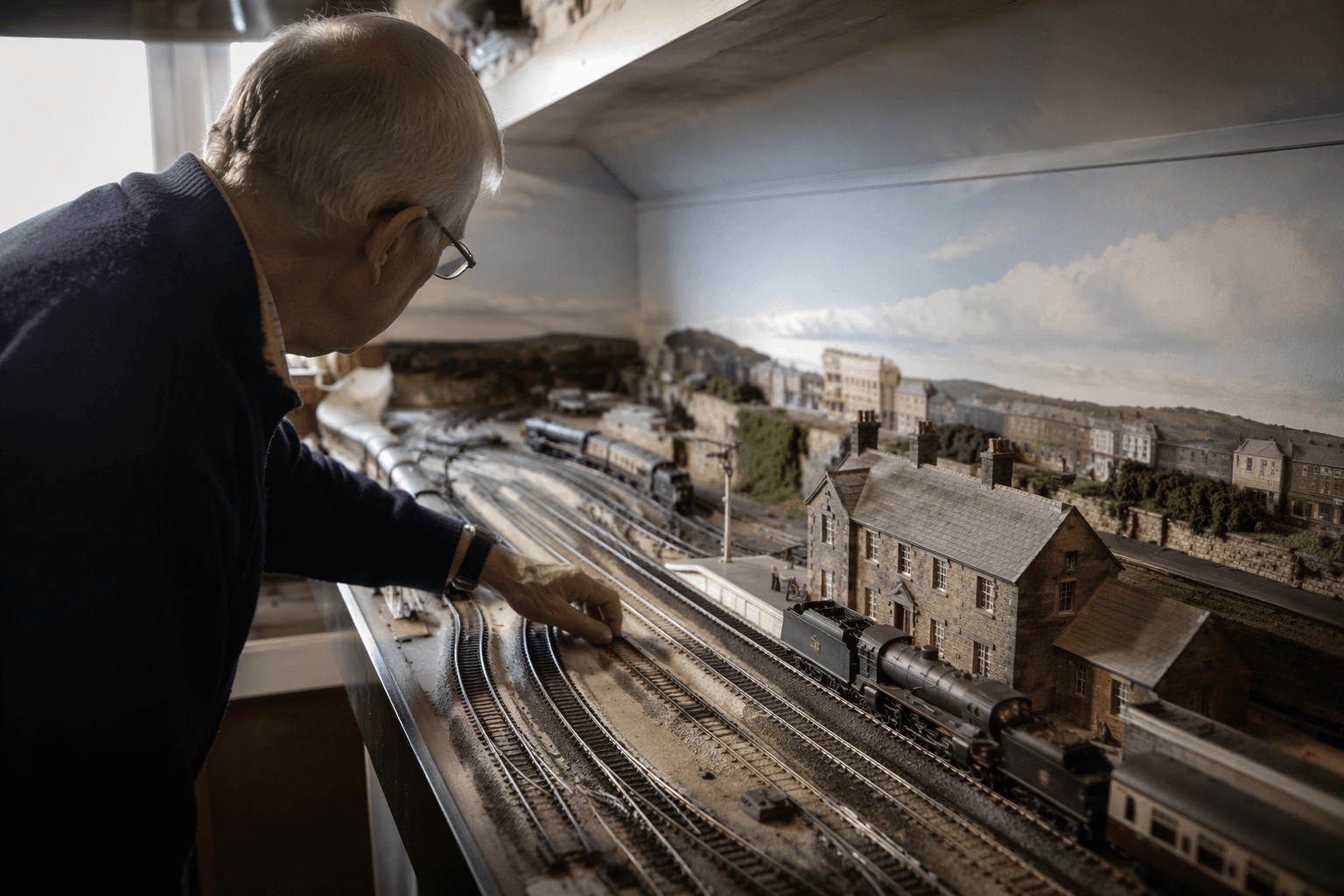
Phoenix Lane is the kind of layout that stops people in their tracks because it arrives with presence as well as pedigree. At 25ft long and about 9ft wide, this OO gauge continuous-run model is big enough to command a hall, but it earns its place through the detail packed into every inch of the scene. Built by Glasgow and West of Scotland MRC, it captures a busy North British Railway passenger station, a yard, and a locomotive shed at a junction where steam, diesel locomotives, DMUs and railbuses all overlap in the same working railway world.
That mixed traction period is exactly why Phoenix Lane matters. It is not just a scenic slice of Scotland, it is a working model of transition, where the timetable, the stock and the operations all have genuine movement built into them. For anyone modelling the last years of Scottish steam, the layout offers a clear reminder that the end of one era and the rise of another did not happen neatly, but side by side, with different types of motive power sharing platforms, yards and shed roads.
Why the layout’s size changes the experience
The first thing that gives Phoenix Lane real exhibition power is scale on the room floor. A 25ft continuous-run layout gives the operating team room to create proper train length, pacing and junction interest, rather than relying on a short scenic cameo. That extra width of about 9ft also allows the scene to breathe, so the station, yard, shed and fiddle-yard end are not crammed together.
Size also matters because it supports the layout’s operational story. A junction setting needs space to show traffic moving through, stopping, shunting and turning over, and Phoenix Lane uses that room to make each train feel placed with purpose. Visitors get the impression of a railway that is busy because it is busy, not because the model has been loaded with stock for effect.
A Fife setting with clear prototype roots
The layout is set in 1960s Fife and depicts a former North British Railway passenger station at a busy junction. That choice of location gives Phoenix Lane a very specific identity, rooted in the Scottish railway geography that modelers know well. It is not a generic station scene with a Scottish sign on it. It is a model that understands the character of the region and the operational habits of the period.
One of the strongest prototype touches is the station building, which the club says is an exact replica of the present-day building at North Queensferry. That kind of accuracy gives the layout more authority than a loosely inspired scenic model. It tells visitors that the club has done the legwork on place, structure and atmosphere, and that the scene is built to reflect a real location rather than simply suggest one.
Scratchbuilt craftsmanship gives the scene its weight
Phoenix Lane’s scenic credibility comes from the amount of custom building on show. Almost all the buildings are scratchbuilt, with only a few resin and modified kit elements used where they fit the job. That is a major reason the layout reads as a cohesive whole rather than a collection of separate scenic items.
The coal loading tower beside the engine shed is a good example of that approach. It was built from reference to an LMS plan supplied by another Scottish club, which adds both authenticity and a useful sense of shared club knowledge. Details like that matter because they turn a display into a believable railway environment, especially in a setting where the eye naturally moves from station to yard to depot and expects each part to make sense.
Operations are built into the design
Phoenix Lane is not just a scenic exhibit. It is wired for both DC and DCC operation, using analogue controllers, a YAMORC control centre and Digitrains handsets. Points and signals are analogue controlled, and there is a separate control panel for the fiddle yard. That combination gives the layout flexibility, and it also hints at the priorities behind the build: reliable running, straightforward control and enough operational variety to keep sessions flowing.
For an exhibition layout, that is a serious advantage. Mixed control systems can support different operating styles while preserving the direct handling that many club teams prefer on show day. The separate fiddle-yard panel is especially useful in a large continuous-run layout, because the hidden side of the railway needs to be just as dependable as the scenic front if the whole presentation is going to stay sharp.
- Dual DC and DCC capability broadens operating options.
- Analogue-controlled points and signals keep the infrastructure simple to manage.
- A separate fiddle-yard control panel helps maintain smooth train circulation.
Those are practical choices, not decorative ones, and they show in the finished layout. Phoenix Lane is built to run as well as to be looked at, which is exactly what makes it stand out among exhibition OO gauge projects.
A layout with a story of recovery behind it
The name Phoenix Lane is not a branding exercise. The layout was rebuilt after a fire in an adjacent unit badly damaged the club’s previous layout, so the title is a literal reflection of recovery and renewal. That history gives the model emotional weight, because every exhibition appearance carries the sense of a project that came back stronger after serious loss.
That background also helps explain the confidence of the finished result. Phoenix Lane feels like the product of a club that knows how to rebuild, refine and present work with purpose. The name fits because the layout is not simply surviving on the circuit, it is making a fresh statement about what a club project can become when craftsmanship, planning and persistence are all pulling in the same direction.
Why visitors should make time for it
Phoenix Lane deserves attention because it combines three things model railway audiences respond to immediately: scale, authenticity and operational intelligence. The size gives it room to tell a proper railway story, the North Queensferry-inspired station and scratchbuilt structures give it prototype credibility, and the DC/DCC arrangement shows that the layout has been engineered for dependable public running.
Just as importantly, it captures a railway scene that feels alive with change. Steam is not replaced overnight here. It shares the stage with diesel traction, DMUs and railbuses, exactly as a 1960s Fife junction should. That is what makes Phoenix Lane more than another OO gauge layout, and why it stands out as an anchor display in any line-up built to impress serious model train fans.
This article was produced by Prism’s automated news system from verified source data, official records, and press releases, then run through automated quality and moderation checks before publishing. The system is built and supervised by the people who set the standards it runs under. Read our full AI policy.
Did this article answer your question?