Poplar East brings East London docklands history to O gauge
Poplar East turns East London docklands history into O gauge theatre, with a 43ft scenic layout, mixed traffic, and a wagon lift that rewards close viewing.

A layout you stop for first
Poplar East is the kind of exhibition layout that pulls you in before you have even traced the track plan. Ron Bailes has built a brand-new 43ft by 15ft O gauge scene set in the docklands area of the East End, and it will make only its second public appearance after more than five years of construction. That combination of scale, scarcity and story gives it instant pull at the Great Electric Train Show, which returns to Arena MK in Milton Keynes on October 10/11, 2026 with more than 30 hand-picked model railways, more than 50 trade stands and modelling demonstrations.
What makes it stand out is that it is not just another urban terminus or freight yard dressed up with period detail. Poplar East is a fictional station with a very specific identity, set in the early 1960s when dieselisation was well underway but steam was still visible on the same rails. That transitional moment gives the layout a living, layered feel, and it is exactly the sort of era that rewards a slow look rather than a quick pass-by.
An East End setting with real railway tension
The story Poplar East tells is rooted in the East London docklands, and that matters because the docklands were never a simple one-note railway landscape. The layout splits its operational world between Great Eastern and Great Northern services, creating the sort of cross-company movement that instantly suggests purpose, routeing and interchange. Through workings, cross-platform transfers and mixed-traffic running all fit naturally here, which means every movement has a reason rather than just filling time between trains.
That makes the layout feel more like a slice of transport geography than a scenic backdrop. The early 1960s setting is especially effective because the area was still busy enough to justify varied traffic, yet old enough that steam had not quite disappeared. The result is a stage where a viewer can spot a suburban arrival, a dockside freight movement and a transfer working without the scene feeling forced.
Why the period choice works
The early 1960s is the sweet spot that gives Poplar East its energy. The railways were changing fast, but they had not settled into the simplified patterns that came later, so the layout can show several layers of service in one place. That is far more interesting than a generic station scene because it gives the operator and the viewer something to read in every move: who is coming from where, what they are carrying, and how the station functions inside a wider network.
The Great Northern side also taps into a wider real-world pattern of joint and connected rail working in the east of England, where lines and services overlapped in ways that made interchange believable. A fictional station can still feel entirely authentic when its operating logic is this carefully chosen, and Poplar East uses that freedom well.
A dockside yard with a story of its own
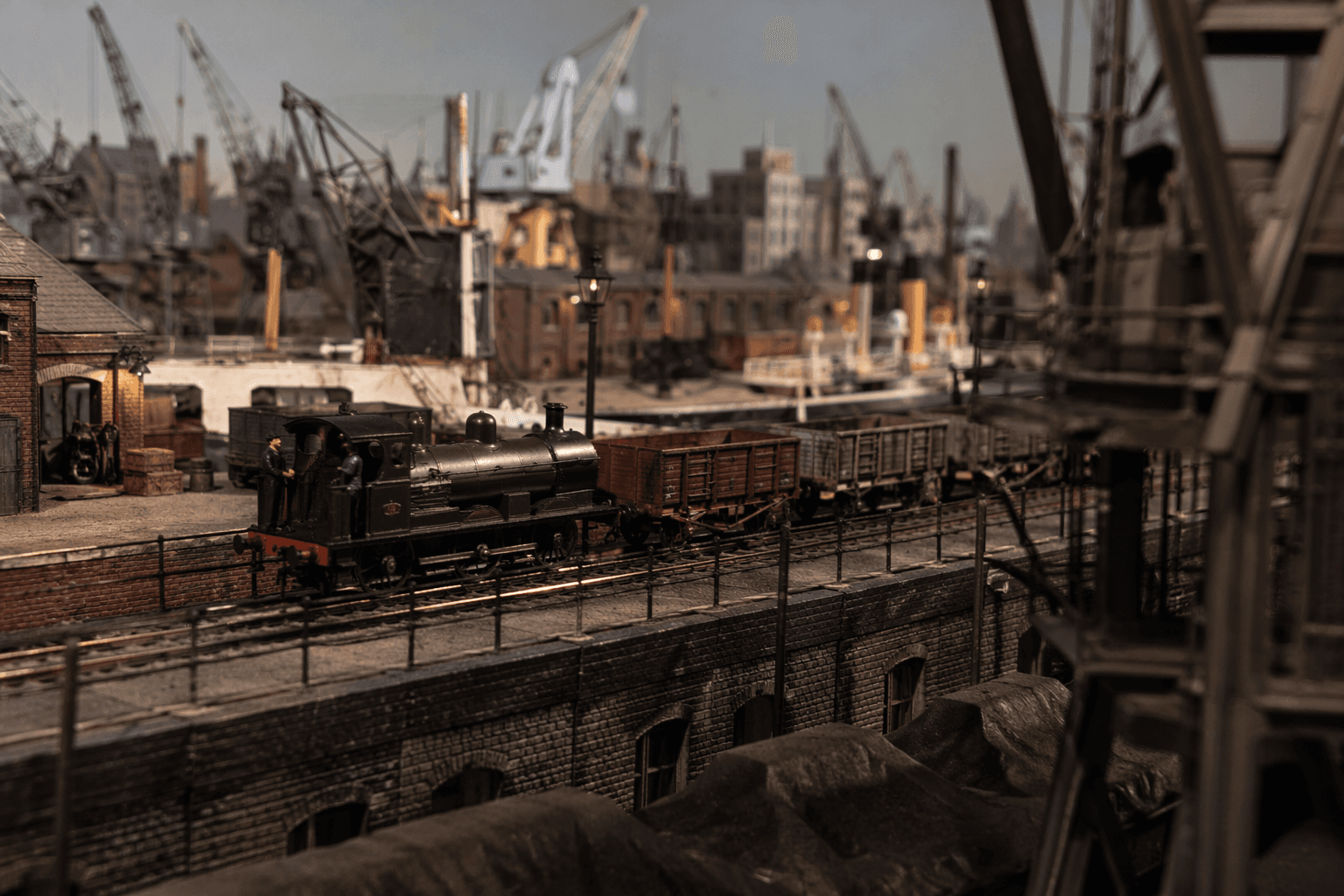
The low-level goods yard is based on Poplar Coal Dock, and that detail is one of the layout’s strongest hooks. Instead of using a token freight corner, the design builds a second layer of purpose into the scene, turning the layout into a miniature piece of urban infrastructure. The wagon lift linking the levels is the sort of feature that makes you linger, because it is not just visually distinctive, it explains how the layout works.
That matters on an exhibition layout, especially in O gauge, where mass and mechanism can be part of the drama. The lift adds vertical movement to a plan that already has horizontal complexity, so the eye gets pulled between platform level, goods level and the machinery that connects them. It is exactly the sort of detail that rewards close inspection, because it tells you how traffic is meant to flow through the scene.
The historical dockland backdrop
Poplar Dock gives the whole project a solid historical spine. It opened as a railway dock in 1851 and was used mainly for coal and export goods traffic, which is precisely the kind of industry that makes a docklands layout feel grounded rather than decorative. The dock was extended west in 1875-7 to provide depots for other railway companies, and in 1909 it remained under North London Railway control rather than coming under the Port of London Authority.
That long operational life runs right through to the modern era, because the dock stayed in British Rail ownership until closure in 1981. For a modeller, that history is useful because it explains why the area could support a mixed railway identity for so long. It also helps justify the layout’s industrial feel, since the scene is not borrowing the look of a dock and hoping it feels convincing, it is drawing from a real working railway environment that lasted through multiple eras of change.

The wider docklands story adds another layer. The Docklands Light Railway opened in 1987 to help regenerate London’s former docklands, and the low-level goods yard is said to sit near the site of Westferry station on the DLR. That creates a neat historical echo: the railway landscape that Poplar East recreates belongs to the world before the docklands were remade, before the area was reconnected in a new form.
Built for dependable public running
Poplar East is not only about atmosphere, because the mechanics behind it are designed for exhibition reliability. The layout runs on DCC, with points and signals controlled by a DCC Signalling Controller, while train detection uses magnetic reed switches and magnets fitted to each train. That sort of setup tells you the layout was built to cope with public running, where repeatability and smooth sequence matter as much as scenic polish.
Those technical choices also support the story the layout is telling. Detection, signalling and controlled pointwork all help traffic move in a believable order, which is vital when a scene depends on through workings and cross-platform transfers. In other words, the technology is not hidden away as a hobby detail for its own sake, it is part of the reason the railway can feel busy without feeling chaotic.
Why it will pull a crowd at Milton Keynes
At the Great Electric Train Show, Poplar East should be one of those layouts that visitors circle back to after the first walk-around. The show’s scale, with more than 30 railways and more than 50 trade stands, means there will be plenty to see, but Poplar East has the sort of built-in character that makes a reader stop and study the scene. It has a named place, a tightly chosen era, a docklands industrial logic and a working pattern that invites you to decode what each train is doing.
That is why it stands out. Poplar East is not just a fine O gauge build, it is a carefully framed East London story with movement, infrastructure and history all locked together. At Arena MK, it should be the layout that makes people slow down first, then stay a little longer.
This article was produced by Prism’s automated news system from verified source data, official records, and press releases, then run through automated quality and moderation checks before publishing. The system is built and supervised by the people who set the standards it runs under. Read our full AI policy.
Did this article answer your question?