Rapido’s HO scale SW9 captures Boston & Maine switcher history
Rapido’s SW9 feels built for the jobs that keep a layout alive: yard switching, terminal work, and heritage scenes, with Boston & Maine history baked in.
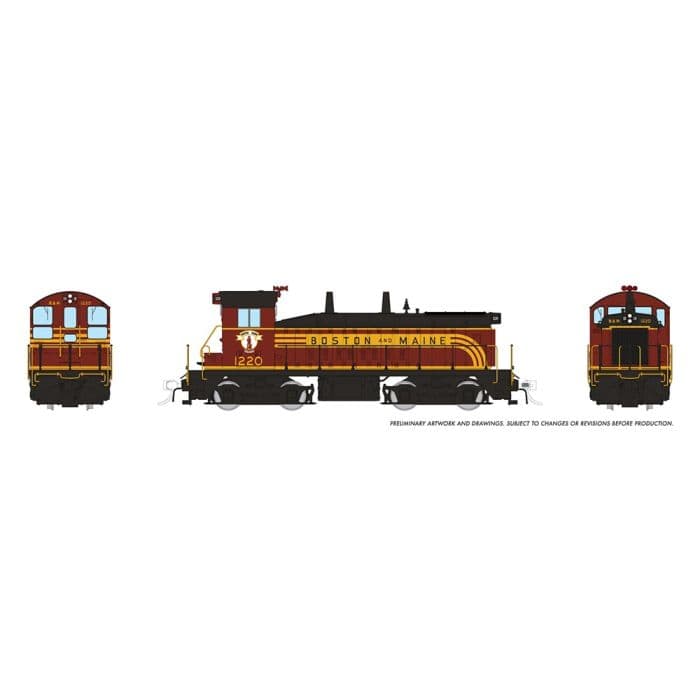
Rapido’s HO scale SW9 lands in the sweet spot where a switcher earns its keep and still draws a crowd. It looks right at home on industrial tracks, terminal assignments, shortlines, and museum or heritage scenes, and the Boston & Maine version gives that versatility a very specific face and era.
A switcher that works as hard as it looks
The best way to read this model is as a practical layout locomotive first and a display piece second. The SW9 was built for the kind of chores that dominate smaller HO railroad worlds, pulling cuts in a yard, serving a terminal, or handling the endless on-and-off-again rhythm of industrial districts. Rapido’s execution reinforces that dual identity: the heavy diecast frame and diecast gear boxes suggest a model meant to run with authority, while the dense exterior detailing gives it the kind of presence that makes slow-speed switching interesting to watch.
That balance matters because the SW9 lives where the eye has time to wander. On a switching layout, or in a terminal scene where the locomotive is constantly in view, cab-end details and roof hardware are not decoration, they are the whole point. Rapido seems to understand that, and the result is a model that looks like it belongs in a working railroad environment instead of a shelf case.
Boston & Maine gives the model its story
The Boston & Maine example anchors the release in real railroad history. The B&M took delivery of five SW9 switchers in May 1953, and the roster included SW9 1224, which later became Springfield Terminal 1422 after Guilford acquired the Boston & Maine and the subsidiary Springfield Terminal in June 1983. That kind of corporate layering gives the prototype a long modeling life, because one locomotive can be justified in more than one paint scheme, on more than one era of layout, and in more than one railroad identity.
That same roster logic helps explain why the Boston & Maine version feels especially useful. A locomotive like 1224 can represent the original B&M diesel era, then later reappear in Springfield Terminal service, which opens the door to modeling Boston, Lowell, Springfield, or other New England terminal and interchange scenes across a wide time span. Even the roster notes around B&M 1226 and 1229, both SW9s built in 1952 and 1953, reinforce how quickly these switchers became part of the railroad’s working vocabulary.
Why the SW9 keeps showing up in model railroading
The prototype had the kind of staying power that modelers love. EMD built the SW9 from November 1950 through December 1953, and Rapido notes that nearly 800 were built in LaGrange, plus 29 more in London, Ontario for Canadian National and Canadian Pacific. Rapido also says 69 railroads bought SW9s, with Illinois Central taking the largest order at 70 units.
That spread tells you why the SW9 is still such a familiar face on layouts. It was common enough to feel natural in all kinds of settings, but not so generic that it loses character. A small switcher with broad railroad adoption becomes a kind of shorthand for midcentury diesel operation, especially in yards, terminals, and light industrial work where the engine is seen moving, stopping, and starting more than it is seen stretching its legs.
Rapido loads the shell with prototype-specific cues
What separates this release from earlier SW-series choices is the amount of road-specific detail packed into it. The Boston & Maine sample includes a three-chime air horn on the front edge of the cab, twin-beam Pyle headlights, trash-can-style spark arrestors, and full-length deck-mounted side handrails. Those are the kinds of features that immediately tell a knowledgeable eye which railroad it is looking at, and they help the model read correctly from normal layout viewing distance.
Rapido also uses separate factory-applied parts such as the air horn and cab vent, plus see-through etched-metal radiator screens, LED lighting, and a rear cab window that gives a clear view into the interior. That rear window is a small thing on paper, but on an end-cab switcher it matters a lot, because the cab is part of the locomotive’s visual identity. The model does not just suggest the SW9 shape, it leans into the specific surfaces, openings, and roof clutter that make the prototype so recognizable.
Built for modern ready-to-run expectations
The product page details push the model toward the top tier of ready-to-run HO locomotives. In addition to the heavy diecast frame and diecast gear boxes, Rapido includes semi-scale metal couplers and full LED lighting. Retail listings also note working number boards and classification lights on some versions, and sound-equipped versions are offered with ESU LokSound.
That combination is important because it changes the way the locomotive fits into a layout. A model like this does not need a long list of aftermarket upgrades before it feels complete, which makes it useful for operators who want a switcher that can go straight to work. At the same time, the detail level keeps it attractive to modelers who care about roof-end hardware, cab visibility, and the small differences between a generic switcher and a specific railroad’s engine.
A good fit for layouts that live at low speed
The SW9 is especially persuasive in places where low-speed movement is the show. Industrial switching scenes, terminal tracks, and shortline jobs all reward a locomotive that looks busy even when it is creeping along with one or two cars. Heritage and museum settings also benefit from that same character, because a switcher in a preserved-road scheme often becomes the visual center of a compact scene.
Rapido’s version seems to understand that assignment. It is not trying to be a big road engine in disguise. Instead, it focuses on the things that make a switcher matter: the cab-end view, the roof details, the working lights, and the sense that the locomotive has real purpose. That is what separates a practical workhorse from a display-only model, and this SW9 lands closer to the first category without giving up the second.
By the time the Boston & Maine story comes into focus, the appeal becomes obvious. The SW9 was built to work, Rapido built the model to be seen, and the result is a switcher that fits the kind of layouts where every move counts and every detail at the cab end tells part of the story.
This article was produced by Prism’s automated news system from verified source data, official records, and press releases, then run through automated quality and moderation checks before publishing. The system is built and supervised by the people who set the standards it runs under. Read our full AI policy.
Did this article answer your question?