Yunnan study adds two new edible Lyophyllum mushrooms to science
A Yunnan paper added two edible Lyophyllum species to science, showing how even basket-worthy mushrooms can stay unnamed until DNA and field work catch up.

A MycoKeys paper published June 26 added two previously undescribed edible Lyophyllum mushrooms from Yunnan Province to the scientific record after researchers sorted seven specimens from a macrofungi survey in southwestern China. The study paired classic morphology with multi-locus phylogenetic analysis and found that two collections belonged to species not seen before in the scientific literature.
The new taxa are Lyophyllum hemigaleatum and Lyophyllum pseudorrhizum. The team, which included Rui-Yu Li, Yuan Luo, Duan-Fen Zhao, Ye-Ting Li, Han-Bing Song, Hong-Wei Shen, Zong-Long Luo, Song-Ming Tang, Shuhong Li, Jun He, Dequn Zhou, Qimeng Liu, Shaoxiong Liu, Jianying Li, Junbo Zhang, Fan Zhou, Xi Luo, Jianxiong Ma, Rong Hua, and Dafeng Sun, used ITS, nrLSU, rpb2, and tef1- sequence data to place the mushrooms among their close relatives. That mix of field characters and gene markers is what pushed the paper past a simple description and into a clean taxonomic split.
The descriptions give foragers the kind of detail that matters when mushrooms look deceptively ordinary. Lyophyllum hemigaleatum has an orange hemispherical pileus measuring 1.4 to 1.8 cm wide, with spores averaging 7.36 by 5.10 micrometers. Lyophyllum pseudorrhizum has a grayish-orange pileus 1.2 to 2.8 cm wide, white flesh that does not change color when injured, and a stipe base that forms a pseudorrhiza. Both species were compared with close matches in the genus, including a Swedish relative, Lyophyllum semitale, which the paper notes has a larger cap and a rooted stipe.
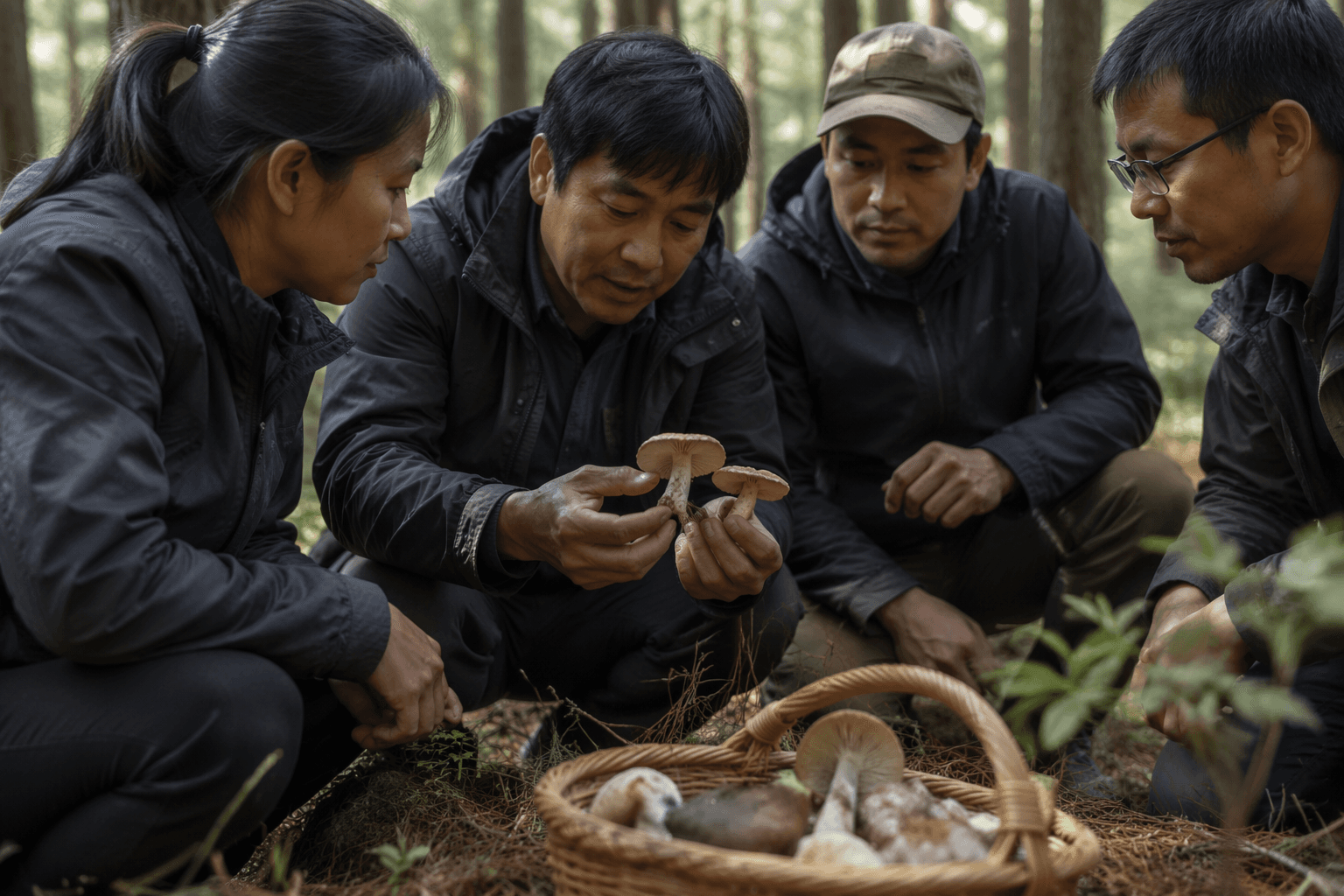
The broader picture is bigger than two names on a checklist. A 2024 Frontiers in Ecology and Evolution study estimated 88 Lyophyllum operational taxonomic units at 98 percent sequence similarity, with 49 not assigned to known species, which is a blunt reminder that the genus is still under-described. In 2023, other Chinese work described Lyophyllum yiqunyang and Lyophyllum heimogu from Tibetan areas as edible low-temperature mushrooms widely collected and eaten by local people, so this is not a one-off discovery but part of a continuing cleanup of the genus.
That matters in Yunnan, long called China’s kingdom of wild fungi and reported to hold about 900 edible wild mushroom varieties, more than 90 percent of the country’s total. Markets in Kunming and other cities fill fast in season, and public-health warnings about poisonous lookalikes keep surfacing alongside the edible trade. The new Lyophyllum paper does what good mushroom science should do: it tightens the map before anyone starts trusting a cap just because it looks familiar.
This article was produced by Prism’s automated news system from verified source data, official records, and press releases, then run through automated quality and moderation checks before publishing. The system is built and supervised by the people who set the standards it runs under. Read our full AI policy.
Did this article answer your question?