NBA 2K25 shooting adds risk-reward timing and rhythm-based shot stick
NBA 2K25 turns shooting into a tradeoff: safer timing for steady looks, tighter windows for elite scorers, and a rhythm stick that rewards repetition.
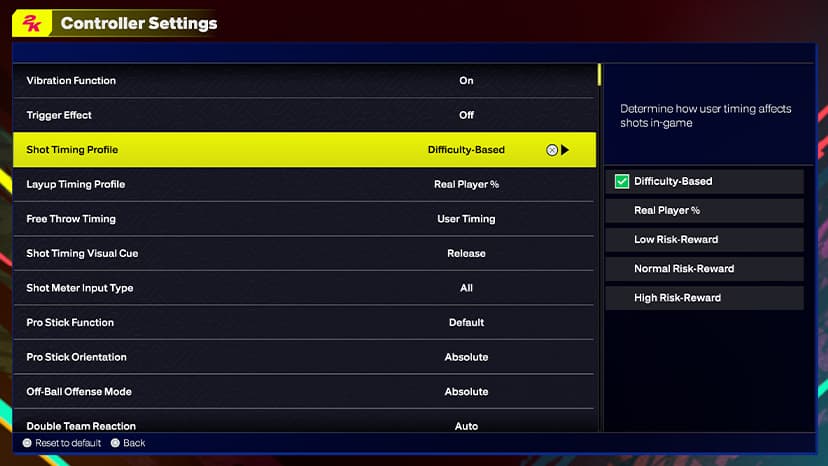
NBA 2K25’s biggest shooting change is Pro Stick Rhythm Shooting, an optional down-up motion on the shot stick that rewards you for matching a player’s signature motion. You pick how much risk you want in your timing, then you decide whether you want to live on a button release or learn that rhythm. The jump shot still ends the possession, but the real work starts earlier, with the space you create, the cue you trust, and the timing profile you can actually repeat.
Shooting is now a risk-reward decision
The cleanest way to understand NBA 2K25 shooting is to stop treating every jumper the same. Shot Timing Profiles let you decide how forgiving your release should be, and that changes the way you should build your offense. Low Risk-Reward gives you a more forgiving window and rewards smart shot selection, while High Risk-Reward demands more precision but can pay off with a higher volume of difficult makes once you really own the timing.
The game is not asking the same thing from every player. A guard who lives off quick pull-ups and contested finishes is playing a different shooting game than a wing who gets most of his looks off catch-and-shoots or a big who mostly works off screens and post seals. The smartest approach is to match the timing profile to the shots you actually generate, not the shots you hope to take when the defense breaks down perfectly.
If you are new, Low Risk-Reward is the safer starting point because it gives you room to learn the game’s shot language without turning every miss into a punishment. If you already know your jumper, understand your release cue, and regularly create clean looks, High Risk-Reward gives you a ceiling worth chasing.
Rhythm shooting changes what a good release feels like
A button tap is about timing a release point; Pro Stick Rhythm Shooting makes shooting feel physical, like you are syncing your hands to the motion of the jumper instead of simply letting go at the right instant.
It rewards players who are willing to practice tempo, not just reaction time. If you can mimic the rhythm of the shot, the system gives you another layer of control over your makes. If you cannot, the mechanic becomes another way to miss clean looks that should have gone down.
NBA 2K25 does not force one shooting language on everyone. Custom Visual Cues let you tune what you watch for, Signature Go-To Shots help define the kind of attempts you build around, and Shot Canceling gives you more control when a possession changes before the release happens. Together, those tools push shooting away from raw button mashing and toward repeatable personal setup.
Who should use which profile
Different timing profiles favor different kinds of players, and that is where the system becomes practical instead of abstract. Beginners get the most value from forgiveness because it shortens the learning curve and reduces how often a clean look turns into a late or early miss. If you are still getting used to the meter, the release point, and the pacing of online games, a forgiving setup protects you from looking like a placeholder when the game speeds up.
More advanced players can afford to lean into tighter timing because they know how to manufacture cleaner shots. If your game is built on dribble chains, stepbacks, spins, and quick reads into open space, High Risk-Reward can turn that skill into more dangerous offense. The catch is simple: tighter windows only help if you are already disciplined enough to repeat the same timing over and over.
- Spot-up shooters usually benefit from a profile that keeps catch-and-shoot timing stable.
- Shot creators may prefer a tighter setting if they can reliably generate their own rhythm.
- Bigs and lower-usage scorers often do better with forgiveness because their looks come in fewer, more specific spots.
- Competitive players who live off repetition can squeeze more out of a harder profile once their release is locked in.
The best fit is often tied to playstyle.
For a lot of players, the answer changes depending on whether they are grinding offline games, running Rec, or trying to survive the faster reads of higher-level competition.
The shot stick does not live alone
Shooting in NBA 2K25 is tied to the rest of the controller language, which is why the game’s broader offensive tools matter. Shot control sits alongside the moves that create the shot in the first place, including dribbling, stepbacks, spins, and Quick Protect. If you do not protect the ball, create a clean angle, and get the defender leaning, even a good release is harder to repeat.
In the Courtside Report, 2K said NBA 2K25 was built to give newcomers, seasoned players, and experts more variety, accessibility, and freedom on offense. The goal is not just to make shooting easier or harder. It is to give you more ways to build a possession that fits the player in your hands, whether that means using a safer jumper, a signature move, or the rhythm stick to force a different kind of release.
NBA 2K25 launched worldwide on September 6, 2024, with early access for preorder players beginning on September 4, 2024, and 2K released it across PS5, PS4, Xbox Series X|S, Xbox One, Nintendo Switch, and PC. The new-gen version was positioned as a major gameplay update powered by ProPLAY.
The green window is still the hidden number behind all of it
The community has spent years talking about the green window, and 2KLab dates the term’s entry into the NBA 2K conversation to NBA 2K18. 2KLab estimates that perfect-release band at roughly 50 to 60 milliseconds, which explains why so many players feel like shooting is unforgiving even when the jumper looks close. There is very little room between perfect and missed, and the newer timing systems are built around that narrow margin.
NBA 2K25 is not reinventing shooting from scratch. It is building on a long-running obsession with timing precision and then giving players more ways to manage the risk. Low Risk-Reward, High Risk-Reward, and Rhythm Shooting all manage that same precision problem in different ways.
Patch changes show where the developers saw friction
2K kept tuning that feel after launch. An NBA 2K25 patch note improved Pro Stick shooting responsiveness and reduced delays on catch-and-shoot attempts. The developers adjusted the stick-based system after launch.
NBA 2K26’s gameplay pages treat enhanced Rhythm Shooting as a core feature on Gen 9 platforms, and the official guide frames the shot stick as a central skill alongside the rest of the move set.
This article was produced by Prism’s automated news system from verified source data, official records, and press releases, then run through automated quality and moderation checks before publishing. The system is built and supervised by the people who set the standards it runs under. Read our full AI policy.
Did this article answer your question?