China's EAST Fusion Reactor Shatters Plasma Density Limits With New Technique
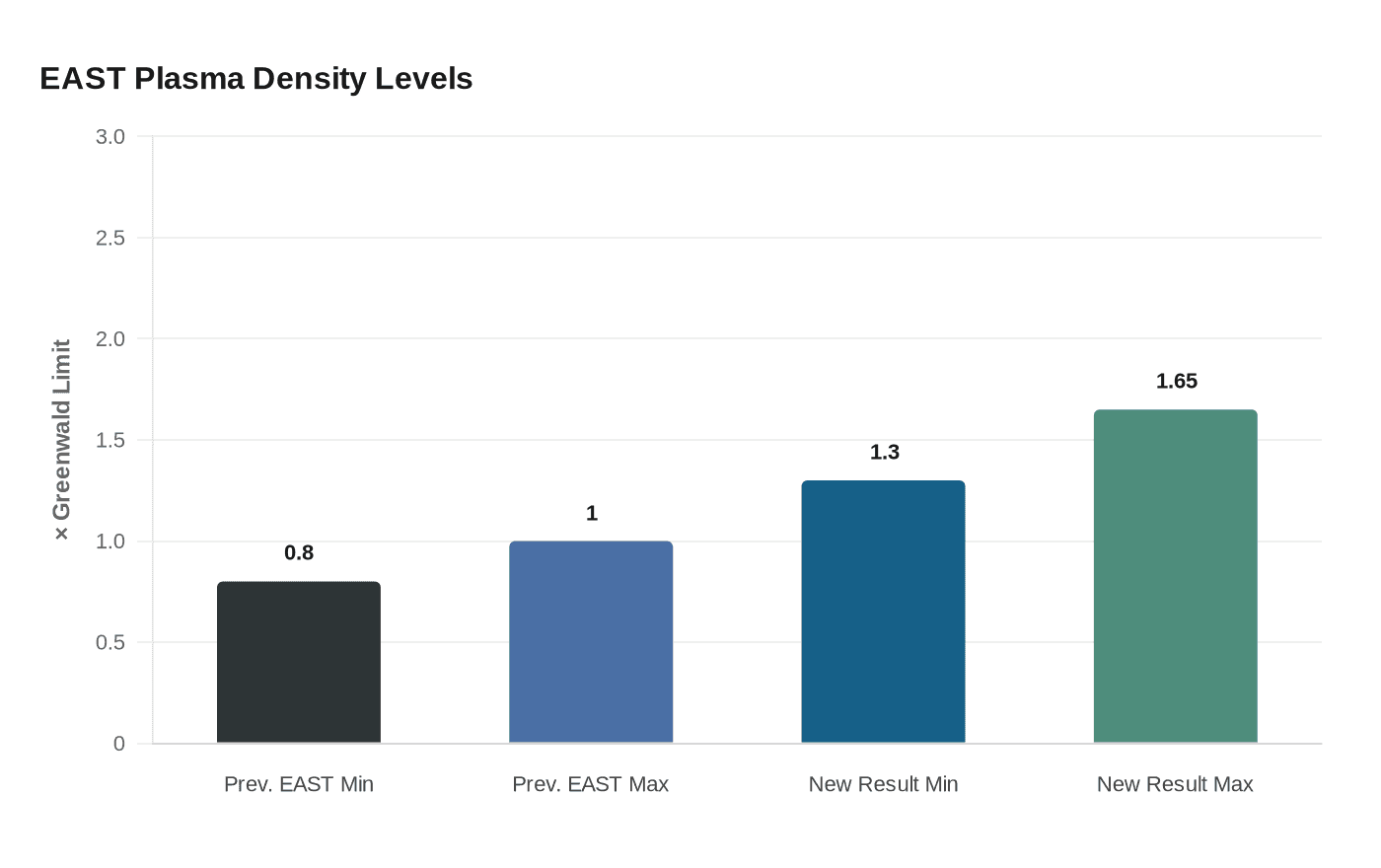
EAST pushed stable plasma to 1.65x the Greenwald density limit, a barrier constraining tokamak design for decades, using a plasma-wall technique that could reshape future reactor sizing.
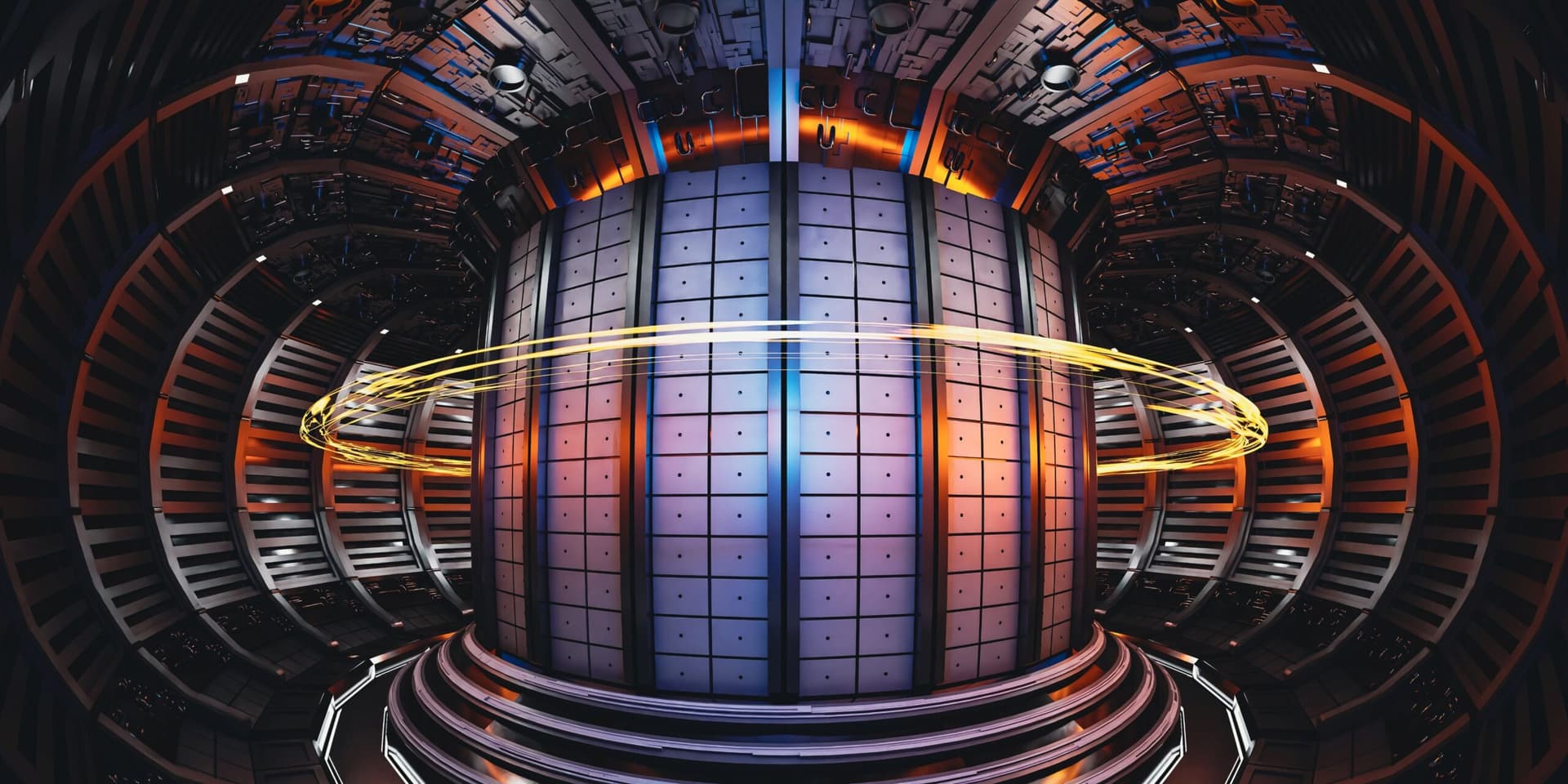
The Greenwald density limit has constrained tokamak design for decades, and China's Experimental Advanced Superconducting Tokamak just operated stably past it at 1.65 times the ceiling.
Researchers at EAST, the "Artificial Sun" facility in Hefei, reported stable plasma at densities between 1.3 and 1.65 times the Greenwald limit in a Science Advances paper published in January 2026, titled "Accessing the density-free regime with ECRH-assisted ohmic start-up on EAST." Before this work, EAST typically ran at 80 to 100 percent of the limit.
The Greenwald limit is an empirical ceiling, not a physical law. It ties the maximum allowable electron density in a tokamak to plasma current and the machine's cross-sectional dimensions. Engineers treated it as a hard boundary because plasma pushed beyond it tends to disrupt, collapsing in instabilities that can damage reactor walls. The EAST result, reaching up to 1.65 times that boundary with no collapse, means the team found a way to reorganize the plasma-wall relationship before those instabilities could develop.
The method hinged on electron cyclotron resonance heating (ECRH) combined with ohmic start-up. Adjusting pre-filled gas pressure and the electron heating resonance altered the initial conditions of the discharge, triggering plasma-wall self-organization (PWSO). By controlling the physical conditions of EAST's tungsten divertor target plates, the team reduced tungsten impurity sputtering, cutting impurity radiation at the plasma edge and preventing the edge cooling that normally enforces the density ceiling.
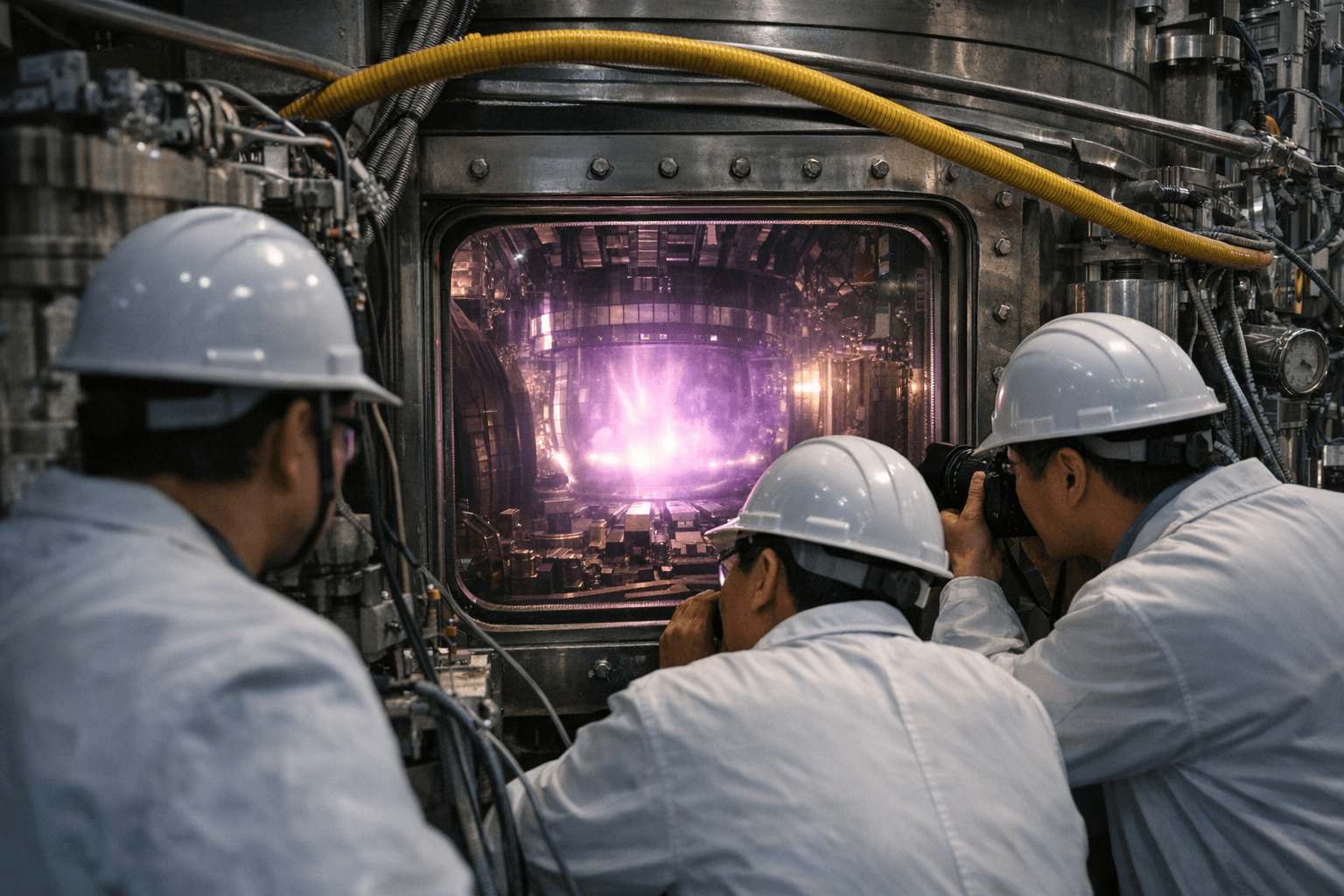
The work also confirms a 2017 theoretical study by physicists in France that first challenged the universality of the Greenwald limit. That pathway had never been demonstrated in a fusion-capable plasma: a previous breach of the limit by over 10 times succeeded only in low magnetic field and low-temperature conditions not capable of nuclear fusion. EAST's result is qualitatively different.
The fusion community cares because power output scales roughly with the square of plasma density. Running at 1.65 times the prior density ceiling opens the possibility of substantially higher power from the same footprint, or achieving ignition conditions at lower temperatures and shorter confinement times. Co-lead author Ping Zhu, a professor at the University of Science and Technology in China, said the findings "suggest a practical and scalable pathway for extending density limits in tokamaks and next-generation burning plasma fusion devices."
Chris Eaglen, vice-chair of IChemE's nuclear technology special interest group and not involved in the study, framed the result plainly: "The Greenwald limit was treated as a hard operational ceiling for decades. Fusion engineers have sized machines, fuelled plasmas and set safety margins around it." The EAST data show the limit "is not a fundamental law, but a consequence of how plasmas are formed and interact with walls," he said, and "reactors may not need to be as large or as conservative in density assumptions." His caveat was equally direct: this "improves confidence in future reactor designs rather than accelerating timelines" and is "not a shortcut to power-producing fusion."
That qualification places the result correctly on the progress map. ITER, the international experiment under construction in France, still depends on solving sustained confinement and materials challenges that higher density alone cannot answer. Clearing the Greenwald ceiling is a plasma physics win; it does not yet guarantee a power plant.
EAST's next test is applying the ECRH-assisted method under high-performance plasma conditions to confirm the density-free regime holds where it counts. The tokamak already logged 1,066 seconds of plasma above 100 million degrees Celsius. If the new technique survives that environment, the design assumptions underpinning ITER and the next generation of burning-plasma machines may need to be rebuilt from a higher baseline.
This article was produced by Prism’s automated news system from verified source data, official records, and press releases, then run through automated quality and moderation checks before publishing. The system is built and supervised by the people who set the standards it runs under. Read our full AI policy.
Did this article answer your question?