floating nuclear plants seen as realistic option for Greece
Greece is not ready for nuclear power, but a new report says floating reactors could still fit its coastlines, ports, and island energy gaps.
_68931.jpg&w=1920&q=75)
What the report actually puts on the table
A floating reactor would not have to win over the whole of Greece at once. It would have to prove it can dock, operate, and be trusted on the water, and that is exactly the level at which the new Deon Policy Institute report tries to judge it.
The institute concludes that floating nuclear power plants could be a realistic option for Greece, with no fundamental barriers to deployment. That is a cautious verdict, not a green light for construction. The report still flags major policy, regulatory, financial, and social-acceptance hurdles, which means the question is not whether the physics can work, but whether Greece could build the institutional machinery to make it happen.
Why Greece is even in the frame
Greece is not a country with a legacy nuclear power fleet waiting to be restarted. The International Atomic Energy Agency says it has no nuclear power plants and has long said it has no intention of building any in the foreseeable future. Its main reactor is the 5 MW Greek Research Reactor-1 at NCSR Demokritos, and that unit is licensed for extended shutdown.
That makes the Deon report notable on its face. It is not arguing for a familiar land-based program in a country already set up for commercial nuclear power. It is asking whether a different model, compact, maritime, and potentially movable, could fit a country whose energy problems often show up at the edge of the map: islands, ports, and coastal demand centers.
The Athens workshop that kicked it off
The report grew out of a two-day workshop in Athens on October 30 to 31, 2025, built as part of a research program involving CORE POWER, Athlos Energy, and the American Bureau of Shipping. Deon says the workshop’s initial PESTLE findings pointed to gaps in existing policy frameworks and to the need for clearer assessment and regulatory pathways.
That matters because PESTLE is the kind of framework that forces a technology pitch to survive contact with reality. It does not just ask whether a reactor can generate electricity. It asks whether the politics, economics, social conditions, technology base, legal regime, and environmental setting all line up. In this case, the report’s answer is that the hurdles are real, but not disqualifying.
Why floating reactors fit the Greek conversation better than a conventional plant
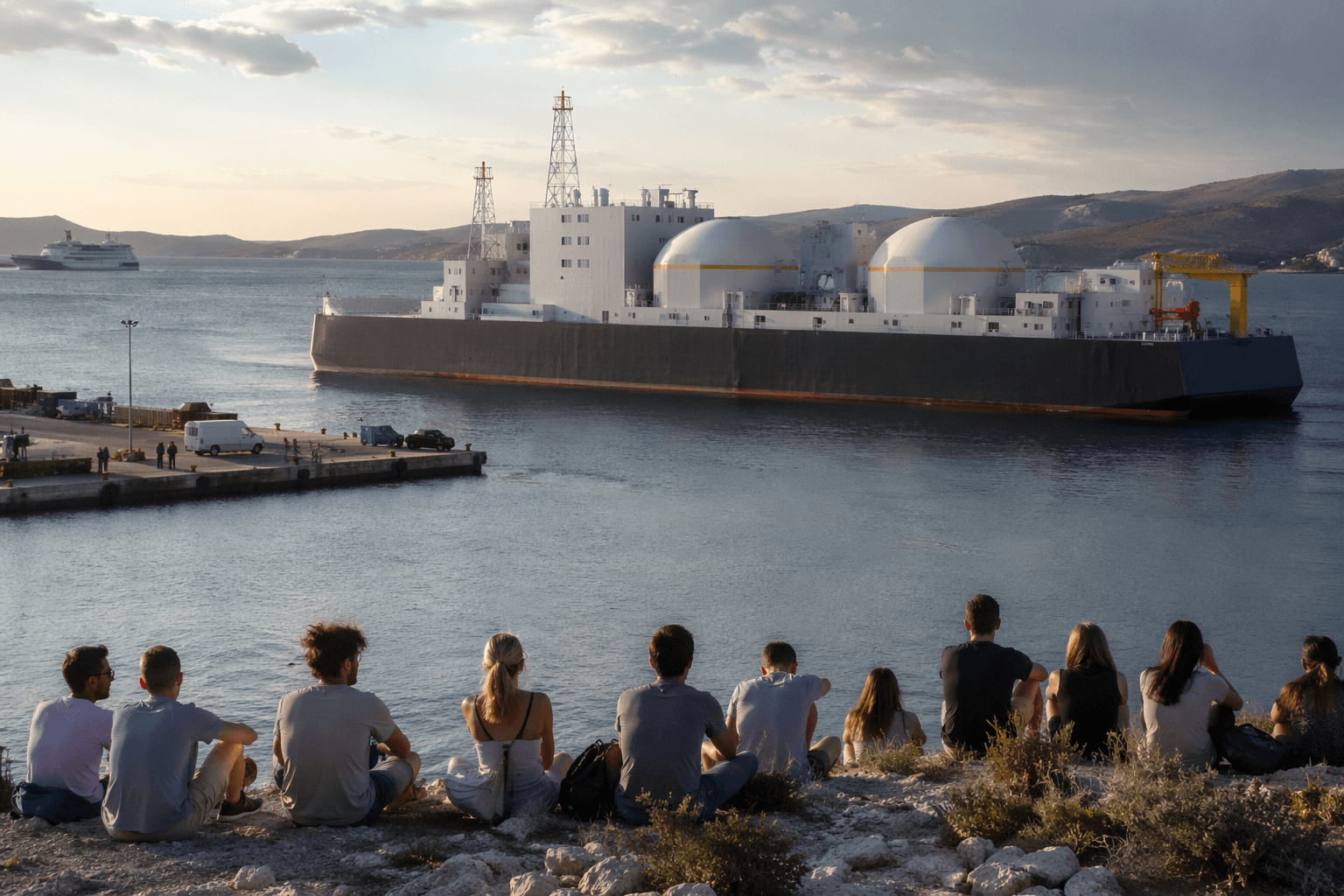
The strongest case for floating nuclear in Greece is not abstract decarbonization language. It is geography. CORE POWER’s work around Athens has framed FNPPs as potentially useful for coastal communities, ports, and desalination, and those are the kinds of use cases that make a floating system feel less like a moonshot and more like infrastructure.
That is especially relevant in a country where energy security still has to be managed across a maze of islands and shorelines, and where some islands continue to rely on oil-fired generation. A floating unit does not solve every grid problem, but it offers something a land plant cannot: the possibility of bringing firm power closer to demand without needing the full footprint of a conventional nuclear site.
The broader commercial pitch also matters. CORE POWER has presented its model as one based on shipyard-assembled plants, which is part of why the technology is now being discussed as an industrial project rather than a distant concept. In Greece, that pitch is landing at a time when the policy door has cracked open just enough for the idea to be taken seriously.
The political backdrop is changing
Prime Minister Kyriakos Mitsotakis said at the Paris Nuclear Energy Summit on March 10, 2026, that Greece would explore whether nuclear energy, specifically small modular reactors, could play a role in the Greek energy system. He also said the government would set up a high-level ministerial committee to make a recommendation on nuclear energy.
_47304.jpg&w=1920&q=75)
The summit brought together 41 countries and numerous international organizations, which gives the Greek statement more weight than a passing remark at a domestic conference. It signals that Greece is no longer treating nuclear as a taboo subject. Instead, it is being examined as part of the country’s broader energy strategy, and that makes the floating-reactor conversation feel less speculative than it would have even a year ago.
What still has to be true for “realistic” to mean buildable
The Deon report’s main value is that it separates possibility from readiness. A floating plant may look attractive on paper, but in Greece it would still need a legal path, a financing model, a public narrative, and a regulatory regime capable of handling nuclear technology at sea.
That is where Greece’s existing nuclear framework becomes relevant. OECD Nuclear Energy Agency materials show that the country already has a formal nuclear legal and regulatory structure, even without a power program. In other words, the country is not starting from zero. It has experience in research reactors, radiation protection, waste management, transport, and liability, and that institutional base could matter if Greece ever decided to license a new nuclear technology.
Still, the report’s own caution is the right one. Policy has to be settled, regulators have to be comfortable, financiers have to see a bankable path, and communities have to decide whether a floating reactor belongs in the same mental category as a port upgrade, a desalination plant, or something far more sensitive. Until those pieces move together, “realistic” means worth evaluating, not ready to launch.
That is the real test here. A floating reactor does not need to conquer all of Greece to matter, only the stretch of water between an idea and a buildable project. Right now, that stretch is still wide, but it is no longer empty.
This article was produced by Prism’s automated news system from verified source data, official records, and press releases, then run through automated quality and moderation checks before publishing. The system is built and supervised by the people who set the standards it runs under. Read our full AI policy.
Know something we missed? Have a correction or additional information?
Submit a Tip