Fusion Energy Advances Accelerate Through Partnerships Toward Commercial Deployment
Troy Carter of ORNL says "partnerships are the linchpin" as federal programs, >$9B in private investment, and UK £2.5 billion push fusion from breakthroughs at NIF and JET toward deployment.

Troy Carter, director of the Fusion Energy Division at Oak Ridge National Laboratory, laid out a partnership-first roadmap in a feature published by the American Nuclear Society on Feb. 20, 2026, and summed the case bluntly: "Partnerships are the linchpin." Carter opens by noting that "Over the past decade, fusion energy has moved decisively from scientific aspiration toward a credible pathway to a new energy technology," and points to breakthroughs at the National Ignition Facility and the Joint European Torus as evidence that plasma physics advances are ready to be translated into devices.
Carter highlights the accelerating ecosystem: "Fusion start-ups are proceeding at pace, advancing multiple concepts spanning magnetic and inertial confinement and hybrid systems," and the feature notes that commercial underpinnings are increasingly appearing in peer-reviewed literature. The piece also stresses alignment mechanisms such as the Department of Energy’s Fusion Milestone Program and the Milestone-Based Fusion Development program to connect private ambition to national capabilities while maintaining technical rigor. The Energy strategy excerpt in the reporting adds that the U.S. private sector is investing > $9B to demonstrate sustaining burning plasma on the path to fusion power plants, even as it flags persistent science and materials gaps.
Policy and international finance are already shaping deployment pathways. The Accelerating Deployment of Versatile, Advanced Nuclear for Clean Energy (ADVANCE) Act, passed July 9, 2024, includes the Fusion Energy Act, which the commentary says "codifies the Nuclear Regulatory Commission’s earlier decision to place fusion energy systems under the same regulatory framework as particle accelerators, streamlining the path to grid deployment." Outside the United States, Kleinmanenergy/Upenn notes the U.K. Atomic Energy Authority has announced £2.5 billion to be invested in fusion over the next five years, and urges Congress to pair private investments with increased public funding for research infrastructure and fusion-relevant training.
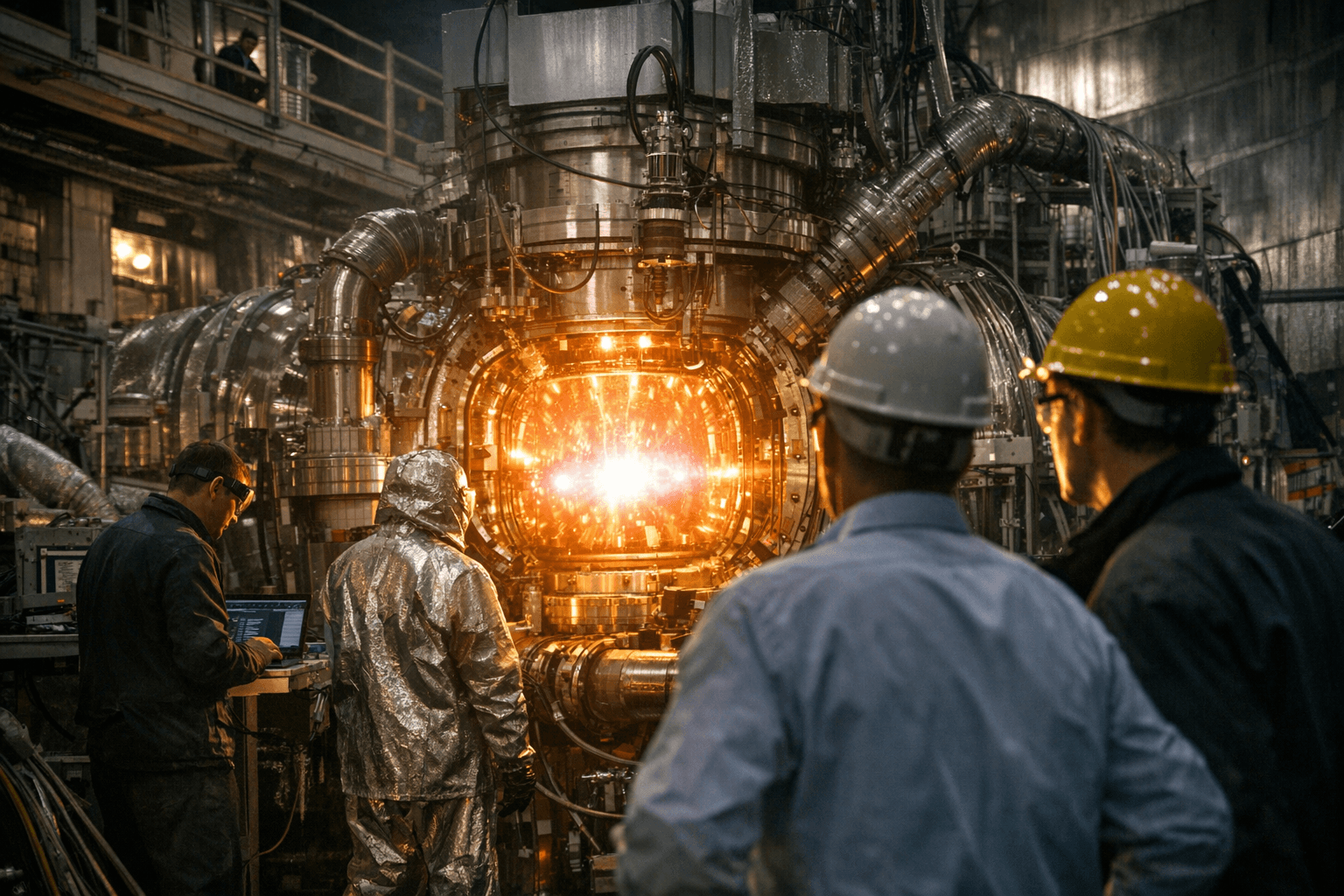
Carter and the Energy excerpt do not sugarcoat technical work left to do: they single out "breeding and handling of fusion fuels" and "critical science, materials and technology gaps" as priorities. The prescribed strategy pillars - Build, Innovate, Grow - call for building FM&T infrastructure, launching Fusion Innovation Research Engine (FIRE) collaboratives that integrate AI and Inertial Fusion Energy, seeding supply chains, and fostering workforce pathways to populate new regional consortia and manufacturing networks.
The discussion is already finding an audience and industry attention. ANS promoted the piece on LinkedIn from an organization page with 49,566 followers and ORNL’s Fusion and Fission page with 6,643 followers. The ANS page carries sponsor messaging from Curtiss-Wright advertising "High-Temperature neutron flux detectors for Generation IV reactors and SMRs" with an image file labeled "Sponsored Article Image-3 2x1.jpg." A NukeWorker forum thread started by Marlin on Feb 20, 2026 shows immediate chatter - the thread page reported "0 Members and 2 Guests are viewing this topic" and a page creation time of 0.148 seconds with 27 queries. As Carter warned, "The emerging fusion industry has set ambitious timelines, and those ambitions are an asset if we align around them effectively." The next 18 months will test whether federal programs, private capital, regulatory clarity, and regional partnerships can close the remaining gaps and turn demonstrations at NIF and JET into deployed plants.
This article was produced by Prism’s automated news system from verified source data, official records, and press releases, then run through automated quality and moderation checks before publishing. The system is built and supervised by the people who set the standards it runs under. Read our full AI policy.
Did this article answer your question?