India activates fifth accelerator module for ANURIB rare isotope facility
VECC’s fifth accelerator module pushed ANURIB to 1.0 MeV/u, with commissioning beams from 14O to 111In now running through the line.

VECC has switched on the fifth heavy-ion accelerator module for ANURIB, pushing the rare-isotope beam line to 1.0 MeV per nucleon and crossing a hard buildout milestone on the way to a working facility. That matters because ANURIB is meant to produce radioactive beams that let nuclear physicists probe structure and reactions in nuclei far from stability, not just talk about them on a slide deck.
VECC spells out ANURIB as the Advanced National facility for Unstable and Rare Isotope Beams, planned for its new campus at Rajarhat, Kolkata, about 10 km from the Salt Lake campus. The first phase centers on a 50 MeV, 0.2 mA proton cyclotron and a 50 MeV, 100 kW electron linac photo-fission driver, with later expansion built into the program from the start.
The latest commissioning step added two more IH linac modules and an inter-connecting beamline in a new annex building, raising the beam energy to 1.0 MeV/u. VECC said that setup has already been used to accelerate rare-isotope beams of 14O, 42K, 43K, 41Ar and 111In, with typical intensities of about 10^3 to 10^4 particles per second. For a rare-isotope machine, that is the kind of number that tells you the line is no longer just assembled, it is alive enough to start producing experimental beam.
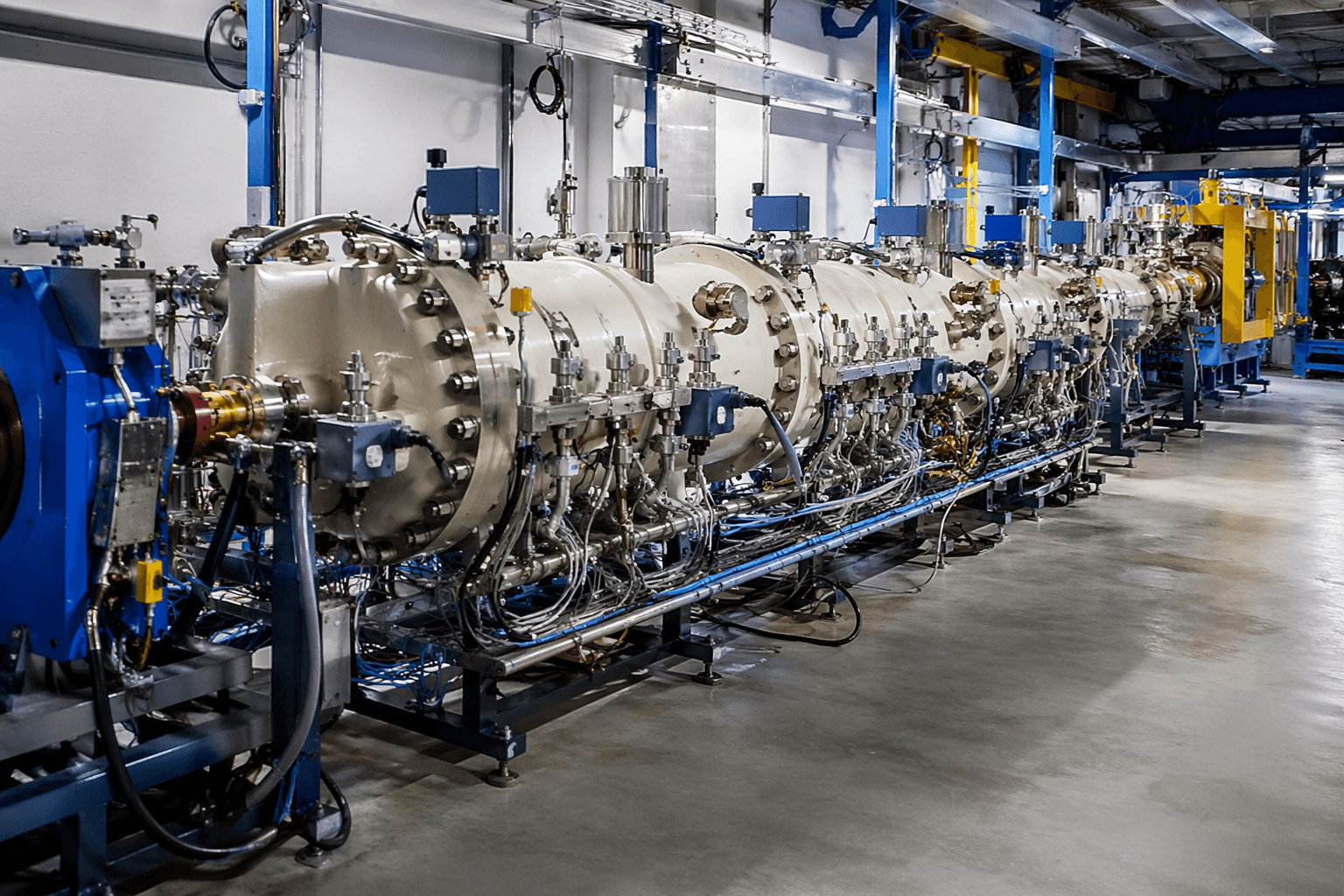
VECC has also leaned hard on in-house design and fabrication. The centre says the accelerator components for the RIB and ANURIB program were designed at VECC and built indigenously with help from CSIR-CMERI Durgapur and SAMEER Mumbai. The existing radioactive ion beam facility is already being used for studies of defect propagation and surface physics of materials, giving the project a working scientific base even before the full ANURIB stack comes online.
The buildout has been paired with long-running international ties. VECC and TRIUMF had an umbrella MOU in place by August 7, 2008, with addenda in 2009 for joint development and testing of injector cryo-modules. TRIUMF’s own rare-isotope program rests on a 520 MeV cyclotron and a 30 MeV electron linac, a reminder that ANURIB is being assembled in a global field where scale, beam quality and commissioning discipline all matter.
VECC’s April 25-27, 2023 theme meeting on ANURIB was framed around the experimental program and utilization of the facility, and the fifth module makes that planning look much less abstract. The line at Rajarhat now has another working stage behind it, and the path from construction to usable rare-isotope beams is starting to look real.
This article was produced by Prism’s automated news system from verified source data, official records, and press releases, then run through automated quality and moderation checks before publishing. The system is built and supervised by the people who set the standards it runs under. Read our full AI policy.
Did this article answer your question?