Iran Stores Half of Near-Weapons-Grade Uranium in Underground Tunnel Complex
IAEA chief Grossi revealed half of Iran's 60% enriched uranium sits in an underground tunnel complex at Isfahan.

IAEA Director-General Rafael Mariano Grossi disclosed last week that approximately half of Iran's stockpile of uranium enriched to around 60% U-235 purity is being held inside a tunnel complex at Isfahan, a development that sharpens international concern about the material's accessibility and intent.
Grossi made the disclosure to reporters in Paris on March 9, 2026. The 60% enrichment level sits well above what any civilian power reactor requires, which typically runs on fuel enriched to between 3% and 5% U-235. Weapons-grade material is generally defined at 90% or above, but the gap between 60% and that threshold is technically far shorter to close than the gap between natural uranium and 60% — a fact that nonproliferation analysts have long flagged as the central danger of Iran's current enrichment posture.
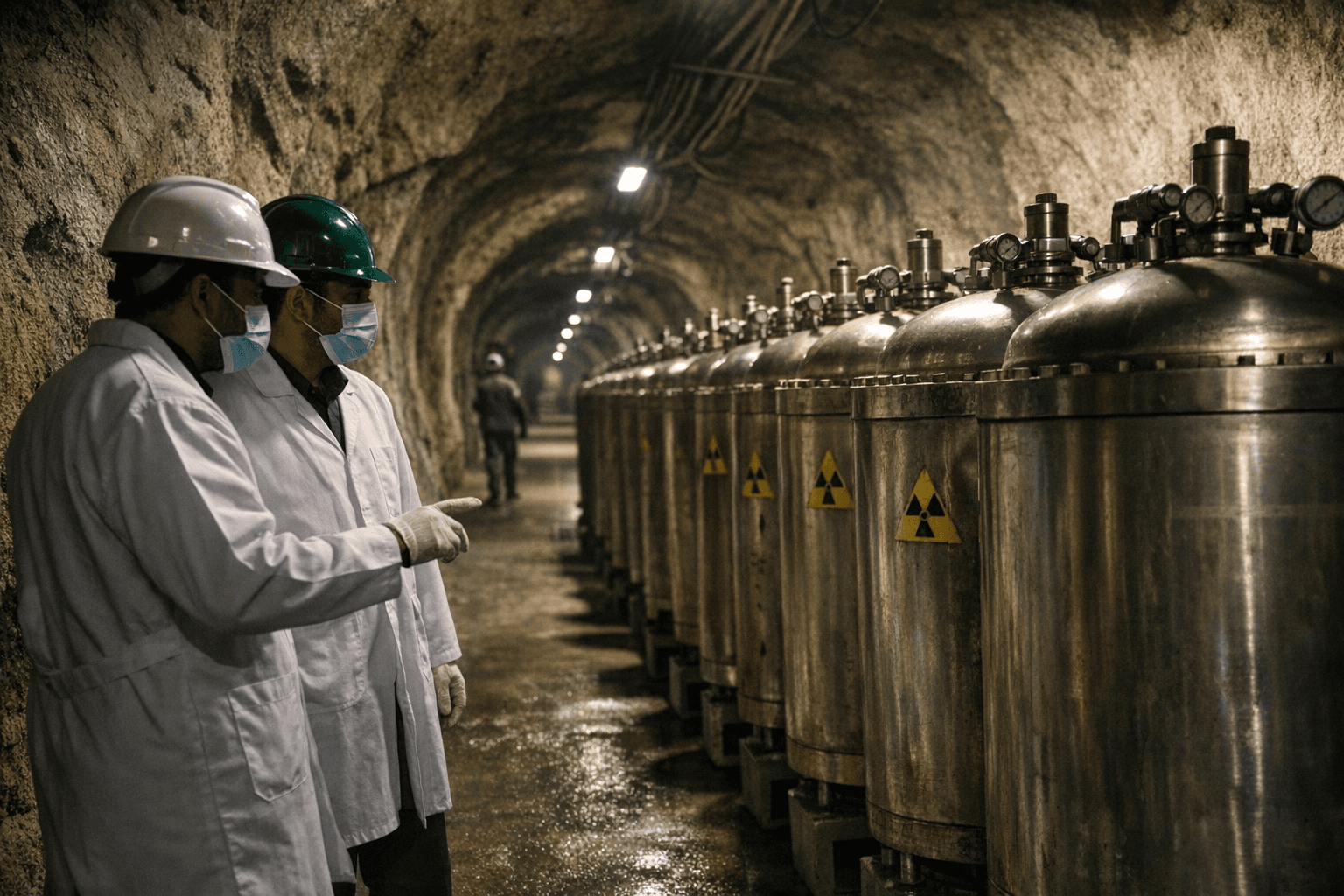
The Isfahan tunnel complex adds a layer of concern beyond the enrichment level itself. Underground hardened facilities complicate both monitoring by IAEA inspectors and any potential military interdiction. Storing a substantial portion of the near-weapons-grade stockpile at such a site signals deliberate choices about both security and survivability of the material.
Grossi has been navigating increasingly strained inspection access in Iran, and his public remarks in Paris represented one of the more direct characterizations of where the most sensitive material is physically located. The IAEA has struggled for years to maintain continuity of knowledge about Iran's nuclear activities following Tehran's decision to limit inspector access and remove surveillance equipment.
The precise quantity of 60%-enriched uranium at Isfahan was not specified in Grossi's remarks, but the IAEA has previously reported Iran's total near-60% stockpile in the hundreds of kilograms — enough that "roughly half" represents a significant concentration of proliferation-sensitive material in a single hardened location.
Know something we missed? Have a correction or additional information?
Submit a Tip