Radiation Safety Essentials for Hobbyists, Students, and Community Researchers
Working with ionizing radiation without knowing your exposure limits is a gamble nobody should take; here's the practical safety foundation every hands-on experimenter needs.
Most people who get into nuclear-related hobbies or student research projects learn the fun stuff first: cloud chambers, Geiger counters, reactor physics, isotope identification. The safety fundamentals tend to get absorbed piecemeal, from forum posts and YouTube comments, which means the gaps in that knowledge are invisible until something goes wrong. This guide is the foundation I wish I'd had when I started: a consolidated, practical look at radiation safety, regulatory basics, and the working knowledge you need to handle ionizing radiation responsibly, whether you're building a demonstration for a classroom, running your own experiments, or just trying to make sense of the scientific literature you're reading.
Understanding ionizing radiation: what you're actually dealing with
Ionizing radiation is the category that matters for safety purposes. Unlike non-ionizing radiation (radio waves, visible light, microwaves), ionizing radiation carries enough energy to strip electrons from atoms, which means it can damage biological tissue and DNA. The four types you'll encounter in most hobbyist and educational contexts are alpha particles, beta particles, gamma rays, and neutrons, and they are not interchangeable in terms of risk or shielding requirements.
Alpha particles are heavy and positively charged. A sheet of paper or the dead outer layer of skin stops them completely, which makes external alpha sources relatively low-risk. The danger flips entirely if you ingest or inhale an alpha emitter: internal exposure bypasses all that natural shielding and delivers dose directly to soft tissue. Beta particles are faster, lighter electrons or positrons; they penetrate further than alpha but are stopped by a few millimeters of aluminum or acrylic. High-energy beta sources can also produce secondary bremsstrahlung X-rays when they interact with dense shielding materials, which is why you don't use lead to shield a pure beta emitter. Gamma rays and X-rays are electromagnetic radiation, highly penetrating, and require dense materials like lead or thick concrete for meaningful attenuation. Neutrons are the most complex: they are uncharged, deeply penetrating, and best moderated by hydrogen-rich materials like water or polyethylene.
Knowing which type you're dealing with isn't academic; it directly determines your shielding choices, your detection equipment, and your handling procedures.
Dose, units, and what the numbers actually mean
The vocabulary of radiation dose trips up a lot of newcomers. The key distinction is between activity (how much radiation a source is emitting) and dose (how much of that radiation is actually being absorbed by a person). Activity is measured in becquerels (Bq) or the older unit curies (Ci). Absorbed dose is measured in grays (Gy) or the legacy unit rads. Effective dose, which accounts for the biological impact of different radiation types on different tissues, is measured in sieverts (Sv) or rem.
For practical safety work, effective dose in millisieverts (mSv) is the number that matters most. The average person in the United States receives roughly 3 mSv per year from background radiation, including natural sources like radon and cosmic radiation, plus medical imaging. The Nuclear Regulatory Commission sets the occupational dose limit for radiation workers at 50 mSv per year (5 rem), with a recommended cumulative limit of 10 mSv multiplied by age in years. For members of the public, the regulatory limit is 1 mSv per year above background from licensed facilities.
As a hobbyist or student researcher, you are almost certainly not operating under an NRC license, which means you are technically operating as a member of the public under most regulatory frameworks. That context matters when you're assessing whether a project is within safe bounds.
The ALARA principle: your operating philosophy
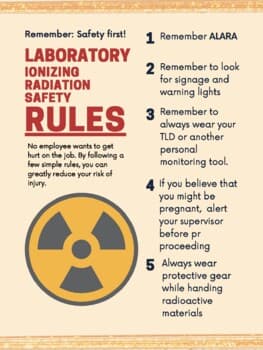
ALARA, which stands for "As Low As Reasonably Achievable," is the guiding principle of professional radiation protection and it should be yours too. The core idea is that no level of radiation exposure should be considered automatically safe just because it falls under a regulatory threshold. Instead, every exposure should be reduced to the lowest level that's practical given the constraints of the work.
In practical terms, ALARA translates into three concrete tools: time, distance, and shielding. Minimize the time you spend near a source. Maximize your distance from it, since dose rate drops with the square of distance (doubling your distance reduces dose by a factor of four). And place appropriate shielding between yourself and the source. Applied together, these three controls can reduce your exposure dramatically without compromising the quality of your experiment or demonstration.
Regulatory framework: knowing where you stand
In the United States, the NRC regulates byproduct materials (radioactive materials produced in nuclear reactors or particle accelerators) and certain source and special nuclear materials. Many states have "Agreement State" status, meaning they've taken over regulatory authority from the NRC for materials within their borders. Either way, possession of radioactive materials above certain thresholds requires a license.
There are important exemptions that cover most hobbyist activity. Consumer products containing small quantities of radioactive materials, like certain smoke detectors (americium-241), vintage radium dial instruments, and low-activity check sources sold for Geiger counter calibration, are generally exempt from licensing requirements. The key word is "generally": exemption thresholds vary by isotope, and it's your responsibility to verify the status of any specific material. The NRC's website maintains the current list of exempt quantities by isotope, and it's worth bookmarking.
Internationally, frameworks vary significantly. If you're in the EU, the Basic Safety Standards Directive (Council Directive 2013/59/Euratom) governs radiation protection. Other countries have their own regulatory bodies and thresholds. If you're reading scientific literature from other jurisdictions, keep that regulatory context in mind when interpreting safety claims or experimental setups.
Practical detection: what you need and why
A Geiger-Müller (GM) tube counter is the standard entry point for hobbyist detection, and it's genuinely useful for detecting beta and gamma radiation, confirming the presence of contamination, and verifying that shielding is working. The limitation is that a GM tube gives you counts per minute (CPM), not dose rate, without calibration. Different tubes have different efficiencies for different radiation types and energies, so a raw CPM reading from an uncalibrated meter is a relative measurement, not an absolute one.
For meaningful dose-rate measurements, look for meters that display in µSv/hr or mR/hr and are calibrated for the radiation type you're measuring. Scintillation detectors offer better sensitivity and energy information than GM tubes, making them valuable for isotope identification work. If you're doing any work where internal contamination is a possibility, a wipe test kit and the ability to count wipe samples is essential.
Personal dosimetry, either film badges, TLD (thermoluminescent dosimeter) badges, or electronic personal dosimeters, should be considered for any regular experimental work. They give you an integrated record of your exposure over time, which is both good practice and useful documentation if questions ever arise.
Working safely: the habits that actually protect you
The procedural habits of safe radiation work are less glamorous than the physics, but they're what actually keeps your cumulative dose low over years of involvement in this hobby.
- Never eat, drink, or apply cosmetics in any space where unsealed radioactive materials are handled.
- Wear nitrile gloves when handling sources and dispose of them properly; don't let contamination hitch a ride out of your workspace.
- Survey your workspace with a detector before and after any session involving unsealed materials.
- Store sources in labeled, shielded containers when not in use and maintain a simple inventory log.
- If you're working with any source that could produce airborne contamination, ensure adequate ventilation or work in an appropriate enclosure.
- Keep a dedicated set of tools for radiation work and don't migrate them to general use.
These aren't bureaucratic box-checking exercises. They're the habits that distinguish people who do this work for decades without incident from those who accumulate unnecessary dose or, worse, spread contamination into living spaces.
Reading the literature critically
One underrated skill in this community is the ability to read published research and accurately assess the safety conditions described. Dose values in papers are often reported as effective dose, absorbed dose, or dose equivalent, and conflating them leads to badly wrong conclusions. Pay attention to whether a reported dose is acute or chronic, whole-body or organ-specific, and whether it's comparable to your own experimental context. A dose that's acceptable in a controlled medical imaging environment with trained technicians and engineered safety systems is not automatically acceptable in a garage or classroom.
The same applies to regulatory citations in papers. An experiment described as "within regulatory limits" in one jurisdiction may not be within limits in yours. Developing the habit of translating reported doses into your own regulatory context is a mark of genuine competence in this field.
Radiation safety isn't a barrier to hands-on nuclear science; it's what makes sustained engagement with this field possible. The physics is extraordinary, and the tools available to amateur researchers today are better than anything previous generations had access to. Using them responsibly, grounded in actual knowledge rather than vague reassurance, is what keeps this community credible and this kind of work accessible for everyone who comes after you.
This article was produced by Prism’s automated news system from verified source data, official records, and press releases, then run through automated quality and moderation checks before publishing. The system is built and supervised by the people who set the standards it runs under. Read our full AI policy.
Did this article answer your question?


