MIT and Commonwealth Fusion Systems Set Record With 20-Tesla Superconducting Magnet
CFS has raised nearly $3 billion on a 20-tesla magnet that shrinks a fusion reactor to 1/40th of ITER's plasma volume; the commercial math is finally starting to work.
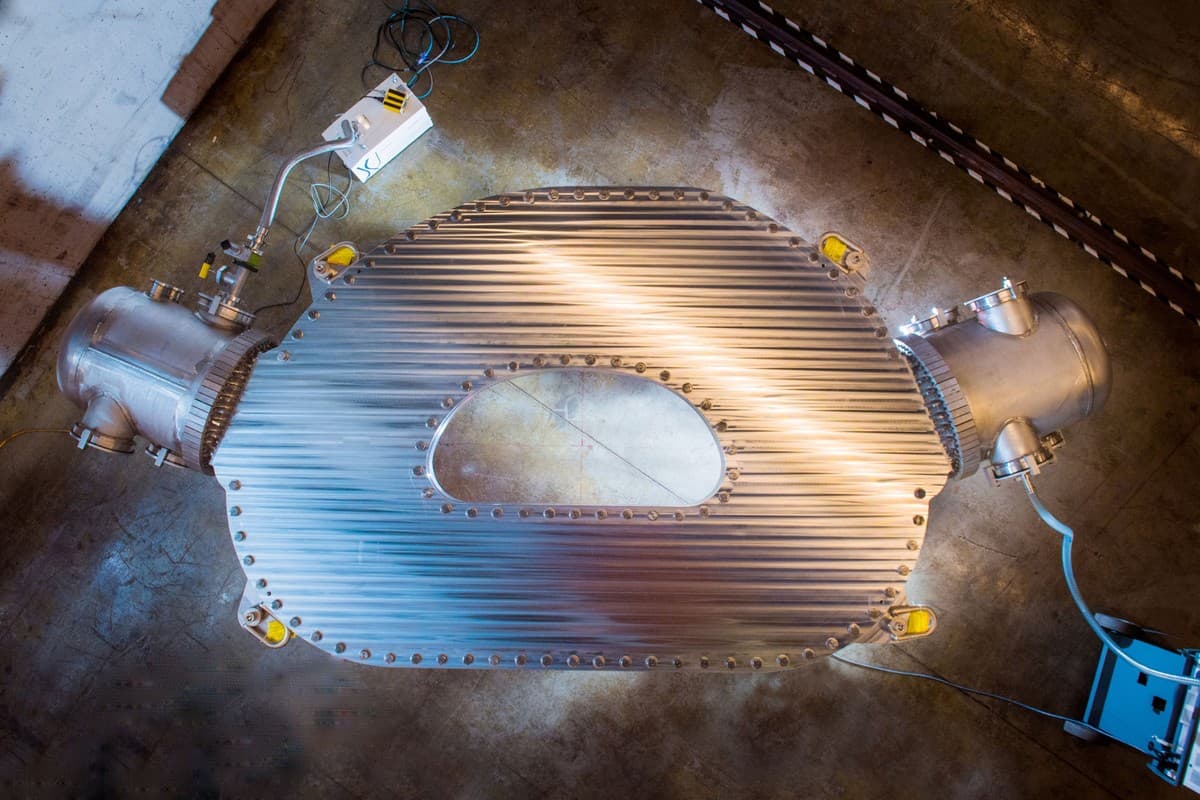
Commonwealth Fusion Systems and MIT's Plasma Science and Fusion Center demonstrated a 20-tesla REBCO superconducting magnet, a world record for a large-scale magnet, and investors responded with nearly $3 billion in private capital, roughly one-third of all private fusion investment worldwide. That funding concentration is a signal: the physics of high-field magnets has crossed a threshold where the commercialization story is credible enough to attract serious money.
The commercial logic runs directly through the geometry. SPARC, the compact tokamak CFS is constructing in Devens, Massachusetts, has a major radius of 1.85 meters. ITER, the international flagship, stretches to 6.2 meters. The 20-tesla field strength is what makes that compression achievable, reducing SPARC's plasma volume to roughly 1/40th of ITER's and, with it, most of the capital burden, construction timeline, and site complexity that has made conventional fusion feel like a multigenerational commitment rather than an investable energy asset.
The magnet itself is a 10-foot-tall structure wound from rare-earth barium copper oxide, REBCO, tape stacked into thin coils the team calls "pancakes," each instrumented with its own sensors and control hardware. About 270 kilometers of superconducting material is distributed across those individual pancakes in a single magnet. Unlike conventional superconductors in today's tokamaks that require cooling to 4 Kelvin (-270°C), REBCO operates at 20 Kelvin (-253°C), a warmer cryogenic regime that reduces insulation complexity. The tape is left bare rather than wrapped like a conventional wire, which the developers say increases conductivity. The design also incorporates demountable, low-resistance joints that allow the magnet to be disassembled for maintenance, a feature that distinguishes a commercial machine from a one-off research installation.
The manufacturing trajectory may be as commercially relevant as the field strength number. Joy Dunn, Commonwealth's head of operations, said building the test magnet produced something beyond the magnet itself. "It allowed us to develop the manufacturing processes and equipment and the supply chain at a scale that is relevant for commercial fusion," Dunn said. The learning curve compressed fast: later pancakes took only 20 percent of the time needed to build the first samples. That unit-cost trajectory is what project financiers and utilities need before treating fusion as a credible grid asset rather than a perpetual science project.
The work traces to 2015, when a group of MIT physicists calculated that commercially available high-temperature superconductors could enable a simpler, more compact machine than the megaproject paradigm assumed. They formed Commonwealth Fusion Systems to test that math. CFS demonstrated the 20-tesla magnet in 2021; subsequent analysis, computer modeling, and testing confirmed the design elements met the requirements for an economical, compact power plant. Commonwealth CEO Bob Mumgaard said the success with the magnet gives the team flexibility elsewhere.
SPARC is now under construction with a 2026 testing target and net energy gain, Q greater than 1, as its explicit milestone. If it achieves that threshold, CFS moves to ARC, a 400-megawatt commercial power plant planned for Chesterfield County, Virginia, targeting grid connection in the early 2030s.
The single bottleneck the 20-tesla magnet cannot resolve is the plasma itself. Confining fusion fuel and igniting it are separate problems. SPARC still has to demonstrate that plasma conditions required for net energy gain can be sustained long enough to matter. The magnets define what geometry is possible; what happens inside them remains the open question every fusion program still has to answer.
Commonwealth Fusion Systems and MIT's Plasma Science and Fusion Center demonstrated a 20-tesla REBCO superconducting magnet, a world record for a large-scale magnet, and investors responded with nearly $3 billion in private capital, roughly one-third of all private fusion investment worldwide. That funding concentration is a signal: the physics of high-field magnets has crossed a threshold where the commercialization story is credible enough to attract serious money.
The commercial logic runs directly through the geometry. SPARC, the compact tokamak CFS is constructing in Devens, Massachusetts, has a major radius of 1.85 meters. ITER, the international flagship, stretches to 6.2 meters. The 20-tesla field strength is what makes that compression achievable, reducing SPARC's plasma volume to roughly 1/40th of ITER's and, with it, most of the capital burden, construction timeline, and site complexity that has made conventional fusion feel like a multigenerational commitment rather than an investable energy asset.
The magnet itself is a 10-foot-tall structure wound from rare-earth barium copper oxide, REBCO, tape stacked into thin coils the team calls "pancakes," each instrumented with its own sensors and control hardware. About 270 kilometers of superconducting material is distributed across those individual pancakes in a single magnet. Unlike conventional superconductors in today's tokamaks that require cooling to 4 Kelvin (-270°C), REBCO operates at 20 Kelvin (-253°C), a warmer cryogenic regime that reduces insulation complexity. The tape is left bare rather than wrapped like a conventional wire, which the developers say increases conductivity. The design also incorporates demountable, low-resistance joints that allow the magnet to be disassembled for maintenance, a feature that distinguishes a commercial machine from a one-off research installation.
The manufacturing trajectory may be as commercially relevant as the field strength number. Joy Dunn, Commonwealth's head of operations, said building the test magnet produced something beyond the magnet itself. "It allowed us to develop the manufacturing processes and equipment and the supply chain at a scale that is relevant for commercial fusion," Dunn said. The learning curve compressed fast: later pancakes took only 20 percent of the time needed to build the first samples. That unit-cost trajectory is what project financiers and utilities need before treating fusion as a credible grid asset rather than a perpetual science project.
The work traces to 2015, when a group of MIT physicists calculated that commercially available high-temperature superconductors could enable a simpler, more compact machine than the megaproject paradigm assumed. They formed Commonwealth Fusion Systems to test that math. CFS demonstrated the 20-tesla magnet in 2021; subsequent analysis, computer modeling, and testing confirmed the design elements met the requirements for an economical, compact power plant. Commonwealth CEO Bob Mumgaard said the success with the magnet gives the team flexibility elsewhere.
SPARC is now under construction with a 2026 testing target and net energy gain, Q greater than 1, as its explicit milestone. If it achieves that threshold, CFS moves to ARC, a 400-megawatt commercial power plant planned for Chesterfield County, Virginia, targeting grid connection in the early 2030s.
The single bottleneck the 20-tesla magnet cannot resolve is the plasma itself. Confining fusion fuel and igniting it are separate problems. SPARC still has to demonstrate that plasma conditions required for net energy gain can be sustained long enough to matter. The magnets define what geometry is possible; what happens inside them remains the open question every fusion program still has to answer.
This article was produced by Prism’s automated news system from verified source data, official records, and press releases, then run through automated quality and moderation checks before publishing. The system is built and supervised by the people who set the standards it runs under. Read our full AI policy.
Did this article answer your question?