Neutron Star Collision Detected 4.7 Billion Light-Years Away, Forging Gold
GRB 230906A, spotted 4.7 billion light-years away in a tiny galaxy buried in a gas stream, may explain how gold and platinum end up scattered through intergalactic space.
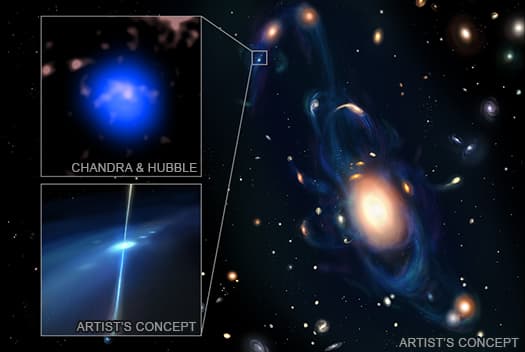
Astronomers have spotted a collision between two neutron stars in an environment unlike any other seen before: a tiny, extremely faint galaxy buried inside a massive stream of gas, roughly 4.7 billion light-years from Earth. The discovery, announced by the Chandra X-ray Center at Harvard-SAO on March 10, 2026, centers on an event designated GRB 230906A and carries significant implications for understanding where the universe's heaviest elements come from.
To pin down the nature and location of GRB 230906A, the team deployed a four-observatory campaign drawing on Chandra, Fermi, Swift, and Hubble. That combination of X-ray, gamma-ray, ultraviolet, and infrared eyes was necessary to identify the host environment as a faint, tiny galaxy embedded within a huge stream of gas rather than a more conventional galactic setting. The Chandra release describes it as "an environment unlike any other seen before," and the team explicitly called it the first time a neutron-star collision has been spotted in such a setting.
The nuclear physics angle is where things get particularly compelling for this community. Through chains of nuclear reactions triggered during the merger, colliding neutron stars can synthesize heavy elements including gold and platinum. Astronomers confirmed that process directly in a much closer neutron-star collision observed in 2017, and GRB 230906A now extends the picture considerably. Events like this one, the Chandra team noted, could generate those heavy elements and spread them throughout the outskirts of galaxies, eventually appearing in future generations of stars. The discovery may also explain the presence of gold and platinum detected in intergalactic space, seeded there by mergers occurring in tiny, gas-embedded galaxies far from any galactic core.
The team did consider an alternative interpretation: the explosion might belong to a much more distant background galaxy sitting behind the galaxy group in which the tiny host resides. They assessed that scenario as the less likely explanation, favoring the tiny embedded galaxy as the true host, though the supplied analysis does not provide a formal statistical confidence level for that preference.
X-ray imaging credit for the event goes to S. Dichiara at Penn State University and NASA/CXC, with infrared data credited to NASA, ESA, and the Space Telescope Science Institute.
GRB 230906A adds a new wrinkle to the established picture of neutron-star mergers as cosmic forges. The 2017 event proved the nucleosynthesis pathway works; this detection suggests those element-forging collisions can happen in stripped-down, gas-rich environments far from the stellar concentrations where most such mergers were expected to occur, with the products scattered directly into the intergalactic medium rather than recycled within a galaxy's disk.
Know something we missed? Have a correction or additional information?
Submit a Tip