New Jersey eases nuclear permitting, launches task force for new reactors
New Jersey cleared the permit barrier that froze new reactor builds and launched a task force to push projects past the concept stage at Salem.
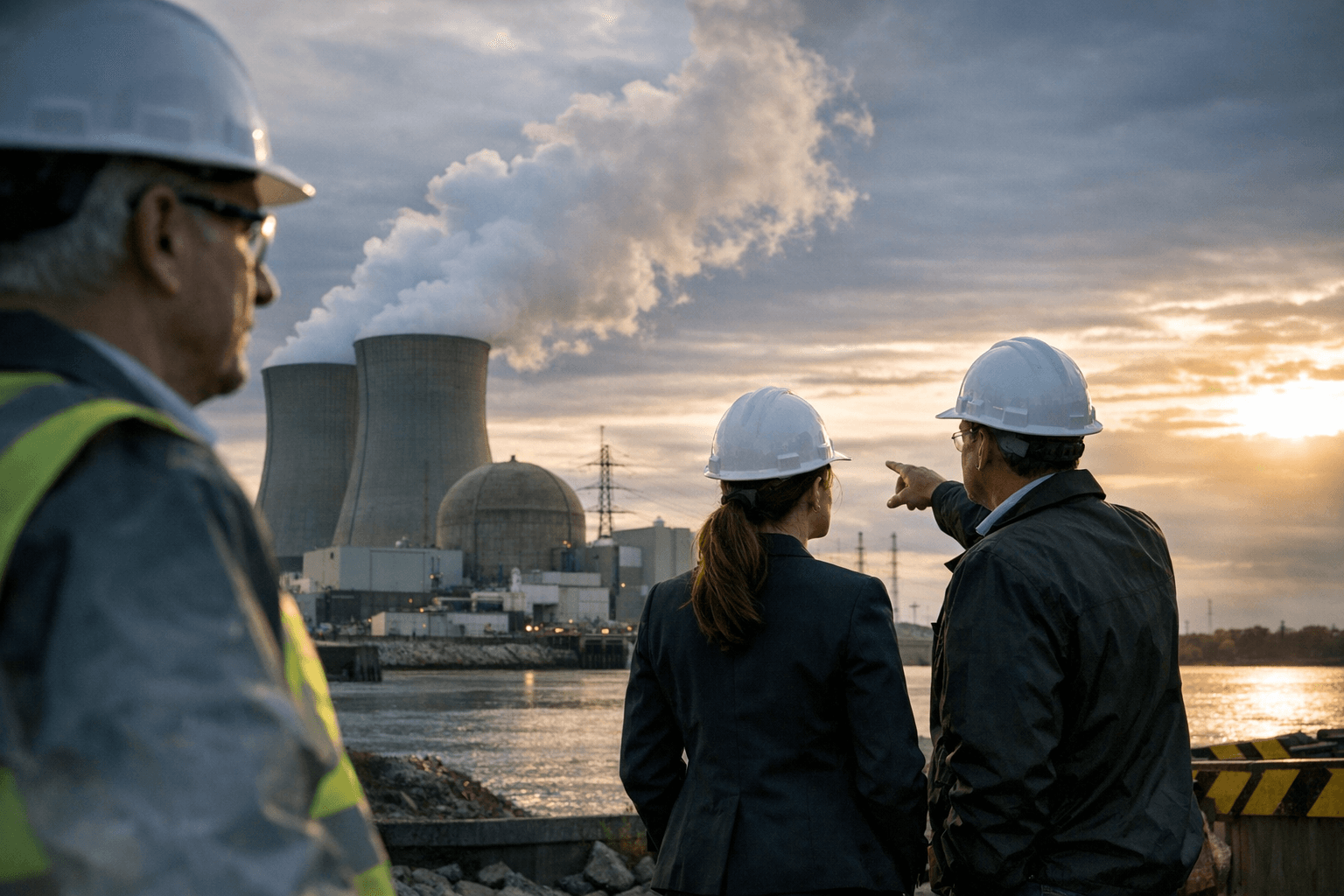
New Jersey has removed the state permit hurdle that had kept new nuclear projects effectively frozen for decades, and it did so at the Salem Nuclear Power Plant, where Gov. Mikie Sherrill signed S3870/A4528 and declared the state “open for business” for next-generation nuclear energy.
The new law rewrites the Coastal Area Facility Review Act process so the Department of Environmental Protection can approve nuclear facilities based on safe, NRC-compliant waste storage instead of demanding a radioactive-waste disposal method that does not exist. That old requirement worked as a de facto ban on new reactors. The bill was introduced on March 10, cleared the Senate 38-0 and the Assembly 68-0-3 on March 23, and became P.L.2026, c.9 on April 8.
Sherrill signed the measure after touring Salem in Salem County, joined by PSEG President Ralph LaRossa, PSEG Nuclear President Charles McFeaters, Senate President Nicholas Scutari, Assemblyman Wayne DeAngelo, Assemblymen Cody Miller and Jerry Walker, and International Brotherhood of Electrical Workers Local 94 Business Manager Adam Neuman. “For costs to come down, we need more energy supply,” Sherrill said, while Scutari called expanding supply one of the most impactful ways to bring utility costs under control. DeAngelo said nuclear can help bridge the gap between what New Jersey generates and what it uses.
The signing also formally launched the Nuclear Task Force, which Sherrill had set in motion in her January 20 inaugural address. That task force is organized around financing, supply chains and technology development, workforce growth and training, the regulatory and permitting framework, and public trust and confidence. It brings together officials from the Board of Public Utilities, the Department of Environmental Protection, the Economic Development Authority, the Department of Military and Veterans Affairs, and the Treasury Department, a sign that Trenton wants to treat nuclear as an industrial pipeline, not just a siting debate.
The practical payoff is that New Jersey can now start thinking about which reactor concepts and sites could move first. Salem and Hope Creek already anchor the state’s nuclear fleet in Hancocks Bridge, with Hope Creek’s 1,172-MWe boiling water reactor and Salem Units 1 and 2 at 1,146 MWe and 1,139 MWe. Together, the stations provide roughly 40 percent of New Jersey’s electricity and about 80 percent of its pollution-free power. In a region where demand is rising and states are competing for new generation, that makes New Jersey’s shift more than symbolic. It opens a real path for advanced reactors, large-scale baseload capacity, and the next round of industrial investment around an existing nuclear corridor.
This article was produced by Prism’s automated news system from verified source data, official records, and press releases, then run through automated quality and moderation checks before publishing. The system is built and supervised by the people who set the standards it runs under. Read our full AI policy.
Did this article answer your question?


