Palisades Nuclear Plant Hits Key Milestones Ahead of Michigan Restart
Holtec completed primary system passivation at the 800-MW Palisades plant, a critical threshold toward the first-ever U.S. nuclear restart from decommissioning.
The 800-megawatt Palisades pressurized water reactor in Covert, Michigan, cleared a critical engineering threshold when Holtec International completed passivation of the plant's primary system, returning it to normal operating temperature and pressure for the first time since its May 2022 shutdown. The process protects key internal components and validates equipment integrity after years of dormancy, placing Palisades firmly in what Holtec describes as the final stretch before fuel loading.
Passivation is one gate in a sequence of technical and regulatory hurdles Holtec must clear before Palisades becomes the first commercial nuclear plant in U.S. history to restart after entering decommissioning. Alongside it, the company completed more than 300 inspections of piping and welds and reinstalled the main turbine generator. Work continues on fuel handling system upgrades, switchyard restoration, and final closeout of major maintenance evolutions.
"The completion of primary system passivation reflects the diligence and technical rigor our team is bringing to position the plant for safe, reliable operation for decades," said Holtec president Kelly Trice.
The next sequence of gates is equally demanding. With passivation complete, the primary system must be cooled and prepared for additional testing before fuel can be loaded, which will be the reactor's first loading since 2022. An operator class of 18 students is currently in training and scheduled to sit NRC licensing exams in July 2026. The plant's operating license, transferred from former operator Entergy Nuclear Operations to Holtec Decommissioning International, runs through March 2031, and Holtec has indicated plans to file for a 20-year renewal. The Department of Energy has disbursed more than $491 million of a $1.52 billion loan guarantee to fund the work, with each disbursement tied to demonstrated progress milestones. Independent oversight included a completed Nuclear Safety Review Board audit and a Pre-Startup Review conducted by the World Association of Nuclear Operators.
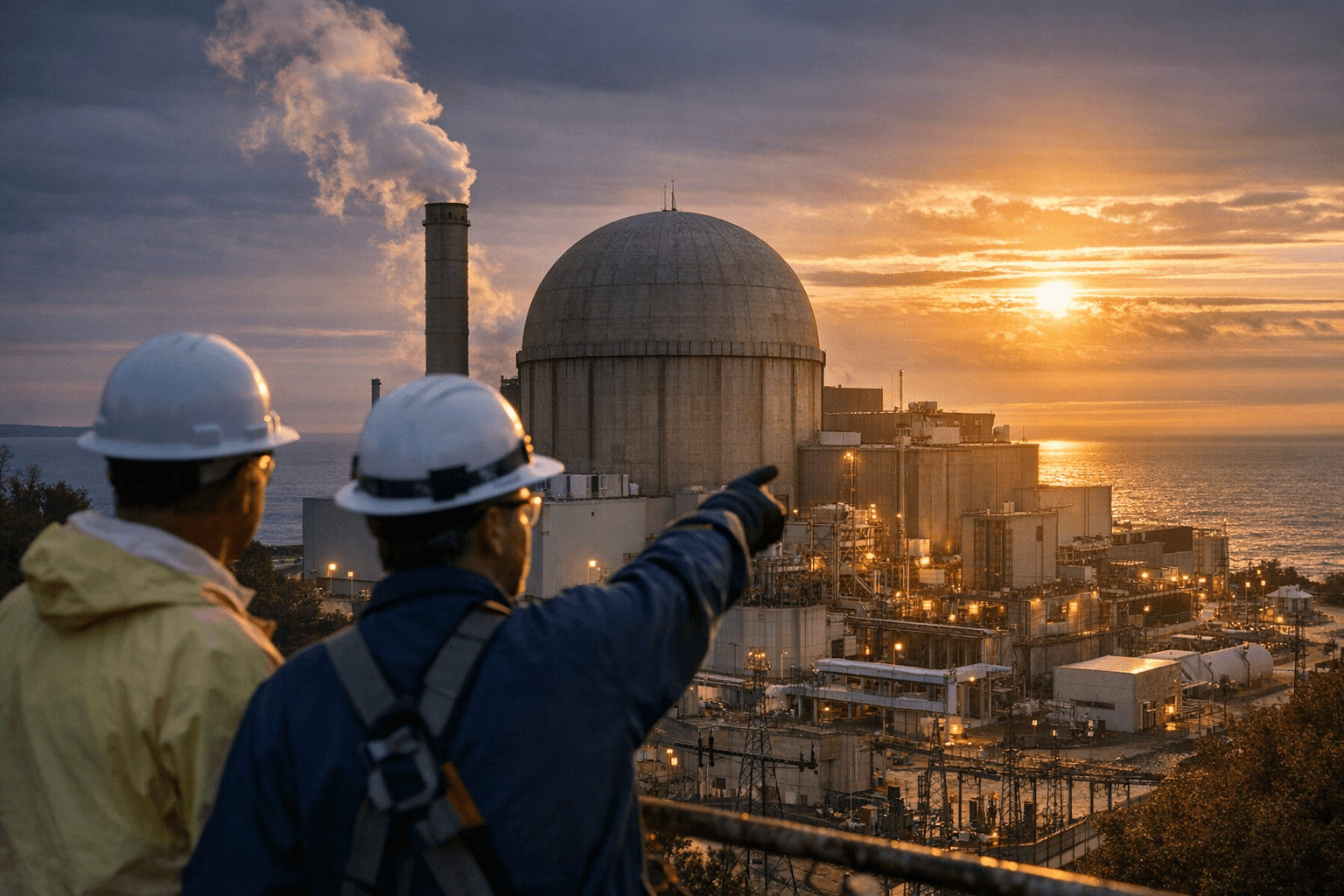
Holtec spokesperson Nick Culp described what follows fuel loading: "As we begin to bring the plant online once fuel is in the reactor, it'll be a gradual, methodical process to bring it back online. We will be doing inspections or surveillance every step of that process."
Running on a parallel track at the same Covert site are plans for Pioneer 1 and Pioneer 2, two SMR-300 pressurized water reactors that would add a combined 680 megawatts of new generation. The NRC accepted the first part of Holtec's construction permit application for docketing in February 2026 and expects to complete its safety evaluations and environmental impact assessment by the first half of 2027. Holtec targets early 2030s commissioning for the Pioneer units, backed by a $400 million DOE Tier 1 First Mover Award announced in December 2025, with partners Hyundai Engineering and Construction and Mitsubishi Electric aligned on site preparation planning.
The dual-track strategy reveals both what the restart experience can credibly transfer to SMR deployment and what it cannot. Palisades built a licensed nuclear workforce, validated vendor supply chains under NRC scrutiny, and demonstrated that the commission can process novel licensing actions at pace. Holtec can argue that an operational Covert site gives Pioneer an infrastructure advantage no greenfield SMR project can replicate: an active nuclear culture, proven supplier relationships, and a regulatory relationship already tested. What the restart cannot hand over is design certainty. The SMR-300 remains an unproven design working through pre-application review on a timeline that no amount of successful passivation work can accelerate. The 800 megawatts Palisades would restore to Michigan's grid are near and quantified. The 680 megawatts from Pioneer remain contingent on a first-of-a-kind design clearing an NRC process that is only just beginning.
This article was produced by Prism’s automated news system from verified source data, official records, and press releases, then run through automated quality and moderation checks before publishing. The system is built and supervised by the people who set the standards it runs under. Read our full AI policy.
Did this article answer your question?