Scientists Find First Evidence of Exotic Meson Trapped Inside Carbon Nucleus
The η′ meson at 958 MeV/c² may actually lose mass inside a nucleus, and an international team at GSI just caught the first evidence of it happening in carbon.
An η′ meson carries a rest mass of 958 MeV/c², far heavier than the pions and kaons that dominate most nuclear spectroscopy work, and theorists have long predicted that this mass actually shrinks when the particle exists inside nuclear matter. Confirming that prediction would hand physicists a direct experimental lever on mass generation itself, the mechanism by which the quantum vacuum gives particles their weight.
An international collaboration anchored by Osaka University published results in Physical Review Letters reporting the first spectroscopic evidence that an η′ meson can be temporarily trapped inside a carbon-11 nucleus, forming an η′-mesic bound state. The experiment ran at GSI Helmholtzzentrum für Schwerionenforschung in Darmstadt, Germany, under lead author Ryohei Sekiya and senior author Kenta Itahashi.
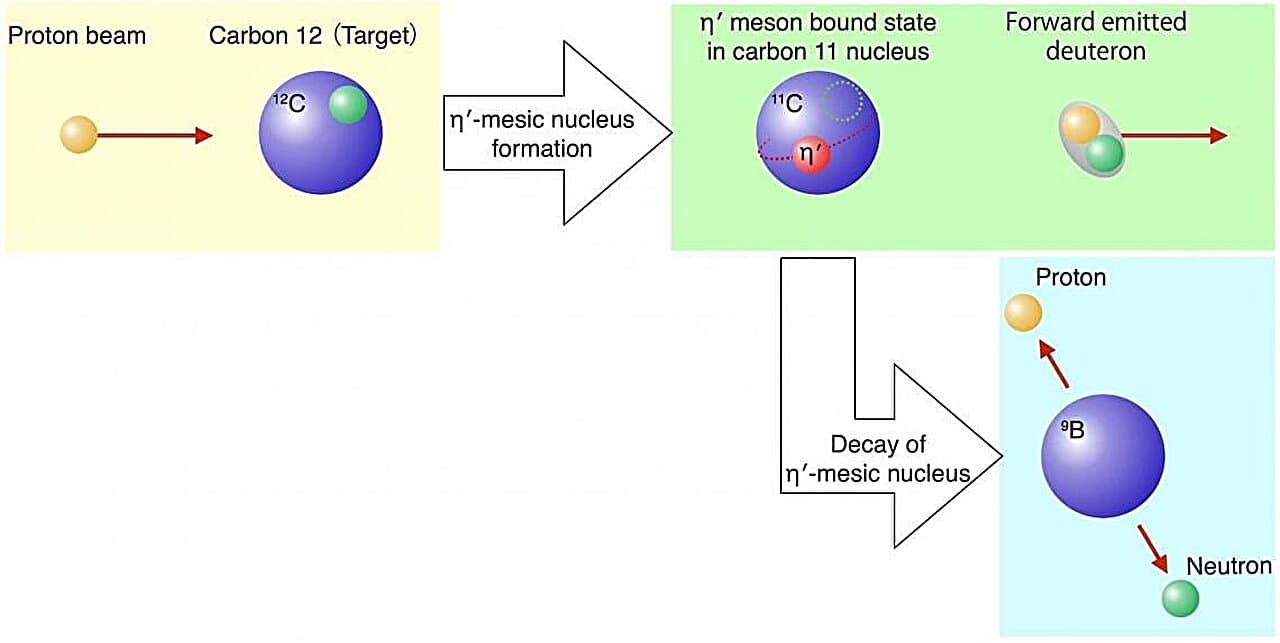
The signal chain works as follows. A 2.5 GeV proton beam from GSI's SIS-18 synchrotron strikes a carbon-12 target. When geometry and energetics align, the proton excites the nucleus while possibly binding an η′ meson inside it, and a forward deuteron escapes at roughly 1.6 GeV. The Fragment Separator, operated as a high-resolution spectrometer, catches that deuteron and measures its momentum precisely enough to reconstruct the excitation energy of the residual ¹¹C system. The key innovation was adding the WASA detector around the target to catch high-momentum protons emitted when the trapped η′ eventually decays inside the nucleus. Requiring a coincidence between the FRS deuteron and a WASA proton selectively isolates the semi-exclusive ¹²C(p,dp)X channel while suppressing nuclear background, which is precisely why an earlier GSI measurement using only the FRS (published in PRL in 2016) saw no distinct structures and could only set upper limits on formation cross sections.
"With our new experimental setup combining the FRS and the WASA, we can identify structures in the data that match theoretical signatures of η′-mesic nuclei," said Sekiya. "Our analysis suggests that these bound states were indeed formed."
Itahashi put the physics stakes plainly: "One particle of particular interest is the η′ meson. It is unusually heavy compared with related particles, and physicists expect that its mass changes when it exists inside nuclear matter. Observing this phenomenon would provide valuable information about how particle masses are generated in the universe."
That claim connects to chiral symmetry restoration: the quantum vacuum is not empty but carries a complex structure that gives quarks, and the composite particles built from them, their masses. If the η′ loses mass inside a nucleus, the nuclear environment is partially modifying that vacuum structure in real time. The same fundamental framework underlies nuclear binding energies, isotope stability, and the reaction cross sections used throughout applied nuclear physics.
The critical caveat is that this is candidate evidence, not a confirmed discovery. The excitation spectrum shows structures consistent with bound-state formation below the η′ emission threshold, but alternative explanations, including near-threshold continuum enhancements and residual nuclear background, are not fully excluded. Independent confirmation will require higher-statistics runs and cross-checks with other target nuclei.
The clearest path forward runs through FAIR, the Facility for Antiproton and Ion Research currently under construction at the same GSI site in Darmstadt. Its Super-FRS will deliver higher beam intensity and resolution, giving the collaboration the statistical power to resolve the spectrum cleanly. Until then, that ¹¹C excitation spectrum just below the η′ threshold is the sharpest experimental window the field has into whether particle mass itself changes inside a nucleus.
This article was produced by Prism’s automated news system from verified source data, official records, and press releases, then run through automated quality and moderation checks before publishing. The system is built and supervised by the people who set the standards it runs under. Read our full AI policy.
Did this article answer your question?