50-Year-Old Cockatoo Stalks Human Brother, Demands Family Attention
Verge the 50-year-old rescue cockatoo turns jealousy into a full-time job, showing how smart parrots track family attention and learn which behaviors pull humans back in.
Verge knows exactly when he is being left out
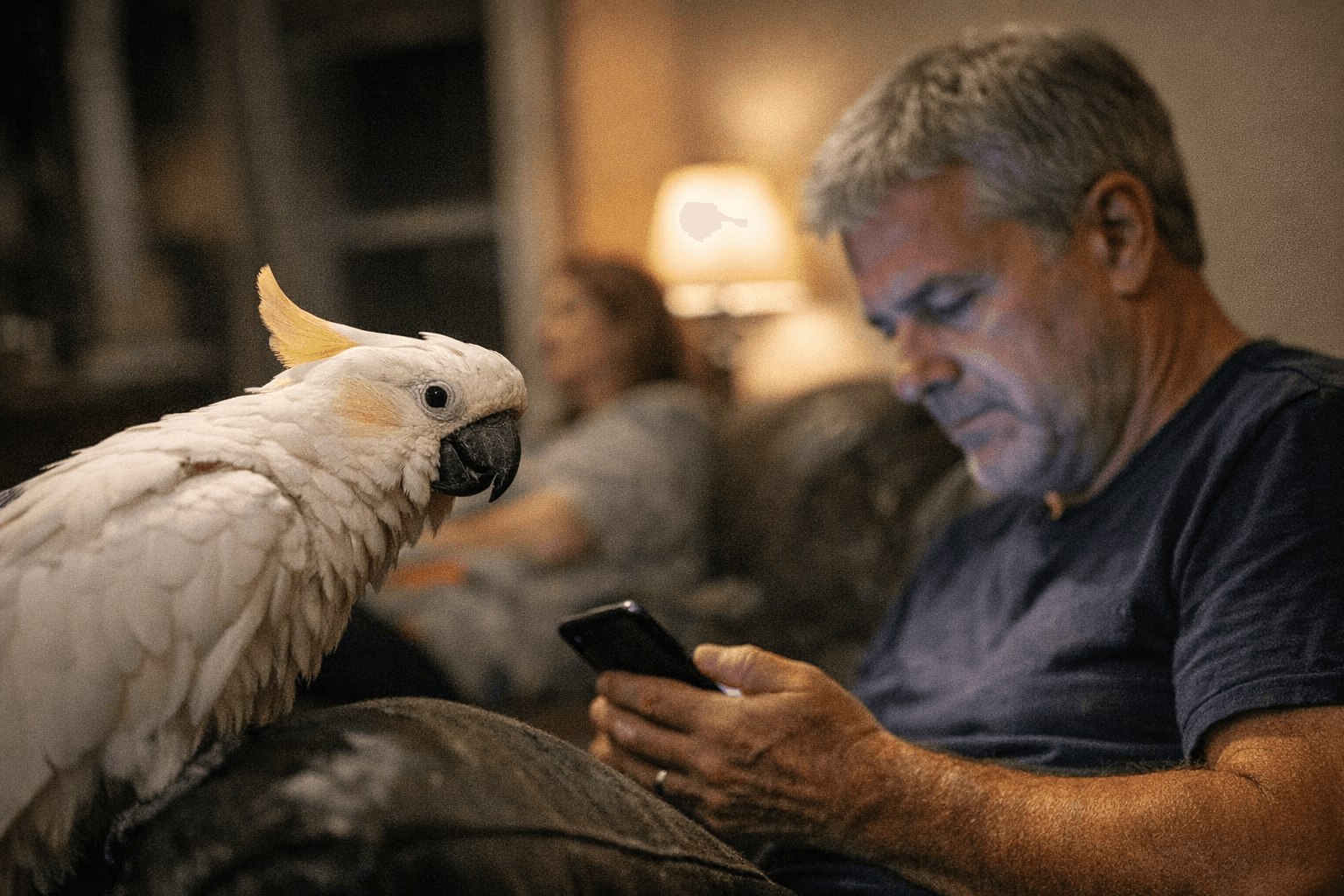
Verge does not do background roles. In the short video shared by @webinthewoodsfarm, the 50-year-young rescue cockatoo keeps inserting himself into his human brother’s business, invading personal space and marching around like he owns the place. The result is funny, but it is also instantly recognizable to anyone who has lived with a cockatoo that refuses to be sidelined.
That is what makes this clip land. Verge is not simply being loud or nosy. He looks like a bird reading the room, clocking where the attention is, and deciding that he should be in the middle of it. When the humans are together without him, he plans, stalks, interrupts, and generally behaves like the household’s most persistent sibling.
A 50-year-old bird is not a novelty, it is a veteran
Calling Verge 50 years young changes the way the story feels. This is not a baby bird making a chaotic first impression. It is a long-lived companion with history, habits, and a well-developed sense of where he belongs in the family structure. The Australian Museum says sulphur-crested cockatoos have been known to live up to 80 years in captivity, so a bird in his 50s is still very much in the middle of a long life.
That longevity matters for anyone living with a cockatoo. A bird like Verge is not a short-term pet; he is a decades-long presence who can learn household rhythms as well as any person in the home. Once a cockatoo has spent years observing who gets fed first, who sits where, and who gets the most attention, that bird can become startlingly good at keeping score.
Why cockatoos act like the nosiest sibling in the house
The joke in Verge’s behavior is that he is jealous, but the deeper truth is that cockatoos are built for social complexity. The ASPCA describes medium and large parrots such as cockatoos as highly intelligent, social animals with complex care requirements, including flight and exercise opportunities plus social and mental stimulation. In other words, the bird is not craving attention because he is spoiled. He is acting like a social animal whose brain is wired to notice and participate.
That intelligence helps explain why Verge feels so pointedly aware of family interaction. Cockatoos can plan ahead and solve difficult problems, which means they are not limited to reacting in the moment. They can watch a situation unfold, remember what worked before, and try again with better timing. In the home, that can look less like simple mischief and more like a bird studying how to get himself back into the conversation.
The broader research on sulphur-crested cockatoos makes that point even sharper. A 2021 study in Science found that wild birds spread garbage-bin-opening behavior from three Sydney suburbs to 44 suburbs through social learning. That is not random noise. It is a clear sign that cockatoos can pick up a skill, copy it, and carry it far beyond the original group.
Another PubMed-indexed study of wild sulphur-crested cockatoos reinforced how social these birds are, documenting context-dependent behavior and interactions in 561 individually marked birds across three roosts. Add that to Verge’s family-room performance and the pattern is hard to miss: cockatoos are not passive observers of household life. They are active participants, and they expect to be treated that way.
Rescue birds bring attachment, memory, and habits with them
Verge is also a rescue cockatoo, and that detail matters just as much as his age. A bird that has already lived through one or more transitions can still become deeply attached in a stable home, but the path there is rarely simple. Rescue birds often arrive with strong opinions about routine, proximity, and who gets to be in charge of the social scene.
The Avian Welfare Coalition notes that newly rehomed parrots often need time to adjust, and that unmet needs can show up as screaming, aggression, or feather plucking. That is the practical side of the story many families only discover after the bird is already home. A cockatoo that seems determined to interrupt every conversation may be communicating more than boredom. He may be signaling uncertainty, overbonding, or a need for more structured interaction.
That does not mean a rescue cockatoo is doomed to difficult behavior. It does mean the bird’s persistence has to be read as communication first, nuisance second. Verge’s stalking and interruption are funny because they are so human in shape, but they also reflect a very bird-specific need to stay socially connected.
What owners often reinforce by accident
The biggest trap with a bird like Verge is not punishment. It is reinforcement. Every time a cockatoo barges in, makes noise, or inserts himself between people and then gets an immediate reaction, the bird gets data. The data says that interruption works. The bird does not need to understand the human logic of privacy to learn that stepping into the center of the action changes the outcome.
That is why attention management matters so much with cockatoos. If a bird demands access and gets it only after escalating, the escalation becomes part of the routine. If the bird rushes over every time two people talk, the family may accidentally teach him that interruption is the fastest route back to the spotlight. The result is a bird that is not just affectionate, but strategically demanding.
How to reduce stalking, interruption, and demand behavior without crushing social interest
The goal is not to make a cockatoo less social. That would fight against the species’ nature. The real task is to make attention predictable, rewarding, and calm so the bird does not have to compete for it.
A good starting point looks like this:
- Give attention on a schedule, not only when the bird demands it.
- Reward quiet, settled behavior before the bird escalates.
- Build more ways to participate, including climbing, foraging, and supervised movement.
- Rotate social time so one person is not always the sole attention source.
- When Verge-style interruption starts, redirect rather than escalate the exchange.
These steps work because they respect the bird’s social drive. A cockatoo should not be ignored for being interested in people. But he also should not learn that stalking, screaming, and body-blocking are the best tools for getting what he wants. Structured attention gives the bird a better job to do.
Why Verge is more than a cute clip
Verge’s appeal comes from the combination of age, smarts, and comic timing. He is 50 years old, a rescue, a master-whistler type with a habit of marching around the house like the rules belong to him. That makes him entertaining, but it also makes him a perfect reminder of what living with cockatoos really means. They watch, they learn, they remember, and they care very much about where they stand in the family hierarchy.
That is the real lesson buried inside the nosy-sibling joke. Cockatoos do not simply want to be near people. They want to be included, and they are clever enough to keep testing the boundary until the household makes the rules clear. Verge’s story is charming because it is so relatable, but it is also a clean picture of how intelligence, long life, and social intensity can turn one bird into the loudest relationship manager in the house.
This article was produced by Prism’s automated news system from verified source data, official records, and press releases, then run through automated quality and moderation checks before publishing. The system is built and supervised by the people who set the standards it runs under. Read our full AI policy.
Did this article answer your question?