Why Parrots Stay Stressed, and How Stable Routines Help
A parrot that screams at breakfast is often reacting to the first 30 minutes, not a random mood swing. Lock down the morning, and stress stops snowballing.
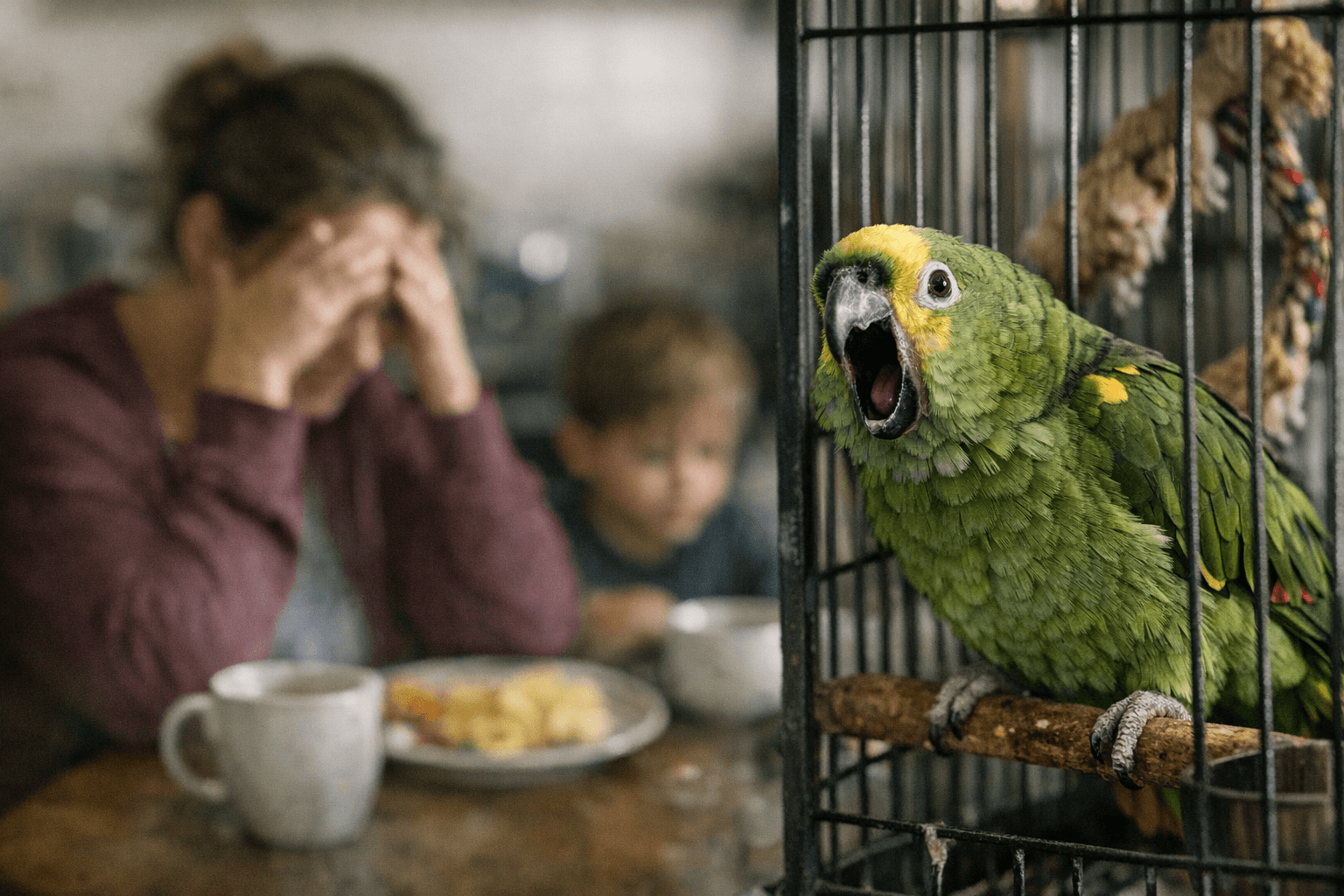
The first half-hour is where stress starts
A parrot that screams when you uncover the cage, lunges at breakfast, or gets clingy before the coffee is done is usually reacting to a morning that never felt predictable. The small stuff adds up fast: the cover comes off too abruptly, the blender roars, breakfast shifts by 20 minutes, and the bird spends the day trying to re-orient instead of settle. That matters because birds also mask illness until late, so what looks like a “bad attitude” can be the first visible edge of something more serious.
Make the room work for the bird
The setup around the cage is not background noise, it is part of the bird’s medical and behavioral story. The MSD Veterinary Manual says the history should cover cage size, bar spacing, cleaning frequency, diet, location in the home, temperature and humidity, and exposure to other birds or pets, which is exactly why a spooked bird needs more than a pep talk. If the same corner keeps setting off startle responses, the corner is doing the damage and should be changed rather than asking the bird to harden up and ignore it.
That is where a lot of owners get trapped: they keep the bird in a traffic lane, then act surprised when every passing footstep turns into a flare-up. Put key perches where the bird can watch the household without living in the middle of it, and keep visual chaos away from the main rest area. For open-room setups and shared family spaces, the goal is not just access, it is control over what the bird has to process all day.
Treat handling like a stress event, because the studies do
Routine restraint is not a neutral moment for parrots, and the data make that plain. In a study led by Shelby N. Parks and Thomas N. Tully Jr. on Hispaniolan Amazon parrots, 10 males and 12 females showed a significant rise in plasma corticosterone across the hour after handling and restraint, with a baseline average of 0.51 ± 0.65 ng/mL and higher levels in females at 30, 45, and 60 minutes. The point is not that every vet visit is a crisis, but that restraint should be planned as an added stressor, not treated like it has no cost.
A second study of captive Amazon parrots found that the more fearful birds were more vocal and struggled more during restraint, and after behavioral training they showed higher responsiveness to physical restraint. That is useful because it explains why some birds seem to “get worse” when the household gets more chaotic, then look even more reactive when they are grabbed, towelled, or rushed. If your bird already starts the day loaded with stress, a clumsy hold can push the whole system over the edge.
Build the day around predictable blocks
The cleanest fix is usually not a bigger toy haul or a last-minute training binge. It is a day that feels legible to the bird: wake-up, feeding, active play, and a calm wind-down that happen in a recognizable order. When those blocks drift every day, the bird is forced to keep recalculating the environment, and that constant re-orientation shows up as louder calls, more reactivity, and a shorter fuse.
Wake-up
Start with a quick safety scan, fresh water, and one predictable interaction before the house gets busy. Keep the first greeting calm and repeatable, because the point is to signal, “nothing surprising is happening yet.” If the blender, hair dryer, or kitchen scramble is about to happen, let the bird know the rhythm before the noise starts. This is the part of the day where you either pay a little attention up front or spend the afternoon paying for it.
Midday
Use lower-arousal enrichment, not constant novelty. Birds do not need a new event every hour, they need enough structure that the middle of the day does not feel like an interruption to be survived. If the room is changing, keep the bird’s core anchors the same: the same perch, the same rest zone, the same food logic.
Evening
Wind-down should look like the opposite of the morning scramble: dimmer lights, quieter sounds, fewer abrupt interactions, and no sudden reshuffling of the cage or room. Birds that spend all day bracing for the next surprise do not relax because the house finally got quiet at 9 p.m.; they relax when the transition into evening has a familiar shape. That steady close matters just as much as the wake-up routine.
Use foraging to burn off jittery energy
Brynn McCleery and the Association of Avian Veterinarians make the right distinction here: foraging enrichment should make parrots search for food, obtain it, and work through it, not just peck at something decorative. The same AAV guidance notes that captive parrots often forage only 30 to 72 minutes, far less than wild birds, which helps explain why a bird can seem “busy” and still be under-stimulated.
The best evidence is practical, not abstract. In six captive red-tailed black cockatoos, foraging interventions increased time spent foraging from 5.0% in control conditions to as high as 31.7%, and grass and millet disc interventions cut oral repetitive behaviors from 16.6% to 8.3%. That is the kind of change you can actually see in a household bird: less mouthy pacing, less compulsive chewing, and more time spent doing the thing the species is built to do.
The contrafreeloading work on Grey parrots drives the point home even further. In that study, 11 healthy parrots and 10 feather-damaging parrots were offered identical food either freely or through a foraging device, and all birds showed some contrafreeloading, which supports the idea that parrots are intrinsically motivated to forage. The feather-damaging birds showed less of it, which is exactly why foraging is not a cute extra, it is part of the behavior budget you have to feed every day.
AAV also cites research showing that foraging opportunity and increased physical complexity can prevent and reduce psychogenic feather picking in young Amazon parrots. That makes the fix feel less mysterious: instead of chasing every nip with a different toy, rotate easy, medium, and slightly harder foraging tasks so the bird gets a real problem to solve without getting frustrated.
Track drift before it becomes a problem
Weekly tracking is where routine turns into prevention. Watch whether the bird is louder in the first hour, more reactive around breakfast, slower to settle in the evening, or more likely to pick at feathers or snap at hands after a noisy morning. Those small shifts matter because chronic stress is tied to behavioral disorders in parrots, and in the PeerJ study by Pierluca Costa, Elisabetta Macchi, Emanuela Valle, Michele De Marco, Daniele M. Nucera, Laura Gasco, and Achille Schiavone, feather-damaging African grey parrots had mean corticosterone metabolite excretion of 1,744 ng/g, compared with 587 ng/g in parent-reared parrots and 494 ng/g in healthy hand-reared parrots.
That is the part people miss when they treat stress as an isolated mood. The bird is not reacting to one blender, one missed greeting, or one off-day with breakfast. It is reacting to a pattern, and once you see the pattern, the fixes stop being expensive and start being boring in the best possible way: same wake-up, same cues, same layout, same wind-down, every day. That boring consistency is what keeps a parrot from sliding into the loud, bitey, clingy version of itself that nobody wanted in the first place.
This article was produced by Prism’s automated news system from verified source data, official records, and press releases, then run through automated quality and moderation checks before publishing. The system is built and supervised by the people who set the standards it runs under. Read our full AI policy.
Know something we missed? Have a correction or additional information?
Submit a Tip