Viral black cockatoo Puppy teaches owners how birds show happiness
Puppy’s “smile” is adorable, but the real lesson is how to read a cockatoo’s posture, feathers, and eyes to spot calm, trust, or overload.
Puppy’s viral grin is really a body-language lesson
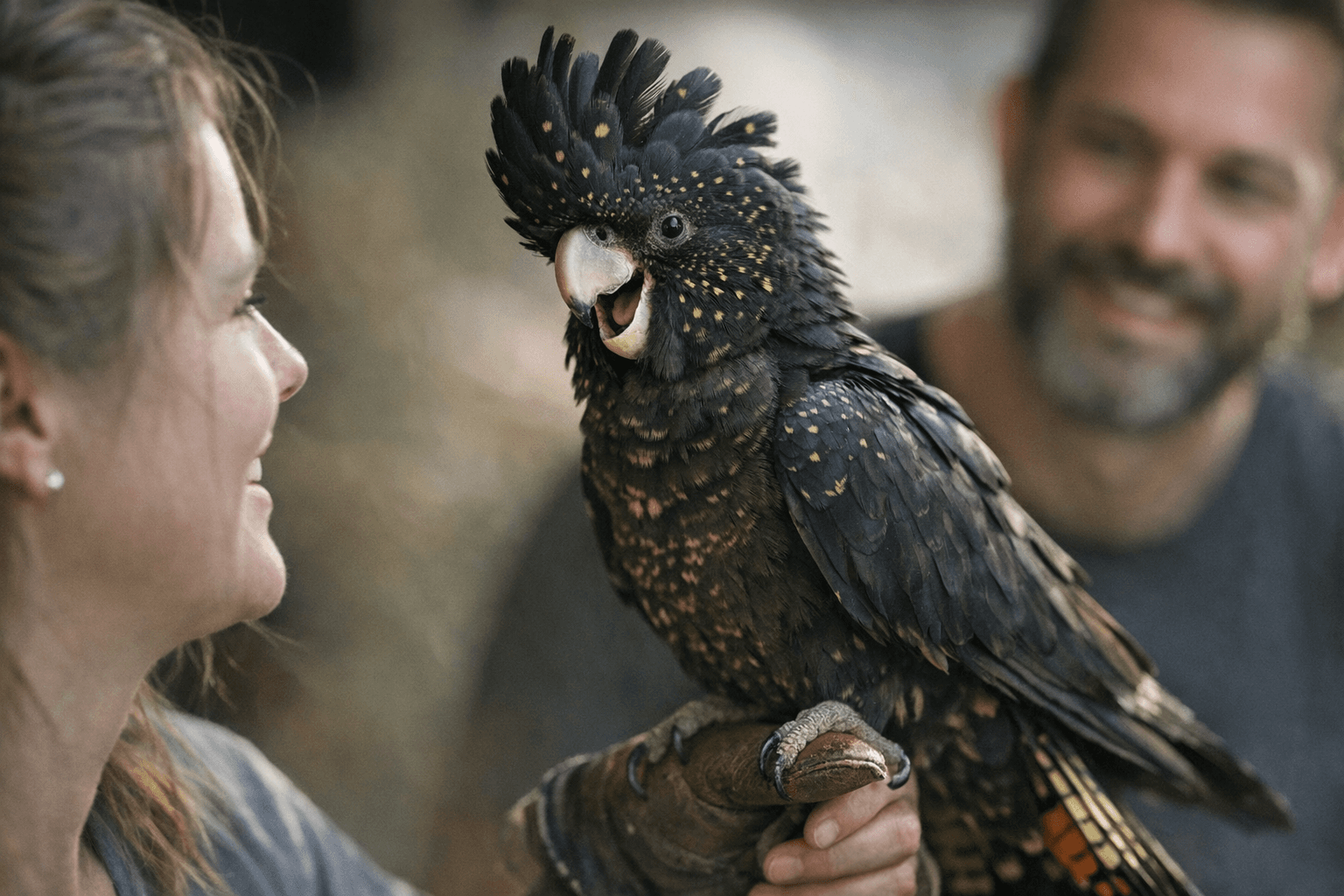
Puppy, a red-tailed black cockatoo, looks for all the world like he is posing for a school photo with a perfect smile. That is exactly why the clip works, and why it also needs a careful read: birds do not smile the way humans do, so the happiness people see in Puppy comes from posture, expression, and trust rather than a human-style face.
What makes Puppy so compelling is that he looks both striking and deeply comfortable. He is a full-grown black cockatoo, a species most people do not keep as pets and do not expect to see acting like a pampered family bird. His TikTok profile, @puppytheblackcockatoo, identifies him plainly as a bird, and the account has 19.3K followers and 323.6K likes. Parade Pets previously reported that he is about 15 years old and has been posting for about 3 years, which helps explain why the audience already knew his personality before this latest wave of attention.
Why Puppy’s “smile” reads as happiness
The viral image works because Puppy’s whole body says calm. The danger is assuming a cockatoo’s face works like ours. Bird body language can be subtle, and the same movement can mean different things depending on what is happening around the bird, which is why context matters so much in parrots.
A relaxed bird usually looks settled rather than posed. Feathers lie softly instead of being tightly plastered down or puffed aggressively, the beak sits naturally, and the eyes look engaged without appearing hard or fixed. When a bird is comfortable with a person, that trust shows up in how easily it stays near them, how freely it interacts, and whether it chooses playful contact instead of defensiveness.
That is the key to Puppy. He has been with his mom since he was a baby, and the bond is obvious in the easy, loving energy that surrounds him. The joy viewers think they see is real in the sense that the bird appears calm and secure, even if the expression is not a human smile.
How to read a parrot without projecting human emotion onto it
If Puppy teaches anything, it is that parrots communicate in posture, not in facial expressions. Start by looking at the beak. A relaxed bird usually holds the beak neutrally, while a tense or overstimulated bird may clench, grind, or keep opening and closing it in a way that feels restless rather than content.
Feather posture tells another part of the story. Soft, even feathers often signal comfort, while sudden slicking down, exaggerated fluffing, or repeated shifts can mean the bird is on alert. Eye expression matters too: a calm cockatoo usually looks steady and attentive, while a bird that is overwhelmed may seem pinned, intense, or overly fixed on one thing.
The safest reading is always a combined one. A bird can be still and happy, still and frightened, or lively and overstimulated, so a single cue never tells the whole story. That is why an “adorable photo face” is only the starting point, not the conclusion.
What makes red-tailed black cockatoos so distinctive
Puppy’s species is part of why the clip lands so strongly. BirdLife Australia describes red-tailed black-cockatoos as largely black birds, with males showing bright scarlet tail panels. BirdLife Australia also notes that the Forest Red-tailed Black-Cockatoo averages about 55 cm in size, which helps explain the bird’s impressive presence in a frame.
These birds can look intimidating when they want to. They have a powerful build, a big wingspan, and a surprisingly fast takeoff, so the softness in Puppy’s clip stands out even more against that dramatic silhouette. BirdLife Australia also notes their loud rolling contact calls, “kree” or “krurr-rr,” which matches the sense that these are birds with strong personalities, not quiet decorative pets.
The Australian Museum adds another layer to that picture. Red-tailed black-cockatoos nest in tree hollows and enter the hollow tail first, and they feed on seeds, fruit, berries, nectar, flowers, and sometimes insects and larvae. That combination of specialized nesting and varied diet is a reminder that these are complex wild birds, even when one lives closely with a person.
Why the conservation story matters to pet owners
Puppy’s fame is charming, but it also points toward a bigger truth about black cockatoos: they are not ordinary birds. BirdLife Australia says the south-eastern red-tailed black-cockatoo is endangered, and the Australian Government’s recovery materials stress that these birds cannot excavate their own hollows and depend on existing tree hollows for nesting.
That matters because hollow availability is not a small detail, it is a survival issue. When mature trees disappear, the nesting sites disappear with them, and birds that rely on those hollows are forced to compete for fewer and fewer safe places. In Southwestern Australia, Victoria, and South Australia, that habitat pressure is part of why these birds draw so much concern from conservation groups.
For parrot caregivers, that broader context is useful because it reinforces a simple habit: treat every cockatoo as a species with its own needs, not as a generic pet bird with a funny face. The better you understand the wild life behind the companion bird, the better you can read the signals that matter at home.
The practical takeaway behind Puppy’s viral moment
Puppy’s “school picture smile” is memorable because it feels familiar, but the real lesson is more useful than a cute image. A bird can look cheerful without wearing a human expression, and the safest way to read that happiness is through body language, trust, and context.
Watch the beak, watch the feathers, and watch the eyes together. A calm, engaged cockatoo with soft posture and easy interaction is telling you something important: this is a bird that feels safe enough to relax. Puppy’s viral appeal comes from that feeling, and from the rare pleasure of seeing a powerful black cockatoo look completely at ease in the arms of someone he knows.
This article was produced by Prism’s automated news system from verified source data, official records, and press releases, then run through automated quality and moderation checks before publishing. The system is built and supervised by the people who set the standards it runs under. Read our full AI policy.
Did this article answer your question?